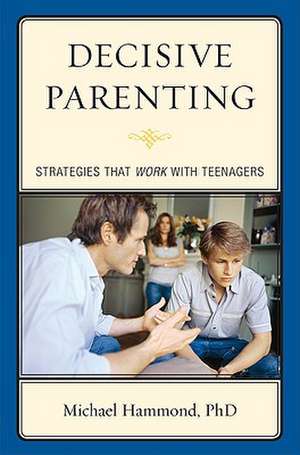
Decisive Parenting: Strategies That Work with Teenagers
Autor Michael Hammonden Limba Engleză Hardback – 30 apr 2010
| Toate formatele și edițiile | Preț | Express |
|---|---|---|
| Paperback (1) | 250.26 lei 43-57 zile | |
| Bloomsbury Publishing – 27 dec 2012 | 250.26 lei 43-57 zile | |
| Hardback (1) | 541.58 lei 43-57 zile | |
| Bloomsbury Publishing – 30 apr 2010 | 541.58 lei 43-57 zile |
Preț: 541.58 lei
Preț vechi: 780.53 lei
-31%
Puncte Express: 812
Preț estimativ în valută:
95.88€ • 111.64$ • 83.29£
95.88€ • 111.64$ • 83.29£
Carte tipărită la comandă
Livrare economică 23 februarie-09 martie
Preluare comenzi: 021 569.72.76
Specificații
ISBN-13: 9780765707635
ISBN-10: 0765707632
Pagini: 209
Dimensiuni: 163 x 239 x 20 mm
Greutate: 0.49 kg
Editura: Bloomsbury Publishing
Colecția Jason Aronson Inc
Locul publicării:New York, United States
ISBN-10: 0765707632
Pagini: 209
Dimensiuni: 163 x 239 x 20 mm
Greutate: 0.49 kg
Editura: Bloomsbury Publishing
Colecția Jason Aronson Inc
Locul publicării:New York, United States
V-ar putea interesa
-
 Adolescents on the Autism SpectrumChantal Sicile-KiraPreț: 109.46 lei
 -
 Divas & Door SlammersCharlie TaylorPreț: 109.02 lei
 -
 The Terrible TeensKate FigesPreț: 118.70 lei
 -
 When Good Kids KillMichael D. Kelleher Ph.D.-34%Preț: 295.42 lei449.47 lei
 -
 Preț: 123.79 lei
 -
 Something to believe inSashi JaisinghPreț: 152.87 lei
 -
 Little Miss SomebodyChristy Lynn AbramPreț: 115.88 lei
 -
 The Contemporary Television SeriesMichael Hammond-19%Preț: 218.75 lei268.71 lei
 -
 Cystic Fibrosis: The Ultimate Teen GuideMelanie Ann Apel-27%Preț: 349.28 lei478.97 lei
 -
 7 Things Your Teenager Won't Tell You: And How to Talk about Them AnywayJenifer LippincottPreț: 100.09 lei
 -
 Confessions of a Mixed-Up Weasel HaterElizabeth Thomas WenningPreț: 40.14 lei
 -
 Python for LinguistsMichael Hammond-20%Preț: 710.39 lei887.99 lei
 -
 The Great War and the Moving ImageMichael Hammond-18%Preț: 1011.47 lei1233.50 lei
 -
 -23%Preț: 681.15 lei884.61 lei
 -
 Brooklyn GirlRonald BelfortPreț: 122.01 lei
 -
 What Teenage Girl's Don't Tell Their ParentsMICHELLE MITCHELLPreț: 171.37 lei
 -
 Because I Said So!! Parents' Guide to Parenting TeenagersNeal HemmelsteinPreț: 102.26 lei
 -
 Preț: 77.87 lei
 -
 Preț: 133.19 lei
 -
 Ungovernable Skills Britain: A National Disaster since 1851Michael HammondPreț: 361.62 lei
Cuprins
Part 1 Acknowledgments
Part 2 How to Use This Book
Part 3 PART I: Building A Secure Foundation
Chapter 4 Chapter 1: Rules-Establishing a Firm Foundation
Chapter 5 Chapter 2: Write the Rules for Your Teen
Chapter 6 Chapter 3: Natural and Logical Consequences
Chapter 7 Chapter 4: Active Consequences for Challenging Situations
Chapter 8 Chapter 5: Level Systems, Point Economies, and Contracts
Chapter 9 Chapter 6: Communication That Gets the Results You Want
Chapter 10 Chapter 7: Conflict Resolution with Teenagers
Chapter 11 Chapter 8: Reinforcers for Behaviors You Want to See Repeated
Part 12 PART II: Problem Behaviors and What to Do about Them
Chapter 13 Chapter 9: Arguing
Chapter 14 Chapter 10: Chore Completion
Chapter 15 Chapter 11: Driving
Chapter 16 Chapter 12: Drug and Alcohol Use
Chapter 17 Chapter 13: Friends
Chapter 18 Chapter 14: Information Technology
Chapter 19 Chapter 15: Lying
Chapter 20 Chapter 16: Running Away
Chapter 21 Chapter 17: School Assignments and Homework
Chapter 22 Chapter 18: Sexual Activity
Chapter 23 Chapter 19: Sibling Fighting
Chapter 24 Chapter 20: Stealing
Chapter 25 Chapter 21: Swearing
Chapter 26 Chapter 22: Television
Chapter 27 Chapter 23: Tobacco Use
Chapter 28 Chapter 24: Truancy
Chapter 29 Chapter 25: Violence
Chapter 30 Chapter 26: Whereabouts and Curfew
Part 31 Epilogue: Every Good Thing
Part 32 References and Suggested Reading
Part 33 Index
Part 34 About the Author
Part 2 How to Use This Book
Part 3 PART I: Building A Secure Foundation
Chapter 4 Chapter 1: Rules-Establishing a Firm Foundation
Chapter 5 Chapter 2: Write the Rules for Your Teen
Chapter 6 Chapter 3: Natural and Logical Consequences
Chapter 7 Chapter 4: Active Consequences for Challenging Situations
Chapter 8 Chapter 5: Level Systems, Point Economies, and Contracts
Chapter 9 Chapter 6: Communication That Gets the Results You Want
Chapter 10 Chapter 7: Conflict Resolution with Teenagers
Chapter 11 Chapter 8: Reinforcers for Behaviors You Want to See Repeated
Part 12 PART II: Problem Behaviors and What to Do about Them
Chapter 13 Chapter 9: Arguing
Chapter 14 Chapter 10: Chore Completion
Chapter 15 Chapter 11: Driving
Chapter 16 Chapter 12: Drug and Alcohol Use
Chapter 17 Chapter 13: Friends
Chapter 18 Chapter 14: Information Technology
Chapter 19 Chapter 15: Lying
Chapter 20 Chapter 16: Running Away
Chapter 21 Chapter 17: School Assignments and Homework
Chapter 22 Chapter 18: Sexual Activity
Chapter 23 Chapter 19: Sibling Fighting
Chapter 24 Chapter 20: Stealing
Chapter 25 Chapter 21: Swearing
Chapter 26 Chapter 22: Television
Chapter 27 Chapter 23: Tobacco Use
Chapter 28 Chapter 24: Truancy
Chapter 29 Chapter 25: Violence
Chapter 30 Chapter 26: Whereabouts and Curfew
Part 31 Epilogue: Every Good Thing
Part 32 References and Suggested Reading
Part 33 Index
Part 34 About the Author
Recenzii
Dr. Hammond has the ideal skill set to write this book: a background in parent training and family counseling with a sprinkling of parenting intervention research experience. He shows how to integrate family rules, workable consequences, and positive reinforcement into a strategy that will enhance parent-teen relationships. This book would be a great gift to the parent of a teen, or to someone whose child is soon to become a teen. It will help the parent set the course for a parent-child relationship based on fair boundaries with mutual respect.
Dr. Hammond provides an excellent, step-by-step guide for parents to encourage positive change in their teenager's behavior. He provides practical applications and examples relevant to the many challenges parents currently face with their teenagers. This book empowers parents with tools to address difficult teenage behaviors that may have rendered them feeling hopeless and helpless.
This book is an important and significant advancement in the genre of parenting manuals. It is composed in the tradition of works like Parent Effectiveness Training (Harris, 1962) and Living with Children (Patterson and Guillion, 1968). The writing and voice are clearly directed to parents who need help in bringing teenagers through difficult and often dangerous years. Hammond's book is practical and easy to read. It begins with principles of behavior and parenting that are soundly and deeply rooted in psychological theory as well as in common sense. Each section includes excellent examples. All parents will be able to relate to, understand, and easily implement the principles of parenting and family interaction that Hammond presents. Hammmond's coverage of issues is up-to-date and incorporates content reflective of the age of technology. This book is destined to be the next classic and 'must-have' for all parents and for professionals working with families of teenagers.
Dr. Hammond provides an excellent, step-by-step guide for parents to encourage positive change in their teenager's behavior. He provides practical applications and examples relevant to the many challenges parents currently face with their teenagers. This book empowers parents with tools to address difficult teenage behaviors that may have rendered them feeling hopeless and helpless.
This book is an important and significant advancement in the genre of parenting manuals. It is composed in the tradition of works like Parent Effectiveness Training (Harris, 1962) and Living with Children (Patterson and Guillion, 1968). The writing and voice are clearly directed to parents who need help in bringing teenagers through difficult and often dangerous years. Hammond's book is practical and easy to read. It begins with principles of behavior and parenting that are soundly and deeply rooted in psychological theory as well as in common sense. Each section includes excellent examples. All parents will be able to relate to, understand, and easily implement the principles of parenting and family interaction that Hammond presents. Hammmond's coverage of issues is up-to-date and incorporates content reflective of the age of technology. This book is destined to be the next classic and 'must-have' for all parents and for professionals working with families of teenagers.