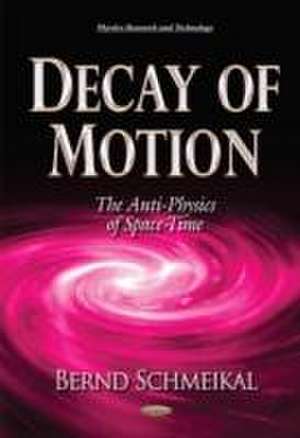
Decay of Motion: The Anti-Physics of Space-Time
Autor Bernd Schmeikalen Limba Engleză Hardback – iun 2014
Subliniem faptul că Decay of Motion reprezintă o provocare riguroasă la adresa fundamentelor fizicii teoretice contemporane. Autorul Bernd Schmeikal propune o metodologie ce inversează raportul cauzal obișnuit: spațiu-timpul nu este un container preexistent, ci un rezultat emergent al împletirii cuantice la nivelul cromodinamicii cuantice (QCD). Structura volumului reflectă această tranziție conceptuală, debutând cu o secțiune de „Filosofie” și „Fenomenologia imediatului”, pentru a avansa progresiv către modele matematice complexe, precum cadrele Minkowski primordiale și spinorii Majorana.
Credem că rigoarea matematică a acestei ediții, susținută de un apendice tehnic detaliat despre algebra iterantă, este esențială pentru înțelegerea argumentului central: imposibilitatea închiderii „loophole-ului” de localitate în interacțiunile nucleare tari. Putem afirma că această lucrare consolidează direcția de cercetare începută de autor în Primordial Space, unde postula că simetriile spațiu-timpului sunt identice cu simetriile interne ale materiei. Față de Time-Out of Time, unde se concentra pe densitatea energetică și viteza luminii, acest volum atacă direct natura discretă a realității de dincolo de coordonatele carteziene.
Cititorii familiarizați cu BEYOND PEACEFUL COEXISTENCE de Licata Ignazio vor aprecia modul în care Bernd Schmeikal adâncește problema inconsistenței semantice dintre evenimentele cuantice discrete și modelele locale continue. În timp ce alte lucrări similare, precum Einstein's Entanglement, analizează „acțiunea la distanță” ca pe un mister experimental, Decay of Motion oferă o soluție teoretică prin reconsiderarea algebrei geometrice a spațiului însuși.
Preț: 1274.81 lei
Preț vechi: 1826.53 lei
-30%
Carte disponibilă
Livrare economică 19 mai-02 iunie
Specificații
ISBN-10: 1631178091
Pagini: 296
Dimensiuni: 180 x 260 x 21 mm
Greutate: 0.73 kg
Editura: Nova Science Publishers Inc
Colecția Nova Science Publishers, Inc (US)
Locul publicării:United States
De ce să citești această carte
Această monografie este indispensabilă cercetătorilor în fizică teoretică și filosofie a științei care doresc să depășească limitele Modelului Standard. Cititorul câștigă o perspectivă matematică nouă asupra emergenței spațiu-timpului din împletirea cuantică (entanglement), primind instrumente analitice precum algebra iterantă pentru a reevalua experimentele de tip EPR și QCD dintr-o paradigmă non-spațială.