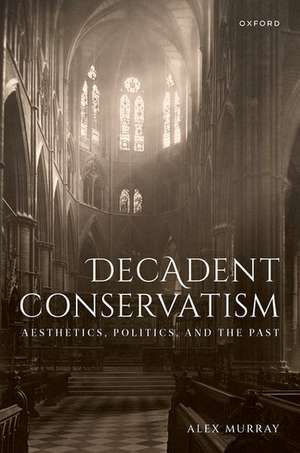
Decadent Conservatism: Aesthetics, Politics, and the Past
Autor Alex Murrayen Limba Engleză Hardback – 13 iul 2023
Preț: 579.89 lei
Preț vechi: 851.66 lei
-32%
Puncte Express: 870
Carte disponibilă
Livrare economică 06-11 noiembrie
Livrare express 23-29 octombrie pentru 155.60 lei
Livrare prin curier în România Termenul estimat este afișat lângă disponibilitate.
Transport gratuit pentru acest produs Plată online sau ramburs, în funcție de opțiunile comenzii.
Retur gratuit în 14 zile Comandă securizată și suport în română.
Specificații
ISBN-13: 9780192858207
ISBN-10: 0192858203
Pagini: 300
Ilustrații: 4 black-and-white illustrations
Dimensiuni: 163 x 245 x 23 mm
Greutate: 0.63 kg
Editura: OUP OXFORD
Colecția OUP Oxford
Locul publicării:Oxford, United Kingdom
ISBN-10: 0192858203
Pagini: 300
Ilustrații: 4 black-and-white illustrations
Dimensiuni: 163 x 245 x 23 mm
Greutate: 0.63 kg
Editura: OUP OXFORD
Colecția OUP Oxford
Locul publicării:Oxford, United Kingdom
V-ar putea interesa
-
 The Oxford Handbook of DecadenceJane Desmarais-32%Preț: 987.16 lei1444.53 lei
 -
 The Passions of John Addington SymondsShane Butler-31%Preț: 809.53 lei1172.30 lei
 -
 -32%Preț: 1148.48 lei1699.59 lei
 -
 The Agamben DictionaryAlex Murray-16%Preț: 211.74 lei251.29 lei
 -
 The Work of Giorgio AgambenJustin Clemens-16%Preț: 190.63 lei227.38 lei
 -
 Gilbert SimondonAlex Murray-16%Preț: 177.39 lei212.03 lei
 -
 The Electoral ImaginationKent PuckettPreț: 298.76 lei
 -
 -28%Preț: 580.69 lei801.55 lei
 -
 DecadenceAlex Murray-23%Preț: 795.85 lei1033.57 lei
 -
 The Nineteenth-Century Novel: A Critical ReaderStephen Regan-18%Preț: 1130.69 lei1378.89 lei
 -
 Victorian Secrecy: Economies of Knowledge and ConcealmentDenise Tischler Millstein-15%Preț: 473.86 lei557.49 lei
 -
 -15%Preț: 438.72 lei516.14 lei
 -
 -15%Preț: 443.78 lei522.09 lei
 -
 Ethics and the English Novel from Austen to ForsterValerie Wainwright-15%Preț: 439.90 lei517.54 lei
 -
 Collected Tales, Poems, and Other Writings of Edgar Allan PoeEdgar Allan Poe-47%Preț: 216.31 lei410.02 lei
 -
 The Politics of RealismProf. Thomas Docherty-28%Preț: 211.51 lei293.47 lei
 -
 An A-Z of Jane AustenMichael GreaneyPreț: 100.64 lei
 -
 -22%Preț: 121.56 lei155.38 lei
 -
 -32%Preț: 551.25 lei816.41 lei
 -
 Decadence in the Age of ModernismKate HextPreț: 414.95 lei
 -
 For That Moment Only and Other Prose WorksMichael FieldPreț: 169.61 lei
 -
 Victorian VerseLee Behlman-18%Preț: 925.30 lei1128.40 lei
Recenzii
Decadent Conservatism makes an important contribution to contemporary attempts to rethink Decadence by expanding its canon, tracing its ramifications into the twentieth century and pushing its boundaries beyond London and metropolitan circles.
I found Decadent Conservatism an extraordinary book... It is convincing and important, all the more so given that the conservatism it unearths is often distasteful from a contemporary point of view. For a considerable time to come, scholars will have to take account of Decadent Conservatism and the many insights Murray brings to bear on the period.
Decadent Conservatism offers an important counterargument to the discourses of its field: the Decadents were not inherently progressive, nor motivated by a progressive worldview or any homogenous ideological framework.
Whilst Murray does not reject readings of decadence as a tool of resistance, he provides a salutary reminder that writers and artists linked to decadence often held elitist and exclusionary political views that may now seem unpalatable....Decadent Conservatism does not resolve the 'notorious' difficulties of defining decadence, but it ably opens up those complexities to critical scrutiny and represents an important contribution to the expanding field of decadence studies.
One of Murray's most important contributions is his sensitive consideration of nineteenth-century conservatism as a set of not only political views but also social and historical ones that were often not well aligned with each other. ... Murray's entire book will be read and discussed by literary and cultural scholars for years to come.
Murray's introduction does an amazing amount of heavy lifting, moving through a thoughtful summary of key works that powerfully shaped more recent attitudes towards Decadence, including the high modernists and other critics who formulated it as a backward-looking, ineffectual (or, with equal derogation, effeminate), and dandiacal display of tired Victorian manners. Murray offers an important new reading that qualifies this modernist perspective, observing that "conservative Decadence very often involves a withdrawal from the world, the embrace of refinement, solitude, and the past as an antidote to the march of modernity" .
I found Decadent Conservatism an extraordinary book... It is convincing and important, all the more so given that the conservatism it unearths is often distasteful from a contemporary point of view. For a considerable time to come, scholars will have to take account of Decadent Conservatism and the many insights Murray brings to bear on the period.
Decadent Conservatism offers an important counterargument to the discourses of its field: the Decadents were not inherently progressive, nor motivated by a progressive worldview or any homogenous ideological framework.
Whilst Murray does not reject readings of decadence as a tool of resistance, he provides a salutary reminder that writers and artists linked to decadence often held elitist and exclusionary political views that may now seem unpalatable....Decadent Conservatism does not resolve the 'notorious' difficulties of defining decadence, but it ably opens up those complexities to critical scrutiny and represents an important contribution to the expanding field of decadence studies.
One of Murray's most important contributions is his sensitive consideration of nineteenth-century conservatism as a set of not only political views but also social and historical ones that were often not well aligned with each other. ... Murray's entire book will be read and discussed by literary and cultural scholars for years to come.
Murray's introduction does an amazing amount of heavy lifting, moving through a thoughtful summary of key works that powerfully shaped more recent attitudes towards Decadence, including the high modernists and other critics who formulated it as a backward-looking, ineffectual (or, with equal derogation, effeminate), and dandiacal display of tired Victorian manners. Murray offers an important new reading that qualifies this modernist perspective, observing that "conservative Decadence very often involves a withdrawal from the world, the embrace of refinement, solitude, and the past as an antidote to the march of modernity" .
Notă biografică
Alex Murray is Reader in Modern Literature at Queen's University Belfast. He has published widely on Decadent and modernist literatures, including Landscapes of Decadence: Literature and Place at the Fin De Siècle (2016) and the edited collection Decadence: A Literary History (2020).
Cuprins
- Introduction: Conservatism and the Experience of Decadence
- 1: Alternative Communities: Decadent-Conservative Little Magazines
- 2: The Politics of Fin-de-Siècle Individualism
- 3: Throne-and-Altar Decadence
- 4: Folk Decadence
- 5: Decadence, Imperialism, and Jingoism
- Coda: Symons and the Superwomen