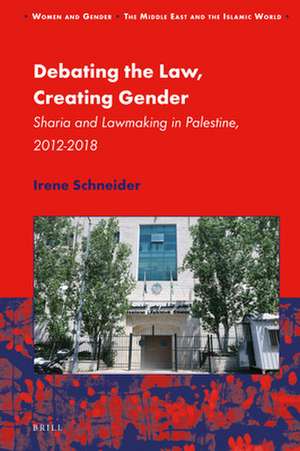
Debating the Law, Creating Gender
Autor Irene Schneideren Limba Engleză Hardback – 22 oct 2020
Preț: 860.83 lei
Preț vechi: 1117.96 lei
-23%
Puncte Express: 1291
Preț estimativ în valută:
152.23€ • 178.65$ • 132.04£
152.23€ • 178.65$ • 132.04£
Carte disponibilă
Livrare economică 16 februarie-02 martie
Specificații
ISBN-13: 9789004442306
ISBN-10: 9004442308
Pagini: 388
Dimensiuni: 161 x 241 x 30 mm
Greutate: 0.69 kg
Editura: Brill
ISBN-10: 9004442308
Pagini: 388
Dimensiuni: 161 x 241 x 30 mm
Greutate: 0.69 kg
Editura: Brill
Cuprins
Preface
List of Ilustrations
Abbreviations
1 Introduction
1.1 Research Design
1.2 Research Literature
2 Palestinian Legal System
2.1 Basic Law, Sharia Court High Council, and Supreme Constitutional Court
2.2 The Jordanian Law of Personal Status (JLPS) of 1976, Applicable in the West Bank and the Egyptian Family Rights Law (EFRL) of 1954, Applicable in Gaza
3 The Actors
3.1 State
3.2 Civil Society
3.3 Sharia Establishment
4 Khulʿ: The New Ruling of 2012 and Its Context
4.1 Uses of the Past: Sources of Khulʿ and the Case of Egypt
4.2 Legal Regulation in Palestine
4.3 Analysis of Taʿmīm 59/2012
4.4 The Qāḍī al-Quḍāt as a Quasi-Legislator?
5 Khulʿ in University Teaching
5.1 Birzeit University as Part of the Palestinian Public Sphere
5.2 Approaches to Academic Teaching
5.3 Class on Khulʿ on October 31, 2013
5.4 Textbook of the Supreme Judge’s Class: Past or Present?
6 Khulʿ in Iterations
6.1 Civil Society
6.2 The State: Palestinian Authority
6.3 Sharia Establishment
6.4 Conclusion
7 CEDAW and Palestine
7.1 CEDAW State Report of Palestine, March 10, 2017
7.2 List of Issues and Questions Relating to the Report by the State of Palestine to the CEDAW Committee, November 30, 2017, and Replies to Questions (List of Issues), February 19, 2018
7.3 Shadow Reports by Civil Society Organizations
7.4 The Palestinian Delegation in Geneva, July 2018
8 CEDAW in Iterations
8.1 Palestine Discusses: How Can International Law and Sharia Be Harmonized?
8.2 Developments through the End of 2018
9 Khulʿ and International Law in Gaza
9.1 The Legal Background of Gaza
9.2 A Failed Draft Law in 2013 and the Issuing of Two Taʿmīmāt in 2016
9.3 Comparison between the West Bank and Gaza
9.4 Standing Up for a New Khulʿ Law in Gaza: The Civil Society Debate in Gaza 2012 to 2017
9.5 Conclusion
10 Conclusions
References
Websites
Laws
Terminology
Index
List of Ilustrations
Abbreviations
1 Introduction
1.1 Research Design
1.2 Research Literature
2 Palestinian Legal System
2.1 Basic Law, Sharia Court High Council, and Supreme Constitutional Court
2.2 The Jordanian Law of Personal Status (JLPS) of 1976, Applicable in the West Bank and the Egyptian Family Rights Law (EFRL) of 1954, Applicable in Gaza
3 The Actors
3.1 State
3.2 Civil Society
3.3 Sharia Establishment
4 Khulʿ: The New Ruling of 2012 and Its Context
4.1 Uses of the Past: Sources of Khulʿ and the Case of Egypt
4.2 Legal Regulation in Palestine
4.3 Analysis of Taʿmīm 59/2012
4.4 The Qāḍī al-Quḍāt as a Quasi-Legislator?
5 Khulʿ in University Teaching
5.1 Birzeit University as Part of the Palestinian Public Sphere
5.2 Approaches to Academic Teaching
5.3 Class on Khulʿ on October 31, 2013
5.4 Textbook of the Supreme Judge’s Class: Past or Present?
6 Khulʿ in Iterations
6.1 Civil Society
6.2 The State: Palestinian Authority
6.3 Sharia Establishment
6.4 Conclusion
7 CEDAW and Palestine
7.1 CEDAW State Report of Palestine, March 10, 2017
7.2 List of Issues and Questions Relating to the Report by the State of Palestine to the CEDAW Committee, November 30, 2017, and Replies to Questions (List of Issues), February 19, 2018
7.3 Shadow Reports by Civil Society Organizations
7.4 The Palestinian Delegation in Geneva, July 2018
8 CEDAW in Iterations
8.1 Palestine Discusses: How Can International Law and Sharia Be Harmonized?
8.2 Developments through the End of 2018
9 Khulʿ and International Law in Gaza
9.1 The Legal Background of Gaza
9.2 A Failed Draft Law in 2013 and the Issuing of Two Taʿmīmāt in 2016
9.3 Comparison between the West Bank and Gaza
9.4 Standing Up for a New Khulʿ Law in Gaza: The Civil Society Debate in Gaza 2012 to 2017
9.5 Conclusion
10 Conclusions
References
Websites
Laws
Terminology
Index
Notă biografică
Irene Schneider is Professor of Arabic and Islamic Studies at Göttingen University (Germany). Her fields of research are Islamic law in history and in contemporary Muslim societies, state-society relations, gender studies, and Islam in Germany.