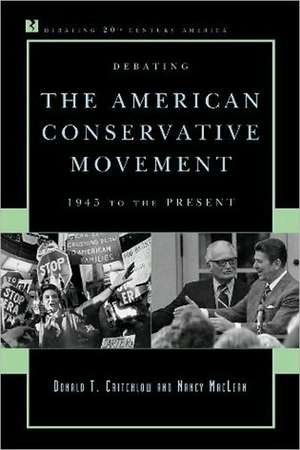
Debating the American Conservative Movement: 1945 to the Present: Debating Twentieth-Century America
Autor Donald T. Critchlow, Nancy MacLeanen Limba Engleză Paperback – 16 mar 2009
Preț: 220.85 lei
Preț vechi: 293.12 lei
-25%
Puncte Express: 331
Carte tipărită la comandă
Livrare economică 08-22 decembrie
Livrare prin curier în România Termenul estimat este afișat lângă disponibilitate.
Transport gratuit de la 400.00 lei Plată online sau ramburs, în funcție de opțiunile comenzii.
Retur gratuit în 14 zile Comandă securizată și suport în română.
Specificații
ISBN-13: 9780742548244
ISBN-10: 0742548244
Pagini: 235
Dimensiuni: 148 x 228 x 14 mm
Greutate: 0.34 kg
Editura: Bloomsbury Publishing
Colecția Rowman & Littlefield
Seria Debating Twentieth-Century America
Locul publicării:New York, United States
ISBN-10: 0742548244
Pagini: 235
Dimensiuni: 148 x 228 x 14 mm
Greutate: 0.34 kg
Editura: Bloomsbury Publishing
Colecția Rowman & Littlefield
Seria Debating Twentieth-Century America
Locul publicării:New York, United States
Cuprins
Preface
Chapter 1: The Conservative Ascendancy
Chapter 2: Conservatives Debate the Cold War: Excerpt from "Conservatism and the National Review: Criticism and Reply," Ronald Hamowy and William F. Buckley, Jr. (November 1961)
Chapter 3: Young Conservatives Organize: The Sharon Statement (September 11, 1960)
Chapter 4: A Conservative Speaks in Favor of Civil Rights: Senator Everett Dirksen, Congressional Record (June 1964)
Chapter 5: A Conservative Opposes the Civil Rights Act of 1964: Senator Barry Goldwater, Congressional Record (June 1964)
Chapter 6: The Cold War and the Arms Race: Excerpt from Memorandum to Donald Rumsfeld, from Paul H. Nitze (December 19, 1974)
Chapter 7: Conservative Values: Ronald Reagan, "Remarks at the Annual Convention of the National Association of the Evangelicals" (March 8, 1983)
Chapter 8: Ronald Reagan, "Creators of the Future" (March 1, 1985)
Chapter 9: Conservatives on Religious Freedom: Mitt Romney, "Religious Liberty" (2008)
Chapter 10: Guardians of Privilege
Chapter 11: Frank Meyer, "What Is Conservatism?" (1966)
Chapter 12: Barry Goldwater, "I sense here a realignment of Southern conservative Democrats" (1953)
Chapter 13: Richard M. Weaver, "Integration Is Communization" (1957)
Chapter 14: "Our Position on States' Rights Is the Same as Your Own" Letter from William F. Buckley, Jr. to W. K. Simmons (September 10, 1958) and letter from W. J. Simmons to J. P. McFadden, (September 5, 1958)
Chapter 15: Young Americans for Freedom, "King Was a Collectivist" (1968)
Chapter 16: William F. Buckley, Jr., "Linda's Crusade" (May 21, 1968)
Chapter 17: Phyllis Schlafly, "What's Wrong with 'Equal Rights' for Women?" (February 1972)
Chapter 18: Southern Partisan Interview with Trent Lott, "Jefferson Davis's Descendents . . . Are Becoming Involved with the Republican Party" (1984)
Chapter 19: Elizabeth Birch, "Out of Sheer Humanity Comes Common Ground" (1995)
Selected Readings
Chapter 1: The Conservative Ascendancy
Chapter 2: Conservatives Debate the Cold War: Excerpt from "Conservatism and the National Review: Criticism and Reply," Ronald Hamowy and William F. Buckley, Jr. (November 1961)
Chapter 3: Young Conservatives Organize: The Sharon Statement (September 11, 1960)
Chapter 4: A Conservative Speaks in Favor of Civil Rights: Senator Everett Dirksen, Congressional Record (June 1964)
Chapter 5: A Conservative Opposes the Civil Rights Act of 1964: Senator Barry Goldwater, Congressional Record (June 1964)
Chapter 6: The Cold War and the Arms Race: Excerpt from Memorandum to Donald Rumsfeld, from Paul H. Nitze (December 19, 1974)
Chapter 7: Conservative Values: Ronald Reagan, "Remarks at the Annual Convention of the National Association of the Evangelicals" (March 8, 1983)
Chapter 8: Ronald Reagan, "Creators of the Future" (March 1, 1985)
Chapter 9: Conservatives on Religious Freedom: Mitt Romney, "Religious Liberty" (2008)
Chapter 10: Guardians of Privilege
Chapter 11: Frank Meyer, "What Is Conservatism?" (1966)
Chapter 12: Barry Goldwater, "I sense here a realignment of Southern conservative Democrats" (1953)
Chapter 13: Richard M. Weaver, "Integration Is Communization" (1957)
Chapter 14: "Our Position on States' Rights Is the Same as Your Own" Letter from William F. Buckley, Jr. to W. K. Simmons (September 10, 1958) and letter from W. J. Simmons to J. P. McFadden, (September 5, 1958)
Chapter 15: Young Americans for Freedom, "King Was a Collectivist" (1968)
Chapter 16: William F. Buckley, Jr., "Linda's Crusade" (May 21, 1968)
Chapter 17: Phyllis Schlafly, "What's Wrong with 'Equal Rights' for Women?" (February 1972)
Chapter 18: Southern Partisan Interview with Trent Lott, "Jefferson Davis's Descendents . . . Are Becoming Involved with the Republican Party" (1984)
Chapter 19: Elizabeth Birch, "Out of Sheer Humanity Comes Common Ground" (1995)
Selected Readings
Recenzii
Debating the American Conservative Movement presents a lively, passionate argument about the rise of the New Right and its far-reaching consequences for American politics since World War II. Two distinguished historians, Donald Critchlow and Nancy MacLean, concur that the conservative movement came to power because 'ideas have consequences' but disagree on almost everything else that they discuss in this volume. Their competing perspectives on modern conservatism will help students understand the high stakes of historical debates over the legacy of the New Deal, the fate of the civil rights movement, the emergence of the Religious Right, and the meaning of the 'Reagan Revolution.'
A stimulating and valuable book. With vigorously argued essays by major scholars and a revealing collection of primary sources, this volume allows students to understand-and invites them to enter-the historical debate on this pivotal subject.
The book splits between Critchlow's sympathetic views of conservatism after World War II and MacLean's rebuttal of conservatism as a positive force in American politics. Each essay is followed by a set of primary documents designed to substantiate preceding arguments. A great guide . . . for history students. . . . The essays are critical to demonstrating how to frame ideological debates without resorting to logical fallacies and name-calling.
An engaging, fair, and invaluable collection-a marvelous addition to any course on modern America.
A stimulating and valuable book. With vigorously argued essays by major scholars and a revealing collection of primary sources, this volume allows students to understand-and invites them to enter-the historical debate on this pivotal subject.
The book splits between Critchlow's sympathetic views of conservatism after World War II and MacLean's rebuttal of conservatism as a positive force in American politics. Each essay is followed by a set of primary documents designed to substantiate preceding arguments. A great guide . . . for history students. . . . The essays are critical to demonstrating how to frame ideological debates without resorting to logical fallacies and name-calling.
An engaging, fair, and invaluable collection-a marvelous addition to any course on modern America.
Notă biografică
Donald T. Critchlow, professor of History and Director of the Center for Political Thought and Leadership at Arizona State University, is the author and editor of over twenty books. He has been a frequent guest regularly on NPR, British Broadcasting Corporation Radio, and many talk radio programs throughout the U.S.