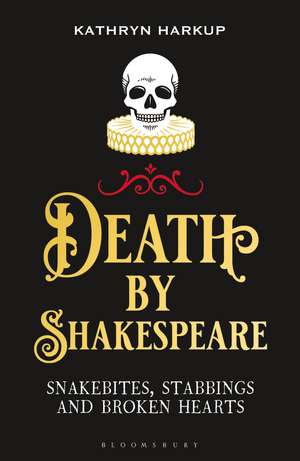
Death By Shakespeare: Snakebites, Stabbings and Broken Hearts
Autor Kathryn Harkupen Limba Engleză Paperback – 3 feb 2022
William Shakespeare found dozens of different ways to kill off his characters, and audiences today still enjoy the same reactions - shock, sadness, fear - that they did more than 400 years ago when these plays were first performed. But how realistic are these deaths, and did Shakespeare have the knowledge to back them up?
In the Bard's day death was a part of everyday life. Plague, pestilence and public executions were a common occurrence, and the chances of seeing a dead or dying body on the way home from the theatre were high. It was also a time of important scientific progress. Shakespeare kept pace with anatomical and medical advances, and he included the latest scientific discoveries in his work, from blood circulation to treatments for syphilis. He certainly didn't shy away from portraying the reality of death on stage, from the brutal to the mundane, and the spectacular to the silly.
Elizabethan London provides the backdrop for Death by Shakespeare, as Kathryn Harkup turns her discerning scientific eye to the Bard and the varied and creative ways his characters die. Was death by snakebite as serene as Shakespeare makes out? Could lack of sleep have killed Lady Macbeth? Can you really murder someone by pouring poison in their ear? Kathryn investigates what actual events may have inspired Shakespeare, what the accepted scientific knowledge of the time was, and how Elizabethan audiences would have responded to these death scenes. Death by Shakespeare will tell you all this and more in a rollercoaster of Elizabethan carnage, poison, swordplay and bloodshed, with an occasional death by bear-mauling for good measure.
Preț: 63.96 lei
Preț vechi: 85.76 lei
-25%
Puncte Express: 96
Carte disponibilă
Livrare economică 11-25 noiembrie
Livrare express 28 octombrie-03 noiembrie pentru 43.44 lei
Livrare prin curier în România Termenul estimat este afișat lângă disponibilitate.
Transport gratuit de la 400.00 lei Plată online sau ramburs, în funcție de opțiunile comenzii.
Retur gratuit în 14 zile Comandă securizată și suport în română.
Specificații
ISBN-13: 9781472958204
ISBN-10: 1472958209
Pagini: 368
Dimensiuni: 130 x 196 x 30 mm
Greutate: 0.26 kg
Editura: Bloomsbury Publishing
Colecția Bloomsbury Sigma
Locul publicării:London, United Kingdom
ISBN-10: 1472958209
Pagini: 368
Dimensiuni: 130 x 196 x 30 mm
Greutate: 0.26 kg
Editura: Bloomsbury Publishing
Colecția Bloomsbury Sigma
Locul publicării:London, United Kingdom
V-ar putea interesa
-
 ShakespeareBill BrysonPreț: 70.17 lei
 -
 Soul of the AgeJonathan BatePreț: 94.46 lei
 -
 Shakespeare and ScienceTom Rutter-16%Preț: 122.12 lei145.91 lei
 -
 -16%Preț: 105.55 lei125.86 lei
 -
 30 Great Myths about ShakespeareEmma SmithPreț: 158.95 lei
 -
 ShakespeareJonathan Bate-19%Preț: 164.62 lei203.49 lei
 -
 Shakespeare's Restless WorldNeil MacGregor-20%Preț: 84.46 lei105.28 lei
 -
 A Piece of Work: Playing Shakespeare and Other StoriesSimon Russell Beale-26%Preț: 69.91 lei94.06 lei
 -
 The Shakespeare Secret: Number 1 in seriesJ. L. Carrell-25%Preț: 59.45 lei79.34 lei
 -
 The Shakespeare Curse: Number 2 in seriesJ. L. Carrell-24%Preț: 61.02 lei80.12 lei
 -
 V is for Venom: Agatha Christie's Chemicals of DeathKathryn Harkup-25%Preț: 106.89 lei143.02 lei
 -
 Shakespeare's HeroinesHonor Cargill-Martin-25%Preț: 81.93 lei109.38 lei
 -
 Sleep of Death: Book 1 in the Nick Revill seriesPhilip GoodenPreț: 64.34 lei
 -
 -27%Preț: 68.52 lei93.38 lei
 -
 Shakespeare for Kids: His Life and Times, 21 ActivitiesColleen AagesenPreț: 123.39 lei
 -
 Preț: 138.99 lei
 -
 Preț: 80.87 leiNou
 -
 Preț: 72.83 lei
 -
 The Surgeon, The Midwife, The QuackAlanna SkusePreț: 138.14 lei
 -
 Shakespeare for EveryoneEmma Roberts-9%Preț: 101.10 lei111.28 lei
Cuprins
I shall offend, either to detain or give it. The contents, as in part I understand them, are to blame.
King Lear, Act 1, Scene 2
Prologue
Chapter 1: Our Humble Author
Chapter 2: All the World's a Stage
Chapter 3: Will You Be Cured of Your Infirmity?
Chapter 4: Off With His Head!
Chapter 5: Murder, Murder!
Chapter 6: The Dogs of War
Chapter 7: A Plague O'both Your Houses!
Chapter 8: Most Delicious Poison
Chapter 9: To Be, or Not to Be
Chapter 10: Excessive Grief the Enemy to the Living
Chapter 11: Exit Pursued by a Bear
Epilogue
Appendix
Bibliography
Acknowledgements
Index
King Lear, Act 1, Scene 2
Prologue
Chapter 1: Our Humble Author
Chapter 2: All the World's a Stage
Chapter 3: Will You Be Cured of Your Infirmity?
Chapter 4: Off With His Head!
Chapter 5: Murder, Murder!
Chapter 6: The Dogs of War
Chapter 7: A Plague O'both Your Houses!
Chapter 8: Most Delicious Poison
Chapter 9: To Be, or Not to Be
Chapter 10: Excessive Grief the Enemy to the Living
Chapter 11: Exit Pursued by a Bear
Epilogue
Appendix
Bibliography
Acknowledgements
Index
Recenzii
Harkup's enjoyable and informative survey presents this somatic Shakespeare for the Horrible Histories generation.
Were I a school-teacher introducing phone-addicted teens to Macbeth or Romeo and Juliet, I'd go in big on Shakespeare's 'violent delights'.
Well-written and intriguing, the book provides a rich behind-the-scenes look at science and historical fact, using the focus on death to deepen understanding of Shakespeare's life and work.
The author of A Is for Arsenic and Making the Monster: The Science Behind Mary Shelley's Frankenstein continues her macabre cultural musings with an immensely readable roundup of Shakespearean death.
Death By Shakespeare is a macabre but fascinating read, rich in historical context, scientific insight, and intriguing asides.
Harkup serves a delectable stew of history, science and wit that is sure to sate the appetite of any Anglophile.
Serious scholarship meets horrid histories. Kathryn Harkup located Death by Shakespeare within the contexts of science and medicine, health and safety, crime and punishment, and in the process gives us tour de force descriptions of Juliet's deep coma, Cleopatra's asp, Ophelia's drowning and the carnage at Agincourt, among other celebrated exits. It's a good read - never morbid, and full of insights into the Tudor way of death and how far we've come.
Light enough to be a quick read for fun but hefty enough to educate, this is a book that any student would be happy to study for a class, and it's a solid addition to any nonfiction or Shakespearean fan's collection. Yet again, Harkup has delivered a satisfying, sterling examination of an iconic figure's literary contributions to history.
Were I a school-teacher introducing phone-addicted teens to Macbeth or Romeo and Juliet, I'd go in big on Shakespeare's 'violent delights'.
Well-written and intriguing, the book provides a rich behind-the-scenes look at science and historical fact, using the focus on death to deepen understanding of Shakespeare's life and work.
The author of A Is for Arsenic and Making the Monster: The Science Behind Mary Shelley's Frankenstein continues her macabre cultural musings with an immensely readable roundup of Shakespearean death.
Death By Shakespeare is a macabre but fascinating read, rich in historical context, scientific insight, and intriguing asides.
Harkup serves a delectable stew of history, science and wit that is sure to sate the appetite of any Anglophile.
Serious scholarship meets horrid histories. Kathryn Harkup located Death by Shakespeare within the contexts of science and medicine, health and safety, crime and punishment, and in the process gives us tour de force descriptions of Juliet's deep coma, Cleopatra's asp, Ophelia's drowning and the carnage at Agincourt, among other celebrated exits. It's a good read - never morbid, and full of insights into the Tudor way of death and how far we've come.
Light enough to be a quick read for fun but hefty enough to educate, this is a book that any student would be happy to study for a class, and it's a solid addition to any nonfiction or Shakespearean fan's collection. Yet again, Harkup has delivered a satisfying, sterling examination of an iconic figure's literary contributions to history.