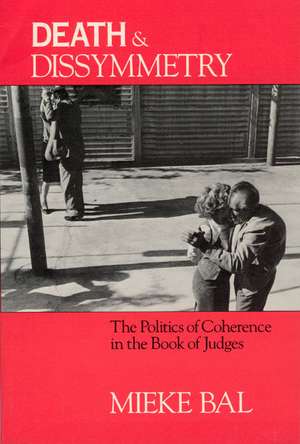
Death and Dissymmetry: The Politics of Coherence in the Book of Judges: Chicago Studies in the History of Judaism
Autor Mieke Balen Limba Engleză Paperback – 15 iun 1988
Structura și metodologia lucrării Death and Dissymmetry sunt fundamentate pe o intersecție riguroasă între critica literară și analiza feministă, oferind o perspectivă academică asupra Cărții Judecătorilor. Suntem de părere că abordarea propusă de Mieke Bal reușește să destabilizeze interpretările tradiționale prin mutarea centrului de greutate de la narativele militare și politice către micro-istoriile violenței domestice. Organizarea materialului, reflectată în cuprins, urmărește o progresie logică de la construcția istoriografică a textului biblic spre analize punctuale ale personajelor feminine, precum fiica lui Iefta sau soția lui Manoah, culminând cu o examinare a raportului dintre violență și sacru.
Subliniem importanța capitolului introductiv, „The Coherence of Politics and the Politics of Coherence”, care stabilește cadrul teoretic pentru ceea ce autoarea numește o „contra-coerență”. Această metodologie extinde cadrul propus de Feminist Companion to Judges de Athalya Brenner-Idan cu date noi din perspectiva analizei naratologice, oferind o profunzime sporită modului în care genul și structura socială sunt reflectate în textul sacru. În timp ce alte comentarii se concentrează pe eroismul masculin, Mieke Bal demonstrează cum tratamentul aplicat femeilor este, de fapt, elementul care oferă unitate ideologică întregii cărți.
Această lucrare se poziționează ca o continuare firească a preocupărilor teoretice ale autoarei, vizibile în Narratology, unde a rafinat instrumentele de analiză a perspectivei și structurii narative. Spre deosebire de Judges Through the Centuries de David M Gunn, care oferă o istorie a receptării, volumul de față este o intervenție critică ce utilizează instrumente din etnografie și psihanaliză pentru a expune contradicțiile inerente ale structurii sociale israelite în perioada de tranziție.
Din seria Chicago Studies in the History of Judaism
-
 Preț: 310.02 lei
 -
 Preț: 336.40 lei
 -
 Preț: 279.93 lei
 -
 Preț: 285.40 lei
 -
 Preț: 250.21 lei
 -
 Preț: 299.37 lei
 -
 Preț: 301.86 lei
 -
 Preț: 283.22 lei
 -
 Preț: 277.27 lei
 -
 Preț: 275.06 lei
 -
 Preț: 261.78 lei
 -
 Preț: 304.07 lei
 -
 Preț: 301.29 lei
 -
 Preț: 307.61 lei
 -
 Preț: 238.51 lei
 - 23%
 Preț: 165.92 lei
 - 34%
 Preț: 564.07 lei
 - 16%
 Preț: 319.58 lei
 - 19%
 Preț: 272.49 lei
Preț: 280.81 lei
Carte tipărită la comandă
Livrare economică 16-30 noiembrie
Specificații
ISBN-10: 0226035557
Pagini: 319
Dimensiuni: 152 x 229 x 23 mm
Greutate: 0.45 kg
Ediția:1
Editura: University of Chicago Press
Colecția University of Chicago Press
Seria Chicago Studies in the History of Judaism
V-ar putea interesa
-
 Textual Sources for the Study of JudaismPhilip S. AlexanderPreț: 247.80 lei
 -
 Preț: 239.11 lei
 -
 Torah For TodayEster R. Taus-23%Preț: 328.57 lei425.95 lei
 -
 The Treasury of Judaism: A New Collection and Translation of Essential TextsRabbi Jacob Neusner-35%Preț: 376.78 lei580.13 lei
 -
 Jewish Philosophy: Foundations and Extensions, Volume 1Raphael Jospe-32%Preț: 362.83 lei532.10 lei
 -
 Preț: 229.65 lei
 -
 Shengold Jewish EncyclopediaMordecai SchreiberPreț: 239.01 lei
 -
 On Story-TellingMieke BalPreț: 218.12 lei
 -
 Conversos of the AmericasKeith FogelPreț: 130.97 lei
 -
 Charley Braunstein and Jewish TraditionRabbi Henry II CohenPreț: 96.63 lei
 -
 The Fall Feasts of Israel: And Their Fulfillment in JesusBruce R. BookerPreț: 75.30 lei
 -
 JudaismRabbi I. EpsteinPreț: 234.82 lei
 -
 The Changing Christian WorldLeonard A SchoolmanPreț: 91.09 lei
 -
 The Women's Haftarah CommentaryRabbi Elyse GoldsteinPreț: 155.24 lei
 -
 Modern Jews Engage the New Testament Companion FiguresRabbi Michael J. CookPreț: 52.11 lei
 -
 The Limits of FaithMuata AshbyPreț: 104.97 lei
 -
 -18%Preț: 355.53 lei434.63 lei
 -
 A World Apart: A Memoir of Jewish Life in Nineteenth Century GaliciaJoseph Margoshes-22%Preț: 246.15 lei315.00 lei
 -
 Tractates Bava Qamma, Bava Mesi'a, and Bava BatraHeinrich W. Guggenheimer-23%Preț: 2480.99 lei3222.06 lei
 -
 Wort Sprache und SprechenFriedrich WeinrebPreț: 251.87 lei
 -
 Die sieben ProphetinnenFriedrich WeinrebPreț: 198.67 lei
De ce să citești această carte
Recomandăm această carte cercetătorilor și studenților din domeniile studiilor religioase, istoriei antice și teoriei de gen. Cititorul câștigă o metodă inovatoare de decodare a textelor biblice, trecând dincolo de suprafața eroică pentru a înțelege mecanismele puterii și ale genului. Este un volum esențial pentru oricine dorește să exploreze cum narațiunea poate ascunde sau revela structuri sociale profunde prin analiză critică riguroasă.
Despre autor
Mieke Bal este profesor emerit la Academia Regală de Arte și Științe a Țărilor de Jos și cofondatoare a Școlii de Analiză Culturală din Amsterdam (ASCA). Renumită pentru contribuțiile sale interdisciplinare, ea a modelat domeniul naratologiei moderne și al analizei culturale. Opera sa vastă include titluri fundamentale precum Narratology și Travelling Concepts in the Humanities, lucrări care demonstrează capacitatea sa de a naviga între discipline umaniste diverse. Expertiza sa în teoria literară și studiile vizuale este aplicată în prezentul volum pentru a oferi o lectură provocatoare a textelor religioase clasice.
Descriere scurtă
Counter to standard readings of Judges, Bal's interpretation demonstrates that the book has a political and ideological coherence in which the treatment of women plays a pivotal role. Bal concentrates here not on the assassinations and battles that rage through Judges but on the violence in the domestic lives of individual characters, particularly sexual violence directed at women. Her skillful reading reveals that murder, in this text, relates to gender and reflects a social structure that is inherently contradictory. By foregrounding the stories of women and subjecting them to subtle narrative analysis, she is able to expose a set of preoccupations that are essential to the sense of these stories but are not articulated in them. Bal thereby develops a "countercoherence" in conflict with the apparent emphases of Judges—the politics, wars, and historiography that have been the constant focus of commentators on the book.
Death and Dissymmetry makes an important contribution to the development of a feminist method of interpreting ancient texts, with consequences for religious studies, ancient history, literary theory, and gender studies.
Notă biografică
Cuprins
Introduction
1. The Coherence of Politics and the Politics of Coherence
Two Views of the Book of Judges
How History Constructs Itself
The Construction of a Different History
The Coherence of Dissymmetry
Heroes of Might and Women of Death
Lethal Ladies
Gender, Sex, and Dissymmetry
Other Female Characters
The Language of Power
2. Virginity and Entanglement
Bath-Jephthah: The Daughter's Gift
Negation and Denial of Womanhood
Freud Entangled
Love at First Sight
Bath's Survival
3. Virginity Scattered
Paradoxes of Virginity
Nonvirginal Virgins, Virginal Spouses
Between Virgin and Wife: Caught Between Men
4. Violence and the Sacred: Contribution to the Ethnography of Fatherhood
The Raw and the Cooked
In the Name of the Law: Proper Sacrifice
Manoah's Failed Fatherhood
In the Name of the Vow: Improper Sacrifice
Bath-Jephthah versus Ben-Abraham: A Case for Separation
Dreaming Fire: Violence without the Sacred
The Body Became Voice, or the Reinforcement of Culture
5. The Scandal of the Speaking Body: From Speech-act to Body Language
Speech-acts: The Word Become Flesh
Samson's Riddle: The Word Became Woman
The Riddle as Vow and the Vow as Riddle
The Daughter's Body Language as a Challenge to Fatherhood
The Mouth of the S/Word
6. The Architecture of Unhomeliness
Oppositions
Limits
Dialectic
Unhomeliness Revisited
The Empty House Is Haunted
7. The Displacement of the Mother
Explicit Mothers: Jephthah's and Abimelech's, Samson's and Micah's
Explicit Mothers: Sisera's and Israel's
Displaced Mothers: Yael
Displaced Mothers: The Woman-with-the-Millstone
Displaced Mothers: Delilah
Mothering, Murdering, Making Love: Yael
Clytemnestra's Absence
Conclusion
The I, the Eye, and Objectification
The Incoherence of Coherence
Once Upon a Time
Once More: Body Language
Appendix 1: A Model for Narratological Analysis
Appendix 2: Notes on Language
Notes
Bibliography
Index