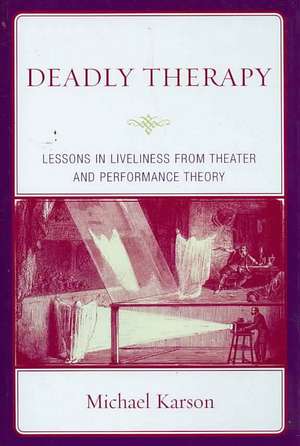
Deadly Therapy: Lessons in Liveliness from Theater and Performance Theory
Autor Michael Karsonen Limba Engleză Hardback – 29 mai 2008
Performance theory-encompassing audience engagement, dramaturgy, gender studies, power and privilege dynamics, critical thinking, and multiculturalism-is used to investigate the "party lines" that get established in therapy and supervision, and to suggest ways to temper the deadening effects of rules and categories.
Preț: 629.85 lei
Preț vechi: 824.00 lei
-24%
Puncte Express: 945
Carte tipărită la comandă
Livrare economică 21 noiembrie-05 decembrie
Livrare prin curier în România Termenul estimat este afișat lângă disponibilitate.
Transport gratuit pentru acest produs Plată online sau ramburs, în funcție de opțiunile comenzii.
Retur gratuit în 14 zile Comandă securizată și suport în română.
Specificații
ISBN-13: 9780765704450
ISBN-10: 0765704455
Pagini: 231
Dimensiuni: 162 x 236 x 22 mm
Greutate: 0.5 kg
Ediția:1
Editura: Bloomsbury Publishing
Colecția Jason Aronson Inc
Locul publicării:New York, United States
ISBN-10: 0765704455
Pagini: 231
Dimensiuni: 162 x 236 x 22 mm
Greutate: 0.5 kg
Ediția:1
Editura: Bloomsbury Publishing
Colecția Jason Aronson Inc
Locul publicării:New York, United States
V-ar putea interesa
-
 Theatre and TherapyFintan Walsh-23%Preț: 54.37 lei70.35 lei
 -
 The Presentation of Self in Everyday LifeErving Goffman-31%Preț: 63.73 lei92.78 lei
 -
 The Next ConversationJefferson Fisher-19%Preț: 99.40 lei122.53 leiRecomandat
 -
 The Drama of Social Life: A Dramaturgical HandbookCharles EdgleyPreț: 337.63 lei
 -
 Pragmatics of Human CommunicationDon D. Jackson-5%Preț: 212.18 lei223.34 lei
 -
 A Boal Companion: Dialogues on Theatre and Cultural PoliticsJan Cohen-Cruz-5%Preț: 444.56 lei467.95 lei
 -
 -5%Preț: 260.01 lei273.69 lei
 -
 Goffman and the MediaPeter LuntPreț: 138.99 lei
 -
 Theatres of the MindJoyce McdougallPreț: 208.26 lei
 -
 Social Interaction and Dramatic Performance: Staging ConversationDr Spencer Hazel-17%Preț: 178.59 lei216.44 lei
 -
 Medicine as Theatre, Theatre as MedicineMarlene Goldman-32%Preț: 841.25 lei1246.12 lei
 -
 Preț: 409.53 lei
 -
 Performing PowerMarcus MorganPreț: 157.34 lei
 -
 Trauma Industrial ComplexDarren McgarveyPreț: 159.17 lei
 -
 Too Tired to FightErin Mitchell-19%Preț: 97.98 lei121.68 lei
 -
 DefySunita SahPreț: 122.36 lei
 -
 Bad TherapyAbigail ShrierPreț: 78.29 lei
 -
 The PerformerRichard SennettPreț: 92.52 lei
 -
 -25%Preț: 155.74 lei207.64 lei
 -
 Irreverence: A Strategy for Therapists' SurvivalGianfranco Cecchin-5%Preț: 337.95 lei355.73 lei
Cuprins
Chapter 1 Lessons from Deadly Theater
Chapter 2 Lessons from Performance Theory
Chapter 3 What Am I Doing to Irma?
Chapter 4 Status Games
Chapter 5 Gender Is Something We Do, Not Something We Are
Chapter 6 Deadly Multiculturalism
Chapter 7 Therapeutic Privilege
Chapter 8 Is Science Just Another Party Line?
Chapter 9 Critical Thinking About Critical Thinking
Chapter 10 Applying Theory to the Therapy (and Not Just to the Patient's Life)
Chapter 11 Deadly Supervision
Chapter 12 Fourteen Things We Can Do to Make Our Therapies Livelier
Chapter 13 References
Chapter 14 Index
Chapter 2 Lessons from Performance Theory
Chapter 3 What Am I Doing to Irma?
Chapter 4 Status Games
Chapter 5 Gender Is Something We Do, Not Something We Are
Chapter 6 Deadly Multiculturalism
Chapter 7 Therapeutic Privilege
Chapter 8 Is Science Just Another Party Line?
Chapter 9 Critical Thinking About Critical Thinking
Chapter 10 Applying Theory to the Therapy (and Not Just to the Patient's Life)
Chapter 11 Deadly Supervision
Chapter 12 Fourteen Things We Can Do to Make Our Therapies Livelier
Chapter 13 References
Chapter 14 Index
Recenzii
Michael Karson provides a fresh way of looking at psychotherapy and theater, with lessons for each. The emphasis on 'lively theater' speaks to both the actor and the therapist within me, permiting me a new sense of integration. The theater metaphor offers a visualization of the different levels of conceptualizing psychotherapy that is clear and understandable.
Warning: this book may induce anxiety in therapists grown accustomed to rigid how-to manuals. In Deadly Therapy, Michael Karson parallels theatre's tradition of questioning political power structures by grappling with contemporary psychological assumptions about the client-therapist relationship, gender and multicultural influences, and the truth of authenticity, among other issues at the crux of psychotherapy. Scarcely should therapists put down this critical treatise without experiencing a deeply personal challenge: to listen by attending to nuance, question self-inflexibility, be open to diversified language and approach, and, therein, to enliven as if on stage the immediate moment of therapeutic space.
Warning: this book may induce anxiety in therapists grown accustomed to rigid how-to manuals. In Deadly Therapy, Michael Karson parallels theatre's tradition of questioning political power structures by grappling with contemporary psychological assumptions about the client-therapist relationship, gender and multicultural influences, and the truth of authenticity, among other issues at the crux of psychotherapy. Scarcely should therapists put down this critical treatise without experiencing a deeply personal challenge: to listen by attending to nuance, question self-inflexibility, be open to diversified language and approach, and, therein, to enliven as if on stage the immediate moment of therapeutic space.