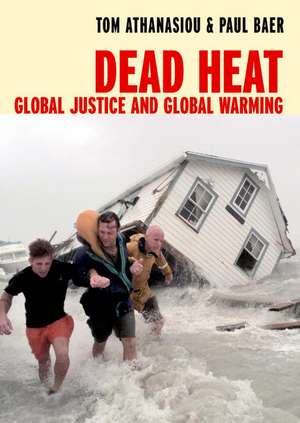
Dead Heat: Globalization and Global Warming (OMP)
Autor Tom Athanasiou, Paul Baeren Limba Engleză Paperback – iun 2002
Today's "extreme weather" events (record-breaking heat waves, droughts, and melting ice caps) foreshadow an increasingly unstable and dire future. Yet, despite all, the Bush administration continued to reject the Kyoto Protocol, to deny the catastrophic consequences of oil dependency, and to define the politics of oil as the politics of U.S. unilateralism, domination, and war. In Dead Heat, Tom Athanasiou and Paul Baer explain the threat and the science of drawing the line before it becomes real. This science (and their sources are the very latest) demonstrates that, if greenhouse pollution is not drastically reduced, the earth's climate system is likely to shift—and perhaps soon—onto a terrifying and irreversible path. Then, on this grim ground, they proceed to argue that only a social justice approach can shape the necessary compromise between the rich world and the poor; that, in effect, justice can make it possible to cut a path to sustainability, even on this, a planet riven with explosive national, ideological, and class divides.
The problem is time. Today, the global average surface warming is only 0.6 degrees Centigrade, and already the climate is changing fast. And the science shows that any future in which we hold the warming to a maximum of 2°C (and 2°C, by the way, would mean massive destruction) will require decisive global action; something like a "global Marshall Plan" but tuned, particularly, to sustainable energy development. It comes to this: the emissions trajectories and climate sensitivity indexes show, in mercilessly unambiguous terms, that even if we move quickly to cap global carbon emissions, the impact of the warming will soon become quite severe, and that in the more pessimistic case, where the fossil-fuel cartel remains in power, its impact will be shattering.
Dead Heat argues that justice—not rhetoric and "aid" but real developmental justice for the people of developing world—is going to be necessary, and surprisingly soon. It argues, more particularly, that such a justice must involve a phased transition from the Kyoto Protocol to a new climate treaty based on equal human rights to emit greenhouse pollutants. Dead Heat makes the case for climate justice, but insists that justice and equity, for all their manifold ethical and humanitarian attractions, must also be seen as the most "realistic of virtues." It insists, in other words, that our limited environmental space will itself show that it is the dream of a "business as usual" future that is naive and utopian.
Preț: 56.34 lei
Preț vechi: 64.01 lei
-12%
Puncte Express: 85
Carte disponibilă
Livrare economică 30 octombrie-10 noiembrie
Livrare prin curier în România Termenul estimat este afișat lângă disponibilitate.
Transport gratuit de la 400.00 lei Plată online sau ramburs, în funcție de opțiunile comenzii.
Retur gratuit în 14 zile Comandă securizată și suport în română.
Specificații
ISBN-13: 9781583224779
ISBN-10: 1583224777
Pagini: 128
Dimensiuni: 127 x 177 x 10 mm
Greutate: 0.16 kg
Ediția:A 7 Stories PR.
Editura: Seven Stories Press
Colecția Seven Stories Press
Locul publicării:New York, United States
ISBN-10: 1583224777
Pagini: 128
Dimensiuni: 127 x 177 x 10 mm
Greutate: 0.16 kg
Ediția:A 7 Stories PR.
Editura: Seven Stories Press
Colecția Seven Stories Press
Locul publicării:New York, United States
V-ar putea interesa
-
 The Copenhagen Diagnosis: Updating the World on the Latest Climate Science26 Leading Scientists-20%Preț: 256.34 lei320.30 lei
 -
 The Economics and Politics of Climate ChangeDieter Helm-10%Preț: 347.41 lei385.69 lei
 -
 Climate TerrorSanjay Chaturvedi-15%Preț: 657.89 lei773.98 lei
 -
 Local Climate Change and SocietyM. A. Mohamed Salih-18%Preț: 1254.81 lei1530.26 lei
 -
 -23%Preț: 674.31 lei875.73 lei
 -
 A Short Introduction to Climate ChangeTony EggletonPreț: 333.44 lei
 -
 Nitrogen and Climate ChangeD. ReayPreț: 384.59 lei
 -
 -27%Preț: 78.20 lei107.25 lei
 -
 -11%Preț: 171.01 lei192.83 lei
 -
 How to Get Expelled from SchoolIan PlimerPreț: 168.74 lei
 -
 Cold Matters: The State and Fate of Canada's Fresh WaterRobert William Sandford-8%Preț: 213.55 lei232.55 lei
 -
 Climate Change Science: A Modern SynthesisG. Thomas Farmer-18%Preț: 778.47 lei949.35 lei
Descriere
George W. Bush's refusal to sign the Kyoto treaty was openly based on protecting corporate profit, not protecting the public good. With scientists claiming that pollution must be cut by 15 percent while current gas emissions are still rising drastically, something must be done. 'Dead Heat' explains the environmental problem, the ethical and political constraints on implementing solutions, and argues that global environmental justice and economic realism must be factored together in order to advance a climate protocol that puts public good before big business.