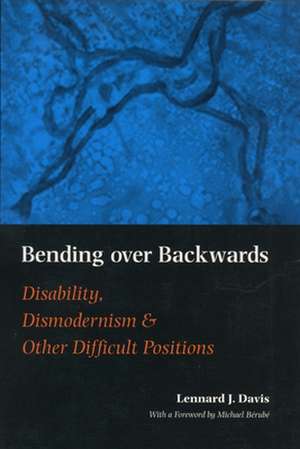
Davis, L: Bending Over Backwards
en Limba Engleză Hardback – sep 2002
Preț: 650.27 lei
Preț vechi: 844.51 lei
-23%
Puncte Express: 975
Carte tipărită la comandă
Livrare economică 30 noiembrie-14 decembrie
Livrare prin curier în România Termenul estimat este afișat lângă disponibilitate.
Transport gratuit pentru acest produs Plată online sau ramburs, în funcție de opțiunile comenzii.
Retur gratuit în 14 zile Comandă securizată și suport în română.
Specificații
ISBN-13: 9780814719497
ISBN-10: 081471949X
Pagini: 214
Dimensiuni: 152 x 229 x 16 mm
Greutate: 0.46 kg
Ediția:New.
ISBN-10: 081471949X
Pagini: 214
Dimensiuni: 152 x 229 x 16 mm
Greutate: 0.46 kg
Ediția:New.
Recenzii
"Bending Over Backwards is a welcome dismemberment of all that was unknowingly artificial from the start."
The Minnesota Review [Its] uniqueness of thought is this collections strength as it makes for an interesting and proactive read.
American Journal of Occupational Therapy "Davis's work offers creative and challenging examples that may be useful to our discipline and particularly to Disability historians. Bending Over Backwards remains an important and useful work for historians as a template for examining the myriad ways disability and Deafness infiltrate vital aspects of our identity, including laws, cultural icons, literature, and citizenship."
H-Net Reviews "Taken all together, the chapters offer an important, theoretically rich introduction to disability issues."
Novel "It is crucial, if at times uncomfortable, reading for medical professionals and scholars in the medical humanities alike. . . . Daring to mix the literary and the medical, the symbolic and the instrumental, the interpretive and the interventionist, Davis demonstrates what disability can teach us about the life that awaits any human baby."
Literature and Medicine "This superlative book is highly recommended for undergraduates, scholars, and researchers in the fields of disability studies, sociology, psychology, anthropology, ethics, and cultural studies."Choice "Lennard Davis is history in the making; for he is one of the foremost proponents of "disability studies," the newest theoretical kid on the block, noteworthy in part because it brings together scholars from the humanities and the medical sciences."
Stanley Fish, in Chicago Tribune A collection of essays written over several years for different audiences, it contains fascinating traces of Daviss intellectual journey from novel theorist and Foucauldian to disability studeis scholar and memoirist.
American Literature
"Bending Over Backwards is a welcome dismemberment of all that was unknowingly artificial from the start." --The Minnesota Review "[Its] uniqueness of thought is this collection's strength as it makes for an interesting and proactive read." --American Journal of Occupational Therapy "Davis's work offers creative and challenging examples that may be useful to our discipline and particularly to Disability historians. Bending Over Backwards remains an important and useful work for historians as a template for examining the myriad ways disability and Deafness infiltrate vital aspects of our identity, including laws, cultural icons, literature, and citizenship." --H-Net Reviews "Taken all together, the chapters offer an important, theoretically rich introduction to disability issues." --Novel "It is crucial, if at times uncomfortable, reading for medical professionals and scholars in the medical humanities alike... Daring to mix the literary and the medical, the symbolic and the instrumental, the interpretive and the interventionist, Davis demonstrates what disability can teach us about the life that awaits any human baby." --Literature and Medicine "This superlative book is highly recommended for undergraduates, scholars, and researchers in the fields of disability studies, sociology, psychology, anthropology, ethics, and cultural studies."--Choice "Lennard Davis is history in the making; for he is one of the foremost proponents of "disability studies," the newest theoretical kid on the block, noteworthy in part because it brings together scholars from the humanities and the medical sciences." --Stanley Fish, in Chicago Tribune "A collection of essays written over several years for different audiences, it contains fascinating traces of Davis's intellectual journey from novel theorist and Foucauldian to disability studeis scholar and memoirist." --American Literature
The Minnesota Review [Its] uniqueness of thought is this collections strength as it makes for an interesting and proactive read.
American Journal of Occupational Therapy "Davis's work offers creative and challenging examples that may be useful to our discipline and particularly to Disability historians. Bending Over Backwards remains an important and useful work for historians as a template for examining the myriad ways disability and Deafness infiltrate vital aspects of our identity, including laws, cultural icons, literature, and citizenship."
H-Net Reviews "Taken all together, the chapters offer an important, theoretically rich introduction to disability issues."
Novel "It is crucial, if at times uncomfortable, reading for medical professionals and scholars in the medical humanities alike. . . . Daring to mix the literary and the medical, the symbolic and the instrumental, the interpretive and the interventionist, Davis demonstrates what disability can teach us about the life that awaits any human baby."
Literature and Medicine "This superlative book is highly recommended for undergraduates, scholars, and researchers in the fields of disability studies, sociology, psychology, anthropology, ethics, and cultural studies."Choice "Lennard Davis is history in the making; for he is one of the foremost proponents of "disability studies," the newest theoretical kid on the block, noteworthy in part because it brings together scholars from the humanities and the medical sciences."
Stanley Fish, in Chicago Tribune A collection of essays written over several years for different audiences, it contains fascinating traces of Daviss intellectual journey from novel theorist and Foucauldian to disability studeis scholar and memoirist.
American Literature
"Bending Over Backwards is a welcome dismemberment of all that was unknowingly artificial from the start." --The Minnesota Review "[Its] uniqueness of thought is this collection's strength as it makes for an interesting and proactive read." --American Journal of Occupational Therapy "Davis's work offers creative and challenging examples that may be useful to our discipline and particularly to Disability historians. Bending Over Backwards remains an important and useful work for historians as a template for examining the myriad ways disability and Deafness infiltrate vital aspects of our identity, including laws, cultural icons, literature, and citizenship." --H-Net Reviews "Taken all together, the chapters offer an important, theoretically rich introduction to disability issues." --Novel "It is crucial, if at times uncomfortable, reading for medical professionals and scholars in the medical humanities alike... Daring to mix the literary and the medical, the symbolic and the instrumental, the interpretive and the interventionist, Davis demonstrates what disability can teach us about the life that awaits any human baby." --Literature and Medicine "This superlative book is highly recommended for undergraduates, scholars, and researchers in the fields of disability studies, sociology, psychology, anthropology, ethics, and cultural studies."--Choice "Lennard Davis is history in the making; for he is one of the foremost proponents of "disability studies," the newest theoretical kid on the block, noteworthy in part because it brings together scholars from the humanities and the medical sciences." --Stanley Fish, in Chicago Tribune "A collection of essays written over several years for different audiences, it contains fascinating traces of Davis's intellectual journey from novel theorist and Foucauldian to disability studeis scholar and memoirist." --American Literature
Notă biografică
Lennard J. Davis is head of the English Department at the University of Illinois at Chicago where he is also Professor of Disability and Human Development. His books include "Enforcing Normalcy: Disability, Deafness and the Body" and "The Disability Studies Reader."