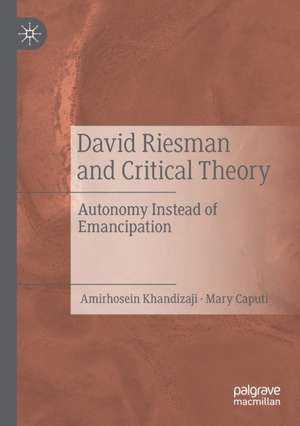
David Riesman and Critical Theory: Autonomy Instead of Emancipation
Autor Amirhosein Khandizaji, Mary Caputien Limba Engleză Paperback – 19 aug 2022
Preț: 744.24 lei
Preț vechi: 907.61 lei
-18%
Puncte Express: 1116
Carte tipărită la comandă
Livrare economică 16-30 noiembrie
Livrare prin curier în România Termenul estimat este afișat lângă disponibilitate.
Transport gratuit pentru acest produs Plată online sau ramburs, în funcție de opțiunile comenzii.
Retur gratuit în 14 zile Comandă securizată și suport în română.
Specificații
ISBN-13: 9783030788711
ISBN-10: 3030788717
Pagini: 160
Ilustrații: XV, 160 p.
Dimensiuni: 148 x 210 mm
Greutate: 0.22 kg
Ediția:1st ed. 2021
Editura: Springer International Publishing
Colecția Palgrave Macmillan
Locul publicării:Cham, Switzerland
ISBN-10: 3030788717
Pagini: 160
Ilustrații: XV, 160 p.
Dimensiuni: 148 x 210 mm
Greutate: 0.22 kg
Ediția:1st ed. 2021
Editura: Springer International Publishing
Colecția Palgrave Macmillan
Locul publicării:Cham, Switzerland
Cuprins
Introduction
1. David Riesman: Life and Social Context.- 2. Erich Fromm: The Mentor.- 3. Theories of David Riesman.- 4. The Culture Industry: Adorno and the Frankfurt School.- 5. Autonomy versus ‘Arrogant Esoterica.- Coda: Reading Reisman Today.
Textul de pe ultima copertă
Although David Riesman wrote over half a century ago, his concept of autonomy as presented in The Lonely Crowd (1950) speaks directly to the intellectual and emotional disarrangements of the twenty-first century. The current malaise produced by the excesses of commodity culture, information technology, the hyperreal, and “fake news” militate against our ability to think critically about contemporary society. And while postmodern authors insist that this bewildering situation weakens and assails our critical thinking skills, Riesman’s notion of autonomy refuses to capitulate to such a somber interpretation. Rather, he is convinced that individuals have the intellectual and emotional mettle to think for themselves and not be drawn into the demands of a commercialized culture and a commodity-driven lifestyle. As we pick and choose the terms of our engagement, we can remain aloof from society’s engulfing influence and preserve the oppositional thinking needed for democracy. To illustrate this point most clearly, this book puts Riesman into conversation with the writings of Theodor Adorno, whose evaluation of the critical faculty’s ability to withstand “the culture industry” is famously pessimistic.
Amirhosein Khandizaji is the author of "The Victory of Instrumental Reason and Farewell to Variety” (Xenomoi Verlag, 2013) and of Baudrillard and the Culture Industry (Springer, 2017). He is the editor of Reading Adorno: the Endless Road (Palgrave Macmillan, 2019), and the founding editor of Berlin Journal of Critical Theory.
Mary Caputi is Professor in the Department of Political Science at California State University, Long Beach, USA. She is the author of Feminism and Power: the Need for Critical Theory (Lexington, 2013), A Kinder, Gentler America: Melancholia and the Mythical 1950s (Minnesota, 2005), co-editor of Teaching Marx and Critical Theory in the 21st Century, with Bryant Sculos (Brill, 2019), and co-editor of Jacques Derrida and the Future of the Liberal Arts, with Vincent Del Casino (Continuum, 2013). In addition to teaching at California State University, Long Beach, she has taught at the University of Venice, at California State University in Florence, and at John Cabot University, Rome.
Mary Caputi is Professor in the Department of Political Science at California State University, Long Beach, USA. She is the author of Feminism and Power: the Need for Critical Theory (Lexington, 2013), A Kinder, Gentler America: Melancholia and the Mythical 1950s (Minnesota, 2005), co-editor of Teaching Marx and Critical Theory in the 21st Century, with Bryant Sculos (Brill, 2019), and co-editor of Jacques Derrida and the Future of the Liberal Arts, with Vincent Del Casino (Continuum, 2013). In addition to teaching at California State University, Long Beach, she has taught at the University of Venice, at California State University in Florence, and at John Cabot University, Rome.
Caracteristici
The book offers a counterargument to the claim that contemporary culture – media, technology, consumerism, “fake news” – has coopted Americans’ critical thinking skills. Drawing on Riesman’s concept of autonomy as presented in The Lonely Crowd, it instead maintains that we can critically evaluate the surrounding culture and so sustain a functional democracy This book highlights David Reisman's concept of autonomy as articulated in The Lonely Crowd, arguing that his insights into mid-twentieth century America are still pertinent to our society today The book puts David Reisman in conversation with Theodor Adorno, contrasting Riesman’s autonomy with Adorno’s plea for emancipation from the culture industry