Cărți de David Hume

David Hume (; born David Home; 7 May 1711 NS (26 April 1711 OS) – 25 August 1776) was a Scottish Enlightenment philosopher, historian, economist, librarian and essayist, who is best known today for his highly influential system of philosophical empiricism, skepticism, and naturalism. Beginning with A Treatise of Human Nature (1739–40), Hume strove to create a naturalistic science of man that examined the psychological basis of human nature. Hume argued against the existence of innate ideas, positing that all human knowledge derives solely from experience. This places him with Francis Bacon, Thomas Hobbes, John Locke, and George Berkeley as a British Empiricist.
Hume argued that inductive reasoning and belief in causality cannot be justified rationally; instead, they result from custom and mental habit. We never actually perceive that one event causes another but only experience the "constant conjunction" of events. This problem of induction means that to draw any causal inferences from past experience, it is necessary to presuppose that the future will resemble the past, a presupposition which cannot itself be grounded in prior experience.
An opponent of philosophical rationalists, Hume held that passions rather than reason govern human behaviour, famously proclaiming that "Reason is, and ought only to be the slave of the passions." Hume was also a sentimentalist who held that ethics are based on emotion or sentiment rather than abstract moral principle. He maintained an early commitment to naturalistic explanations of moral phenomena and is usually taken to have first clearly expounded the is–ought problem, or the idea that a statement of fact alone can never give rise to a normative conclusion of what ought to be done.
Hume also denied that humans have an actual conception of the self, positing that we experience only a bundle of sensations, and that the self is nothing more than this bundle of causally-connected perceptions. Hume's compatibilist theory of free will takes causal determinism as fully compatible with human freedom. His views on philosophy of religion, including his rejection of miracles and the argument from design for God's existence, were especially controversial for their time.
Hume influenced utilitarianism, logical positivism, the philosophy of science, early analytic philosophy, cognitive science, theology, and many other fields and thinkers. Immanuel Kant credited Hume as the inspiration who had awakened him from his "dogmatic slumbers."
Hume: Political Writings
The Essential Philosophical Works
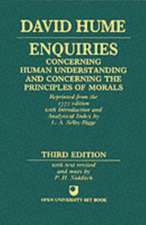
Enquiries concerning Human Understanding and concerning the Principles of Morals
On Suicide
Enquiries: Concerning Human Understanding and Concerning The Principles Of Morals
Complete Essays: Volume 2
Complete Essays: Volume 1
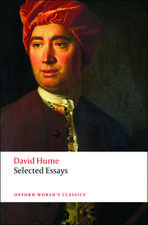
Selected Essays
David Hume on Morals, Politics, and Society
An Enquiry Concerning Human Understanding
Dialogues Concerning Natural Religion
A Treatise of Human Nature
Essays and Treatises on Philosophical Subjects
Enquiry Concerning Human Understanding
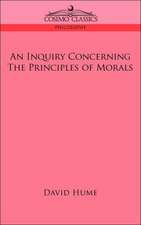
An Enquiry Concerning the Principles of Morals
Writings on Economics
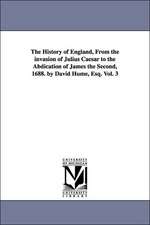
The History of England, From the invasion of Julius Caesar to the Abdication of James the Second, 1688. by David Hume, Esq. Vol. 3
The History of England, From the invasion of Julius Caesar to the Abdication of James the Second, 1688. by David Hume, Esq. Vol. 1
The History of England, from the Invasion of Julius Caesar to the Abdication of James the Second, 1688. by David Hume, Esq. Vol. 2
The Philosophical Works of David Hume. Including All the Essays, and Exhibiting the More Important Alterations and Corrections in the Successive Editi: Made Under the Direction of the United States Patent Office and the Smithsonian Institution from the Year 1854
The History of England, from the Invasion of Julius Caesar to the Abdication of James the Second, 1688. by David Hume, Esq. Vol. 6
The History of England, from the Invasion of Julius Caesar to the Abdication of James the Second, 1688. by David Hume, Esq. Vol. 5
The History of England, from the Invasion of Julius Caesar to the Abdication of James the Second, 1688. by David Hume, Esq. Vol. 4
Essays

Treatise of Human Nature
The Natural History of Religion
Writings on Religion
A Treatise of Human Nature - Vol I
A Treatise of Human Nature - Volume II
Dialogues Concerning Natural Religion;
Enquiries Concerning the Human Understanding: Its Organization and Administration
An Inquiry Concerning the Principles of Morals
A Treatise of Human Nature - Volumes I and II
People Power: The History and Future of the Referendum in Australia
The Elements of Mentality: The Foundations of Psychology and Philosophy
Four Dissertations Ane Essays on Suicide and the Immortality of the Soul
An Enquiry Concerning Human Understanding / Eine Untersuchung über den menschlichen Verstand
Crime Unlimited
Human Rights under the Australian Constitution
The Revelation Chronicles
Blind Without Barriers
Essays, Moral, Political and Literary
Tourism Art and Souvenirs: The Material Culture of Tourism
Hume's Enquiry: Expanded and Explained
The History of England

The History of England, from the Invasion of Julius Caesar to the Abdication of James the Second, 1688, Volume 1
The Scorpion's Dance
Paisano
The History of England Volume One Part C from Henry VII to Mary
The History of England - Volume I. Part A.
The History of England from Charles I. to Cromwell
The History of England from Charles II to James II
The History of England from Elizabeth to James I
The History of England from Henry III. to Richard III.- Volume I. Part B.
The History of England from Henry VII to Mary
The History of England Volume I
The History of England Volume II
The History of England Volume III
The History of England Volume IV
The History of England Volume Five
The History of England Volume Six
A Treatise on Human Nature
An Enquiry Concerning Human Understanding (Annotated)
An Enquiry Concerning the Principles of Morals (Annotated)
The History of England, from the Invasion of Julius Caesar to the Revolution in 1688 - Vol. III: Mandalas! Reduce Stress, Relax, Increase Focus & Boost Creativity with Amazing Mandala Coloring Patterns
The History of England - Volume V
The Life of David Hume, Esq
Letters of David Hume and Extracts from Letters Referring to Him
The Natural History of Religion (Annotated)
The History of England, from the Invasion of Julius Caesar to the Revolution of 1688
Of Money, and Other Economic Essays
The Rise and Fall of Murdoch Jefferson Jones
Hume's Treatise of morals:
The History of England Vol. I VIII
The History Of England From The Invasion Of Julius Caesar To The Revolution In 1688
Social Contract
David Hume: A Treatise of Human Nature: Volume 1: Texts
The History of England. Volume I
Hume and Smollett's History of England, Abridged, and Continued to the Accession of George Iv
A Treatise of Human Nature [By D. Hume]
History of England, by Hume and Smollett
Das Genie Des Herrn Hume (1774)
Histoire De La Maison De Plantagenet V1
Histoire De La Maison De Stuart V3
Histoire De La Maison De Tudor V1
Dialogues Concerning Natural Religion (1779)
Political Discourses (1752)
The Life Of David Hume (1777)
Philosophical Essays Concerning Human Understanding (1751)
An Enquiry Concerning Human Understanding, and Selections from A Treatise of Human Nature
Hume's Political Discourses
An Enquiry Concerning Human Understanding (with an Introduction by L. A. Selby-Bigge)
Questions On The Student's Hume
Life, Death, and Meaning: Key Philosophical Readings on the Big Questions
The History Of England, From The Invasion Of Julius Caesar To The Revolution Of 1688 - Vol X.
- 1
- 2