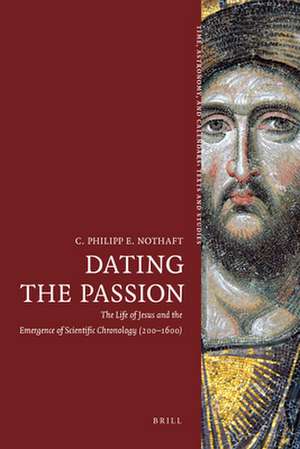
Dating the Passion
Autor C Philipp E Nothaften Limba Engleză Hardback – 6 oct 2011
Preț: 1221.75 lei
Preț vechi: 1586.70 lei
-23%
Puncte Express: 1833
Carte tipărită la comandă
Livrare economică 08-22 decembrie
Livrare prin curier în România Termenul estimat este afișat lângă disponibilitate.
Transport gratuit pentru acest produs Plată online sau ramburs, în funcție de opțiunile comenzii.
Retur gratuit în 14 zile Comandă securizată și suport în română.
Specificații
ISBN-13: 9789004212190
ISBN-10: 9004212191
Pagini: 322
Dimensiuni: 165 x 244 x 18 mm
Greutate: 0.74 kg
Ediția:New.
Editura: Brill
ISBN-10: 9004212191
Pagini: 322
Dimensiuni: 165 x 244 x 18 mm
Greutate: 0.74 kg
Ediția:New.
Editura: Brill
V-ar putea interesa
-
 Preț: 234.89 lei
 -
 Why Be Jewish?David J. WolpePreț: 85.41 lei
 -
 Women and Water: Menstruation in Jewish Life and LawRahel WasserfallPreț: 212.23 lei
 -
 The Sacred Table: Creating a Jewish Food EthicMary L. ZamorePreț: 185.31 lei
 -
 -8%Preț: 71.71 lei78.27 lei
 -
 Passover ParodiesShoshana HantmanPreț: 100.30 lei
 -
 My People's Passover Haggadah Vol 1David ArnowPreț: 215.10 lei
 -
 DaveningRabbi Zalman Schachter-ShalomiPreț: 132.81 lei
 -
 May God RememberRabbi Lawrence A. HoffmanPreț: 169.47 lei
 -
 My People's Prayer Book Vol 1Rabbi Lawrence A. HoffmanPreț: 171.33 lei
 -
 A Bit of Wit, A World of WisdomYehoshua Kurland-11%Preț: 133.16 lei150.32 lei
 -
 The Shemittah GuideRabbi Yissachar Dov Krakowski-10%Preț: 96.39 lei107.54 lei
 -
 The Lieberman Open Orthodox HaggadahRabbi Shmuel Herzfeld-8%Preț: 101.55 lei110.59 lei
Cuprins
Chapter One: From Astronomy to the Crucifixion and Back
Chapter Two: The Origins of Computistical Chronography
Chapter Three: The Crisis of Computistical Chronography in the Early Middle Ages
Chapter Four: All Coherence Restored? The Age of the Critical Computists
Chapter Five: New Foundations: Chronology and the Twelfth-Century Renaissance
Chapter Six: A Science of Time: Roger Bacon and his Successors
Chapter Seven: Time for Controversy: Catholic Chronologers and the Date of the Passion in the Fifteenth and Sixteenth Century
Chapter Eight: The Life of Jesus and the Emergence of Scientific Chronology
Chapter Two: The Origins of Computistical Chronography
Chapter Three: The Crisis of Computistical Chronography in the Early Middle Ages
Chapter Four: All Coherence Restored? The Age of the Critical Computists
Chapter Five: New Foundations: Chronology and the Twelfth-Century Renaissance
Chapter Six: A Science of Time: Roger Bacon and his Successors
Chapter Seven: Time for Controversy: Catholic Chronologers and the Date of the Passion in the Fifteenth and Sixteenth Century
Chapter Eight: The Life of Jesus and the Emergence of Scientific Chronology
Notă biografică
C. Philipp E. Nothaft, Ph.D. (2011) in History, University of Munich, is a research assistant at the Department of Hebrew & Jewish Studies, University College, London. He has published several articles on the history of scholarship and chronology.