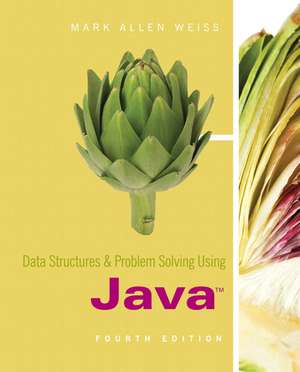
Data Structures & Problem Solving Using Java
Autor Mark Allen Weissen Limba Engleză Paperback – 30 sep 2009
Preț: 1351.51 lei
Preț vechi: 1755.21 lei
-23%
Puncte Express: 2027
Carte disponibilă
Livrare economică 24 septembrie-08 octombrie
Livrare prin curier în România Termenul estimat este afișat lângă disponibilitate.
Transport gratuit pentru acest produs Plată online sau ramburs, în funcție de opțiunile comenzii.
Retur gratuit în 14 zile Comandă securizată și suport în română.
Specificații
ISBN-13: 9780321541406
ISBN-10: 0321541405
Pagini: 985
Dimensiuni: 185 x 231 x 41 mm
Greutate: 1.47 kg
Ediția:4Nouă
Editura: Addison Wesley Longman
Locul publicării:Boston, United States
ISBN-10: 0321541405
Pagini: 985
Dimensiuni: 185 x 231 x 41 mm
Greutate: 1.47 kg
Ediția:4Nouă
Editura: Addison Wesley Longman
Locul publicării:Boston, United States
Descriere
For the second or third programming course.
A practical and unique approach to data structures that separates interface from implementation.
This book provides a practical introduction to data structures with an emphasis on abstract thinking and problem solving, as well as the use of Java. It does this through what remains a unique approach that clearly separates each data structure’s interface (how to use a data structure) from its implementation (how to actually program that structure). Parts I (Tour of Java), II (Algorithms and Building Blocks), and III (Applications) lay the groundwork by discussing basic concepts and tools and providing some practical examples, while Part IV (Implementations) focuses on implementation of data structures. This forces the reader to think about the functionality of the data structures before the hash table is implemented.
The Fourth Edition features many new updates as well as new exercises.
A practical and unique approach to data structures that separates interface from implementation.
This book provides a practical introduction to data structures with an emphasis on abstract thinking and problem solving, as well as the use of Java. It does this through what remains a unique approach that clearly separates each data structure’s interface (how to use a data structure) from its implementation (how to actually program that structure). Parts I (Tour of Java), II (Algorithms and Building Blocks), and III (Applications) lay the groundwork by discussing basic concepts and tools and providing some practical examples, while Part IV (Implementations) focuses on implementation of data structures. This forces the reader to think about the functionality of the data structures before the hash table is implemented.
The Fourth Edition features many new updates as well as new exercises.
Cuprins
PART ONE: TOUR OF JAVA
Chapter 1: Primitive Java
Chapter 2: Reference Types
Chapter 3: Objects and Classes
Chapter 4: Inheritance
PART TWO: ALGORITHMS AND BUILDING BLOCKS
Chapter 5: Algorithm Analysis
Chapter 6: The Collections API
Chapter 7: Recursion
Chapter 8: Sorting Algorithms
Chapter 9: Randomization
PART THREE: APPLICATIONS
Chapter 10: Fun and Games
Chapter 11: Stacks and Compilers
Chapter 12: Utilities
Chapter 13: Simulation
Chapter 14: Graphs and Paths
PART FOUR: IMPLEMENTATIONS
Chapter 15: Inner Classes and Implementation of ArrayList
Chapter 16: Stacks and Queues
Chapter 17: Linked Lists
Chapter 18: Trees
Chapter 19: Binary Search Trees
Chapter 20: Hash Tables
Chapter 21: A Priority Queue: The Binary Heap
PART FIVE: ADVANCED DATA STRUCTURES
Chapter 22: Splay Trees
Chapter 23: Merging Priority Queues
Chapter 24: The Disjoint Set Class
APPENDIX A: Operators
APPENDIX B: Graphical User Interfaces
APPENDIX C: Bitwise Operators
Chapter 1: Primitive Java
Chapter 2: Reference Types
Chapter 3: Objects and Classes
Chapter 4: Inheritance
PART TWO: ALGORITHMS AND BUILDING BLOCKS
Chapter 5: Algorithm Analysis
Chapter 6: The Collections API
Chapter 7: Recursion
Chapter 8: Sorting Algorithms
Chapter 9: Randomization
PART THREE: APPLICATIONS
Chapter 10: Fun and Games
Chapter 11: Stacks and Compilers
Chapter 12: Utilities
Chapter 13: Simulation
Chapter 14: Graphs and Paths
PART FOUR: IMPLEMENTATIONS
Chapter 15: Inner Classes and Implementation of ArrayList
Chapter 16: Stacks and Queues
Chapter 17: Linked Lists
Chapter 18: Trees
Chapter 19: Binary Search Trees
Chapter 20: Hash Tables
Chapter 21: A Priority Queue: The Binary Heap
PART FIVE: ADVANCED DATA STRUCTURES
Chapter 22: Splay Trees
Chapter 23: Merging Priority Queues
Chapter 24: The Disjoint Set Class
APPENDIX A: Operators
APPENDIX B: Graphical User Interfaces
APPENDIX C: Bitwise Operators
Notă biografică
Mark Allen Weiss is a Professor in the School of Computing and Information Sciences at Florida International University in Miami Florida. He received his Bachelor's Degree in Electrical Engineering from The Cooper Union in 1983, and his Ph.D. in Computer Science from Princeton University in 1987, working under Bob Sedgewick. He has been at FIU since 1987, and was promoted to Professor in 1996. His interests include data structures, algorithms, and education, and he is most well-known for his highly-acclaimed Data Structures textbooks, which have been used at hundreds of universities worldwide.
Caracteristici
Unique approach. Weiss separates the interface of a data structure (Part 2) from their implementations (Part 4) to motivate abstract thinking and problem solving. Students are then asked to use the data structures in Part 3 (Applications). While this book has some mathematical content, it is not overwhelming.
Incorporates new features of Java 6.0.
Provides an introduction to Java in Part I for readers without previous experience using Java.
Discusses advanced structures in Part V.
Provides an implementation of a large subset of the Collections API in Part IV.
SUPPLEMENTS
Instructor’s Manual with Solutions
Teaching resources for instructors containing solutions to problems and exercises.
PowerPoints
A set of slides covering all chapters, suitable for use in lecturing.
Website
Incorporates new features of Java 6.0.
Provides an introduction to Java in Part I for readers without previous experience using Java.
Discusses advanced structures in Part V.
Provides an implementation of a large subset of the Collections API in Part IV.
SUPPLEMENTS
Instructor’s Manual with Solutions
Teaching resources for instructors containing solutions to problems and exercises.
PowerPoints
A set of slides covering all chapters, suitable for use in lecturing.
Website
Caracteristici noi
NEW. 120 new exercises.
NEW. This edition provides additional discussion on using classes (Chapter 2), writing classes (Chapter 3), and interfaces (Chapter 4).
NEW. Chapter 6 contains additional material discussing the running time of lists, the use of maps, andthe use of views in the Java Collections API.
NEW. The Scannerclass is described, and code throughout the text makes use of the Scanner class.
NEW. Chapter 9 describes and implements the 48-bit linear congruential generator that is part of both the Java and many C++ libraries.
NEW. Chapter 20 has new material on separate chaining hash tables and the StringhashCodemethod.
NEW. This edition provides additional discussion on using classes (Chapter 2), writing classes (Chapter 3), and interfaces (Chapter 4).
NEW. Chapter 6 contains additional material discussing the running time of lists, the use of maps, andthe use of views in the Java Collections API.
NEW. The Scannerclass is described, and code throughout the text makes use of the Scanner class.
NEW. Chapter 9 describes and implements the 48-bit linear congruential generator that is part of both the Java and many C++ libraries.
NEW. Chapter 20 has new material on separate chaining hash tables and the StringhashCodemethod.