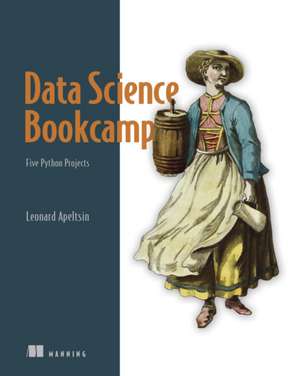
Data Science Bookcamp
Autor Leonard Apeltsinen Limba Engleză Paperback – 19 ian 2022
Actualizarea majoră pe care o aduce acest volum față de ghidurile teoretice clasice constă în transformarea procesului de învățare într-o simulare riguroasă a unui mediu de lucru real. Observăm că Leonard Apeltsin nu se limitează la prezentarea sintaxei, ci forțează cititorul să rezolve cinci proiecte complexe, cu dificultate incrementală, care testează abilitățile de gestionare a problemelor de tip „open-ended”. Ne-a atras atenția modul în care Data Science Bookcamp elimină bariera dintre mediul academic și cel profesional prin aceste exerciții practice extinse pe parcursul celor 600 de pagini. Structura este una de tip „bootcamp”, punând accent pe utilizarea limbajului Python pentru a extrage informații utile din seturi de date brute. Complementar lui Python for Data Science, volumul acoperă zona critică a rezolvării problemelor nesfârșite și ambigue, pe care titlul lui Ted Wolf o tratează la nivel de curs intensiv de bază. Apreciem în mod deosebit faptul că Manning Publications oferă, pe lângă formatul fizic, și accesul la versiunile digitale, facilitând astfel consultarea codului pe mai multe ecrane în timpul implementării proiectelor. Comparativ cu The Python Workshop - Second Edition, care explorează o gamă mai largă de utilizări ale Python (precum dezvoltarea web), lucrarea de față rămâne strict focalizată pe ingineria datelor și analiza predictivă, oferind o profunzime tehnică superioară în acest domeniu specific.
Preț: 355.07 lei
Preț vechi: 443.83 lei
-20%
Carte disponibilă
Livrare economică 02-16 noiembrie
Livrare express 17-23 octombrie pentru 106.80 lei
Specificații
ISBN-10: 1617296252
Pagini: 600
Dimensiuni: 188 x 236 x 39 mm
Greutate: 1.27 kg
Editura: Manning Publications
V-ar putea interesa
-
 Foundational Python for Data ScienceKennedy Behrman-20%Preț: 355.84 lei444.81 lei
 -
 Learn Enough Python to Be DangerousMichael Hartl-20%Preț: 238.79 lei298.49 lei
 -
 Just Enough Data Science and Machine LearningMark LevenePreț: 342.01 lei
 -
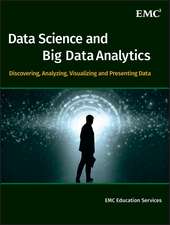 Data Science and Big Data AnalyticsEmc Education Services-20%Preț: 395.12 lei493.89 lei
 -
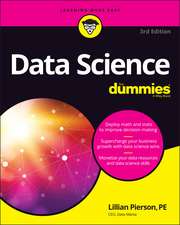 -20%Preț: 192.78 lei240.98 lei
 -
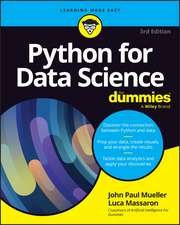 Python for Data Science For DummiesJohn Paul Mueller-20%Preț: 175.45 lei219.31 lei
 -
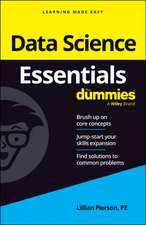 Data Science Essentials for DummiesLillian Pierson-20%Preț: 76.56 lei95.69 lei
 -
 Statistical Analysis with Python For DummiesJoseph SchmullerPreț: 197.44 lei
 -
 Data Science with Python and DaskJesse Daniel-20%Preț: 364.24 lei455.29 lei
 -
 The Well-Grounded Data AnalystDavid AsbothPreț: 338.31 lei
 -
 -37%Preț: 195.45 lei309.29 lei
 -
 Python for Data Science: A Hands-On IntroductionYuli Vasiliev-20%Preț: 290.75 lei363.45 lei
 -
 -37%Preț: 198.14 lei312.88 lei
 -
 -34%Preț: 293.51 lei447.85 lei
 -
 -36%Preț: 236.20 lei367.37 lei
 -
 -37%Preț: 186.17 lei295.57 lei
 -
 PythonMartin Czygan-23%Preț: 644.95 lei837.61 lei
 -
 Preț: 433.14 lei
 -
 The Data Science Design ManualSteven S. Skiena-20%Preț: 412.81 lei516.02 lei
 -
 Python Data ScienceChaolemen Borjigin-20%Preț: 513.94 lei642.42 lei
De ce să citești această carte
Recomandăm această carte programatorilor care doresc să treacă de la cunoștințe teoretice la o carieră de data scientist. Prin finalizarea celor cinci proiecte de anvergură, cititorul câștigă experiență practică în manipularea datelor cu Python, învățând să gândească analitic în fața unor scenarii reale de business, totul sub îndrumarea unui expert în domeniu.
Descriere scurtă
In Data Science Bookcamp you will learn:
Techniques for computing and plotting probabilities
Statistical analysis using Scipy
How to organize datasets with clustering algorithms
How to visualize complex multi-variable datasets
How to train a decision tree machine learning algorithm
In Data Science Bookcamp you’ll test and build your knowledge of Python with the kind of open-ended problems that professional data scientists work on every day. Downloadable data sets and thoroughly-explained solutions help you lock in what you’ve learned, building your confidence and making you ready for an exciting new data science career.
About the technology
A data science project has a lot of moving parts, and it takes practice and skill to get all the code, algorithms, datasets, formats, and visualizations working together harmoniously. This unique book guides you through five realistic projects, including tracking disease outbreaks from news headlines, analyzing social networks, and finding relevant patterns in ad click data.
About the book
Data Science Bookcamp doesn’t stop with surface-level theory and toy examples. As you work through each project, you’ll learn how to troubleshoot common problems like missing data, messy data, and algorithms that don’t quite fit the model you’re building. You’ll appreciate the detailed setup instructions and the fully explained solutions that highlight common failure points. In the end, you’ll be confident in your skills because you can see the results.
What's inside
Web scraping
Organize datasets with clustering algorithms
Visualize complex multi-variable datasets
Train a decision tree machine learning algorithm
About the reader
For readers who know the basics of Python. No prior data science or machine learning skills required.
About the author
Leonard Apeltsin is the Head of Data Science at Anomaly, where his team applies advanced analytics to uncover healthcare fraud, waste, and abuse.
Table of Contents
CASE STUDY 1 FINDING THE WINNING STRATEGY IN A CARD GAME
1 Computing probabilities using Python
2 Plotting probabilities using Matplotlib
3 Running random simulations in NumPy
4 Case study 1 solution
CASE STUDY 2 ASSESSING ONLINE AD CLICKS FOR SIGNIFICANCE
5 Basic probability and statistical analysis using SciPy
6 Making predictions using the central limit theorem and SciPy
7 Statistical hypothesis testing
8 Analyzing tables using Pandas
9 Case study 2 solution
CASE STUDY 3 TRACKING DISEASE OUTBREAKS USING NEWS HEADLINES
10 Clustering data into groups
11 Geographic location visualization and analysis
12 Case study 3 solution
CASE STUDY 4 USING ONLINE JOB POSTINGS TO IMPROVE YOUR DATA SCIENCE RESUME
13 Measuring text similarities
14 Dimension reduction of matrix data
15 NLP analysis of large text datasets
16 Extracting text from web pages
17 Case study 4 solution
CASE STUDY 5 PREDICTING FUTURE FRIENDSHIPS FROM SOCIAL NETWORK DATA
18 An introduction to graph theory and network analysis
19 Dynamic graph theory techniques for node ranking and social network analysis
20 Network-driven supervised machine learning
21 Training linear classifiers with logistic regression
22 Training nonlinear classifiers with decision tree techniques
23 Case study 5 solution