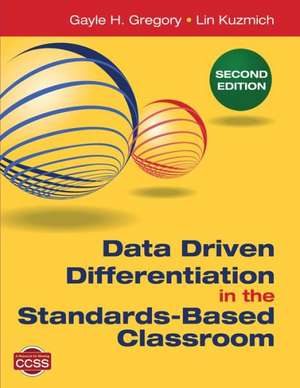
Data Driven Differentiation in the Standards-Based Classroom
Autor Gayle H. Gregory, Lin Kuzmichen Limba Engleză Paperback – 5 iun 2014
Descoperim în această a doua ediție a lucrării Data Driven Differentiation in the Standards-Based Classroom un instrument de lucru riguros, centrat pe componenta practică a instruirii diferențiate. Punctul forte al volumului este reprezentat de cele patru unități de învățare model, care demonstrează aplicarea concretă a tehnicilor de planificare, alături de o serie bogată de șabloane și grile de evaluare gata de utilizat în clasă. Structura cărții ghidează cititorul de la înțelegerea standardelor actuale până la colectarea datelor despre profilul elevului, oferind soluții pentru gestionarea diferențelor de gen, culturale și de stil de învățare. Reținem modul în care Gayle H. Gregory și Linda M. Kuzmich fac trecerea de la teorie la execuție, punând accent pe utilizarea datelor pentru pre-evaluare și evaluare formativă. Comparabil cu Differentiated Instructional Strategies în rigurozitate, acest volum este actualizat specific pentru contextul învățământului bazat pe standarde, oferind mecanisme de monitorizare a creșterii elevului la fiecare etapă a procesului educațional. Găsim aici o progresie logică: de la climatul clasei și neuroștiința învățării, până la strategii diferențiate de celebrare a succesului. În contextul operei sale, această carte rafinează conceptele prezentate în Teacher as Activator of Learning, mutând focusul de la teoriile mentalității de creștere către execuția tehnică bazată pe date. Dacă în lucrările anterioare autorii puneau bazele teoretice ale diferențierii, aici oferă infrastructura necesară pentru liderii instrucționali care trebuie să alinieze nevoile individuale ale elevilor cu cerințele curriculare stricte.
Preț: 247.53 lei
Carte disponibilă
Livrare economică 09-23 noiembrie
Livrare express 23-29 octombrie pentru 41.14 lei
Specificații
ISBN-10: 1483332497
Pagini: 248
Ilustrații: black & white illustrations, figures
Dimensiuni: 216 x 280 x 14 mm
Greutate: 0.63 kg
Ediția:2. Auflage
Editura: Corwin
Locul publicării:Thousand Oaks, United States
V-ar putea interesa
-
 Essays on PedagogyRobin AlexanderPreț: 389.18 lei
 -
 Creative Dialogue: Talk for Thinking in the ClassroomRobert FisherPreț: 342.15 lei
 -
 Teaching Skills For DummiesSue CowleyPreț: 154.73 lei
 -
 Fierce TeachingEric JensenPreț: 190.41 lei
 -
 Preț: 384.18 lei
 -
 The Book of ThunksIan GilbertPreț: 106.89 lei
 -
 Building Better Behaviour in the Early YearsChris DukesPreț: 396.20 lei
 -
 Changing Behaviour in SchoolsSue RoffeyPreț: 372.54 lei
 -
 Contemporary Issues in Learning and TeachingMargery Mcmahon-15%Preț: 596.82 lei702.15 lei
De ce să citești această carte
Această resursă este esențială pentru profesorii și coordonatorii de curriculum care doresc să transforme datele brute din evaluări în strategii pedagogice eficiente. Cititorul câștigă acces la un set complet de instrumente de planificare care facilitează succesul fiecărui elev, indiferent de nivelul de pornire. Este un ghid practic care elimină ambiguitatea din instruirea diferențiată prin exemple clare și structuri gata de implementat.
Despre autor
Gayle H. Gregory este un pedagog cu experiență vastă în toate ciclurile de învățământ, de la primar la universitar. Expertiza sa acoperă domenii precum învățarea compatibilă cu funcționarea creierului, strategiile de evaluare diferențiată și inteligența emoțională. A activat ca director de curs la Universitatea York și consultant de curriculum, publicând numeroase lucrări de referință care ajută profesorii să implementeze comunități de învățare profesională. Abordarea sa îmbină cercetarea neurologică cu practica pedagogică de la catedră.
Descriere scurtă
Cuprins
Acknowledgments
About the Authors
Introduction: Differentiating With Data for Student Growth and Achievement
What Is Our Target?
Challenges and Shifts Presented by the Common Core State Standards
Why Differentiate?
Theaters of the Mind: Learning Systems and the Brain
Learning Systems and Student Growth
Connecting Data to Learning
Using Classroom Data to Plan Differentiated Instructional Strategies
Targeting Growth for All Students
1. Collecting Data to Create a Positive Classroom Climate
Positive Classroom Connections
Assessing the Learning Environment
Using Feedback
Ritual, Respect, and Cultural History
Differentiating Classroom Climate
Differentiating Celebration and Praise
Summary
2. Collecting Data to Know the Learner
Going With the Flow
Learning Profiles
Different Learning Preferences
Different Intelligences
Student Contracting for Reflective Learning
Gender Differences
Cultural Differences
Pop Culture Differences
21st Century Learners and Technology
Reflections
3. Collecting and Using Assessment Data for Diagnostic Teaching
Diagnostic Teaching
Pre-Assessment
Formative Assessment
Final Assessment
Assessing Our Assessments
Summary
4. Curriculum Approaches for Data Driven Instruction
Curriculum Mapping and Data Driven Instruction
Standards-Based Unit Planning: Sample Math Unit on Data Analysis and Probability, "The Survey Says . . . ," Grades 3 to 5
Critical Questions for Unit Planning
Pre-Assessing the Learning Gap for Unit Planning
Chunking the Learning
Summary
Other Sample Unit Plans
The Weather Reporter, Grades K to 2
Do You Know Your Rights? Grades 5 to 8
Argumentation Writing--Convince Me! Grades 9 to 12
5. Adjustable Assignments for Differentiated Learning
Options for Differentiated Learning
Adjustable Learning Grids
Adjustable Learning Elements
Flexible Grouping
Differentiating Pairs
Differentiating Small Groups
Summary
6. Instructional Strategies That Increase Student Learning
The Art and Science of Teaching
Memory Processes and the Cognitive Learning System
Differentiating Instructional Strategies
Cooperative Group Learning
Nonlinguistic Representations
Summarizing and Note Taking
Homework and Practice
Recognizing Similarities and Differences/Using Metaphors and Analogies
Summary
7. Data Driven Lesson Planning for Differentiated Learning
Using Data for Lesson Planning
Essential Elements for Data Driven Lesson Planning
Chunking the Learning for Sample Unit Plans
Summary
Conclusion: Putting It All Together for Student Growth and Achievement
How Do We Do All This Without Running From the Room Screaming?
What Can We Learn From the Errors and Successes of the Best Teachers?
What Are the Major Changes With Common Core State Standards?
Why Is It Always About the Student?
References
Index
Notă biografică
Gayle H. Gregory is first and foremost a teacher, having experienced teaching and learning in elementary, middle, and secondary schools, community colleges, and universities. She has had extensive district-wide experience as a curriculum consultant and staff development coordinator. Gayle was principal/course director at York University for the Faculty of Education, teaching in the teacher education program.
Her areas of expertise include brain-compatible learning, differentiated instructional and assessment strategies, block scheduling, emotional intelligence, student motivation, RTI Tier One, collaborative learning, common core, renewal of secondary schools, enhancing teacher quality, coaching and mentoring, managing change, and building professional learning communities. She also a trainer for Visible Learning Plus with Corwin.
She is an author of numerous books related to educational neuroscience and differentiated instruction, assessment, and curriculum, including the following titles:
¿ Data Driven Differentiation in the Standards-Based Classroom, Second Edition (2014, with Lin Kuzmich)
¿ Differentiated Instructional Strategies: One Size Doesn't Fit All, Third Edition (2013, with Carolyn Chapman)
¿ Differentiated Instructional Strategies Professional Learning Guide: One Size Doesn't Fit All, Third Edition (2013)
¿ Differentiated Literacy Strategies for English Language Learners, Grades K-6 and Differentiated Literacy Strategies for English Language Learners, Grades 7-12 (2011, with Amy Burkman)
¿ Differentiated Instructional Strategies for the Block Schedule (2010, with Lynne E. Herndon)
¿ Student Teams That Get Results: Teaching Tools for the Differentiated Classroom (2009, with Lin Kuzmich)
¿ Teacher Teams That Get Results: 61 Strategies for Sustaining and Renewing Professional Learning Communities (2009, with Lin Kuzmich)
¿ Differentiated Instructional Strategies for Science, Grades K-8 (2009, with Elizabeth Hammerman)
¿ Differentiating Instruction With Style: Aligning Teacher and Learner Intelligences for Maximum Achievement (2005)
¿ The Activities for Differentiated Classroom series (2007, with Carolyn Chapman)
She is affiliated with organizations such as ASCD and Learning Forward. Her ASCD publication is The Motivated Brain: Improving Student Attention engagement and Perseverance (2015, with Martha Kaufeldt).
Gayle consults internationally with teachers, administrators, and staff developers.
She and her family of two daughters and two granddaughters all reside in Burlington, Ontario.
Gayle is committed to lifelong learning and professional growth for herself and others. She may be contacted at gregorygayle@netscape.net, www.gaylehgregory.com, and @gaylegregory6.