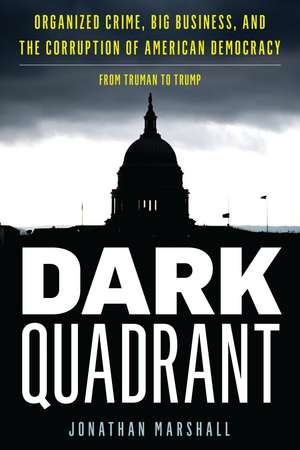
Dark Quadrant: Organized Crime, Big Business, and the Corruption of American Democracy: War and Peace Library
Autor Jonathan Marshallen Limba Engleză Hardback – 9 apr 2021
Many critiques of the Trump era contrast it with the latter half of the twentieth century, when the United States seemed governed more by statesmen than by special interests. Without denying the extraordinary vigor of President Trump's assault on traditional ethical and legal norms, Jonathan Marshall challenges the myth of a golden age of American democracy. Drawing on a host of original archival sources, he tells a shocking story of how well-protected criminals systematically organized the corruption of American national politics after World War II.
Marshall begins by tracing the extraordinary scandals of President Truman, whose political career was launched by the murderous Pendergast machine in Missouri. He goes on to highlight the role of organized crime in the rise of McCarthyism during the Cold War, the near-derailment of Vice President Johnson's political career by two mob-related scandals, and Nixon's career-long association with underworld figures. The book culminates with a discussion of Donald Trump's unique history of relations with the traditional American Mafia and newer transnational gangs like the Russian mafiya-and how the latter led to his historic impeachment by the House of Representatives.


Preț: 134.40 lei
Preț vechi: 236.05 lei
-43%
Puncte Express: 202
Carte disponibilă
Livrare economică 31 octombrie-14 noiembrie
Livrare prin curier în România Termenul estimat este afișat lângă disponibilitate.
Transport gratuit de la 400.00 lei Plată online sau ramburs, în funcție de opțiunile comenzii.
Retur gratuit în 14 zile Comandă securizată și suport în română.
Specificații
ISBN-13: 9781538142493
ISBN-10: 153814249X
Pagini: 448
Ilustrații: 2 tables
Dimensiuni: 158 x 232 x 34 mm
Greutate: 0.72 kg
Editura: Bloomsbury Publishing
Colecția Rowman & Littlefield
Seria War and Peace Library
Locul publicării:New York, United States
ISBN-10: 153814249X
Pagini: 448
Ilustrații: 2 tables
Dimensiuni: 158 x 232 x 34 mm
Greutate: 0.72 kg
Editura: Bloomsbury Publishing
Colecția Rowman & Littlefield
Seria War and Peace Library
Locul publicării:New York, United States
Cuprins
Acknowledgments
1 Introduction
Part I: The Truman Years
2 Organized Crime and Corruption Scandals in the Truman Administration
3 Anti-Communism: Mobsters, the FBI, and the China Lobby
Part II: From Ike to LBJ
4 The Dominican Connection: Dictators, Mobsters, and Caribbean Intrigues
5 The Friends of LBJ-I: Bobby Baker and the Mob
6 The Friends of LBJ-II: The Murchisons
7 Henry Crown, the Chicago Outfit, and the TFX Scandal
Part III: Richard Nixon
8 President Nixon and the Mob, 1969-1974
9 Nixon, Howard Hughes, the CIA, and the Mob: The Road to Watergate
Part IV: Conclusion
10 From Ronald Reagan to Donald Trump
Notes
Bibliography
Index
1 Introduction
Part I: The Truman Years
2 Organized Crime and Corruption Scandals in the Truman Administration
3 Anti-Communism: Mobsters, the FBI, and the China Lobby
Part II: From Ike to LBJ
4 The Dominican Connection: Dictators, Mobsters, and Caribbean Intrigues
5 The Friends of LBJ-I: Bobby Baker and the Mob
6 The Friends of LBJ-II: The Murchisons
7 Henry Crown, the Chicago Outfit, and the TFX Scandal
Part III: Richard Nixon
8 President Nixon and the Mob, 1969-1974
9 Nixon, Howard Hughes, the CIA, and the Mob: The Road to Watergate
Part IV: Conclusion
10 From Ronald Reagan to Donald Trump
Notes
Bibliography
Index
Recenzii
For those who wish to gain an intimate knowledge of the nexus among organized crime, business, and politics, Dark Quadrant is a fascinating and jolting journey into the abyss. There is something for everyone-the organized crime buff, the political scientist, and most certainly, the historian who often gives short shrift to the invisible hand. Simply put, money now and forever has and will rule American politics. The evidence marshalled here proves the case beyond any doubt.
Investigative journalist Jonathan Marshall's Dark Quadrant: Organized Crime, Big Business, and the Corruption of American Democracy might be the first serious examination of the influence of moneyed interests on our elections and on public policy. . . . Marshall's unsparing history begins with Harry Truman and works its sobering way to our own time.
Corruption in government has been a problem for as long as there have been governments. Here, journalist and historian Marshall takes a look at the problem as it applies to modern American government. Few will doubt the premise that corruption has always been a factor in American politics to some extent, but the assumption has also been that it has been kept (somewhat) in check by the assiduous effort of American law enforcement. Marshall's historical examination reveals that, since the mid-twentieth century, political corruption has been widespread thanks to the efforts of organized crime and the largesse of big business. The influence of organized crime has been largely staunched, but, in recent decades, changes in laws have allowed the proliferation of corrupt cash in American government, threatening the function of modern democracy-as readers who followed the news during recent elections have seen. Marshall's detailed analysis paints a distressing picture, but hopefully also provides a useful roadmap to the idealized future envisioned by reformers seeking to genuinely drain the swamp.
A unique blend of magma-deep research, dramatic revelations, and judicious conclusions. Marshall tells some frequently gobsmacking tales while steadily keeping his eye on the larger historical context. Readers will come away with an enlarged sense of the meaning and methods of corruption-and with a fresh perspective on what makes modern America tick.
A deeply troubling history of corruption in the United States, from Truman's presidency to Trump's. Marshall charts the 'swamp' that Trump fatuously claimed he would drain, exposes the fetid reality, and warns that it is a cancer in the heart of democracy.
Jonathan Marshall's newest couldn't be more timely. As America struggles to hold together its fragile democracy, many wonder how this could be happening. Marshall skillfully reminds us that we should have seen it all coming, showing how we have ignored the 'dark quadrant' of systemic political corruption for far too long. Everyone must read the deeply researched, sobering Dark Quadrant and decide for themselves if it's finally time to get serious about corruption in America.
Jonathan Marshall, a courageous and respected investigative historian, explores our country's corruption in the latter part of the twentieth century. He then documents how corruption became more sophisticated in the twenty-first century and, via the rise of the corrupt and dishonest Donald Trump, jeopardized America's basic institutions, as well as our fundamental rights and freedoms. . . . Marshall has given America a wake-up call.
Jonathan Marshall's new book . . . effectively challenges this narrative [of a golden age of U.S. democracy] and the myth of the 'greatest generation.' The book details the largely neglected story of how well-protected criminals organized the corruption of U.S. politics and business at a national level after World War II. . . . The presidents featured in Dark Quadrant . . . ultimately governed in the interests of their corporate and mob-linked donors, betrayed democratic values, and corroded the nation's moral fabric. With a new Cold War heating up, U.S. leaders now strive to present U.S. global leadership as necessary to save the world from Russian and Chinese autocracy. Marshall's study reminds us, however, that the United States evolved after World War II as a corrupted dollarocracy. Its rhetoric about promoting democracy around the world as such rings hollow.
Investigative journalist Jonathan Marshall's Dark Quadrant: Organized Crime, Big Business, and the Corruption of American Democracy might be the first serious examination of the influence of moneyed interests on our elections and on public policy. . . . Marshall's unsparing history begins with Harry Truman and works its sobering way to our own time.
Corruption in government has been a problem for as long as there have been governments. Here, journalist and historian Marshall takes a look at the problem as it applies to modern American government. Few will doubt the premise that corruption has always been a factor in American politics to some extent, but the assumption has also been that it has been kept (somewhat) in check by the assiduous effort of American law enforcement. Marshall's historical examination reveals that, since the mid-twentieth century, political corruption has been widespread thanks to the efforts of organized crime and the largesse of big business. The influence of organized crime has been largely staunched, but, in recent decades, changes in laws have allowed the proliferation of corrupt cash in American government, threatening the function of modern democracy-as readers who followed the news during recent elections have seen. Marshall's detailed analysis paints a distressing picture, but hopefully also provides a useful roadmap to the idealized future envisioned by reformers seeking to genuinely drain the swamp.
A unique blend of magma-deep research, dramatic revelations, and judicious conclusions. Marshall tells some frequently gobsmacking tales while steadily keeping his eye on the larger historical context. Readers will come away with an enlarged sense of the meaning and methods of corruption-and with a fresh perspective on what makes modern America tick.
A deeply troubling history of corruption in the United States, from Truman's presidency to Trump's. Marshall charts the 'swamp' that Trump fatuously claimed he would drain, exposes the fetid reality, and warns that it is a cancer in the heart of democracy.
Jonathan Marshall's newest couldn't be more timely. As America struggles to hold together its fragile democracy, many wonder how this could be happening. Marshall skillfully reminds us that we should have seen it all coming, showing how we have ignored the 'dark quadrant' of systemic political corruption for far too long. Everyone must read the deeply researched, sobering Dark Quadrant and decide for themselves if it's finally time to get serious about corruption in America.
Jonathan Marshall, a courageous and respected investigative historian, explores our country's corruption in the latter part of the twentieth century. He then documents how corruption became more sophisticated in the twenty-first century and, via the rise of the corrupt and dishonest Donald Trump, jeopardized America's basic institutions, as well as our fundamental rights and freedoms. . . . Marshall has given America a wake-up call.
Jonathan Marshall's new book . . . effectively challenges this narrative [of a golden age of U.S. democracy] and the myth of the 'greatest generation.' The book details the largely neglected story of how well-protected criminals organized the corruption of U.S. politics and business at a national level after World War II. . . . The presidents featured in Dark Quadrant . . . ultimately governed in the interests of their corporate and mob-linked donors, betrayed democratic values, and corroded the nation's moral fabric. With a new Cold War heating up, U.S. leaders now strive to present U.S. global leadership as necessary to save the world from Russian and Chinese autocracy. Marshall's study reminds us, however, that the United States evolved after World War II as a corrupted dollarocracy. Its rhetoric about promoting democracy around the world as such rings hollow.