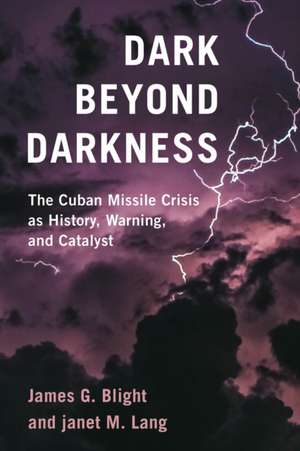
Dark Beyond Darkness: The Cuban Missile Crisis as History, Warning, and Catalyst
Autor James G. Blight, janet M. Langen Limba Engleză Hardback – 22 dec 2017
Their history also comes with a warning: we are currently at risk not only of Armageddon-fast, in a war between superpowers, but Armageddon-in-Slow-Motion (the result a climate catastrophe following a regional nuclear war), and from Armageddon, Oops! (a conflict sparked by an accident, which is misinterpreted, and ends in nuclear war). Drawing on the insights of poets, musicians and novelists, as well as climate scientists and agronomists, they show the terrible risk we run by refusing to abolish nuclear weapons.
Preț: 265.31 lei
Preț vechi: 338.67 lei
-22%
Puncte Express: 398
Carte disponibilă
Livrare economică 29 octombrie-12 noiembrie
Livrare prin curier în România Termenul estimat este afișat lângă disponibilitate.
Transport gratuit de la 400.00 lei Plată online sau ramburs, în funcție de opțiunile comenzii.
Retur gratuit în 14 zile Comandă securizată și suport în română.
Specificații
ISBN-13: 9781538101995
ISBN-10: 1538101998
Pagini: 290
Ilustrații: 4 BW Photos, 1 Graphs
Dimensiuni: 158 x 232 x 32 mm
Greutate: 0.58 kg
Editura: Bloomsbury Publishing
Colecția Rowman & Littlefield
Locul publicării:New York, United States
ISBN-10: 1538101998
Pagini: 290
Ilustrații: 4 BW Photos, 1 Graphs
Dimensiuni: 158 x 232 x 32 mm
Greutate: 0.58 kg
Editura: Bloomsbury Publishing
Colecția Rowman & Littlefield
Locul publicării:New York, United States
Cuprins
Authors' Note
Prologue:Armageddon in Retrospect: On the Road with Papa & The Boy
Part One: Dark
Chapter 1: Shit (Almost) Happened in October 1962: The Struggle to Avoid Armageddon Involves the Struggle of Memory Against Forgetting.
Chapter 2: The Bullshit: Bad Guys Threaten; Good Guys Stand Firm; Good Guys Win; Bad Guys Lose; the Little Guy Doesn't Matter; JFK's Moxie Prevails.
Chapter 3: The Truth: Big Guys Ignore Little Guy; Feeling Doomed, Little Guy Throws Caution to the Wind, Starts Shooting, and Asks Big Friend to Nuke the U.S.; Armageddon Nearly Occurs.
Part Two: Darker
Chapter 4: Habitable History: How Hilary Mantel's Wolf Hall Became the Template for a "WABAC" Machine for the Cuban Missile Crisis.
Chapter 5: Be Robert McNamara: Bringing the Abolition Message Home, With (and Without) "Maximum Bob"
Chapter 6: Be Fidel Castro: A Leader at the Hinge of the World.
Part Three: Darkest
Chapter 7: Armageddon in Slow Motion: More Bullshit and Truth about Avoiding Armageddon in the 21st Century.
Chapter 8: Armageddon Oops! Nuclear War via Mechanical and/or Human Screw-up.
Chapter 9: On The Road Again Via Climate Catastrophe: From a 19th Century Volcanic Eruption to a 21st Century Nuclear Winter.
Part Four: The Darkness Defined and Defied (via the Lessons of the Cuban Missile Crisis)
Chapter 10: Be Anybody WABAC: Empathy, Not Sympathy is the Key.
Chapter 11: Darkness Visible:Findings, Takeaways and Imperatives of the Cuban Missile Crisis
Chapter 12: The Black Saturday Manifesto: Abolishing Nuclear Weapons One Anniversary Per Year, For As Long As It Takes.
Epilogue:Show Us Your Darkness: Warning Given! Warning Received?
Acknowledgments
Permissions & Credits
Notes
Index
About the Authors
Prologue:Armageddon in Retrospect: On the Road with Papa & The Boy
Part One: Dark
Chapter 1: Shit (Almost) Happened in October 1962: The Struggle to Avoid Armageddon Involves the Struggle of Memory Against Forgetting.
Chapter 2: The Bullshit: Bad Guys Threaten; Good Guys Stand Firm; Good Guys Win; Bad Guys Lose; the Little Guy Doesn't Matter; JFK's Moxie Prevails.
Chapter 3: The Truth: Big Guys Ignore Little Guy; Feeling Doomed, Little Guy Throws Caution to the Wind, Starts Shooting, and Asks Big Friend to Nuke the U.S.; Armageddon Nearly Occurs.
Part Two: Darker
Chapter 4: Habitable History: How Hilary Mantel's Wolf Hall Became the Template for a "WABAC" Machine for the Cuban Missile Crisis.
Chapter 5: Be Robert McNamara: Bringing the Abolition Message Home, With (and Without) "Maximum Bob"
Chapter 6: Be Fidel Castro: A Leader at the Hinge of the World.
Part Three: Darkest
Chapter 7: Armageddon in Slow Motion: More Bullshit and Truth about Avoiding Armageddon in the 21st Century.
Chapter 8: Armageddon Oops! Nuclear War via Mechanical and/or Human Screw-up.
Chapter 9: On The Road Again Via Climate Catastrophe: From a 19th Century Volcanic Eruption to a 21st Century Nuclear Winter.
Part Four: The Darkness Defined and Defied (via the Lessons of the Cuban Missile Crisis)
Chapter 10: Be Anybody WABAC: Empathy, Not Sympathy is the Key.
Chapter 11: Darkness Visible:Findings, Takeaways and Imperatives of the Cuban Missile Crisis
Chapter 12: The Black Saturday Manifesto: Abolishing Nuclear Weapons One Anniversary Per Year, For As Long As It Takes.
Epilogue:Show Us Your Darkness: Warning Given! Warning Received?
Acknowledgments
Permissions & Credits
Notes
Index
About the Authors
Recenzii
Blight and Lang, married scholars at the University of Waterloo, use the Cuban missile crisis as a case study in developing a long argument against nuclear weapons. The authors, decades-long advocates of nuclear disarmament, advance their premise here by presenting the U.S.-Soviet crisis over missiles in Cuba from the perspective of the Cuban government. They argue that the Cuban leadership's role in the crisis has been underappreciated and that Cuban leadership was very willing to sacrifice Cuba to provoke a nuclear exchange between the U.S. and the U.S.S.R. It is an interesting thesis.... [T]his book will be of interest to those drawn to the anti-nuclear movement and those looking for an uncommon viewpoint on the event.
"This book builds in intensity, from the first shocking page to the last sober reflection. The sensory material about the impact of the U.S. low-level flights over Cuba is perfect, brilliant. These are true war sounds. It's great to have this dimension in the book. Reading this book in the age of Trump is truly horrifying: the IMAX version of the most dangerous moment in recorded history."
"Jim Blight and janet Lang place Cuba at the center of the Cuban missile crisis in this chilling wake-up call about our complacency with nuclear weapons."
"Jim Blight and janet Lang have crafted another indispensable book proving that the lessons of the Cuban missile crisis may hold the key to our survival - if only we learn them. Using history, psychology, and their gifted imaginations, they force us to recognize how precarious is a world with nuclear weapons, and how stunningly lucky we have been to avoid catastrophe. This book encourages us to rid the world of nuclear weapons, and terrifies us with an unforgettable understanding of what happens if we don't."
"The authors do two rare things for the reader: they entertain in this genuinely funny book about Armageddon (!), while they inform deeply. Blight and Lang gracefully weave a fabric of scholarship, literature, and memory to provide not merely the facts of this haunting episode, but the broader meaning of nuclear annihilation-which is what was at stake in 1962. They draw on cultural artifacts-everything from Lord Byron to Cormac McCarthy-to brace and explore the meaning of the nuclear peril. And that is a peril, they convincingly remind us, which remains with us today and demands new attention. They challenge millennials to recognize the danger and act to abolish nuclear weapons. Dark Beyond Darkness should be atop every citizen's reading list."
"This groundbreaking book addresses the challenge of understanding those in small countries-those who in 1962, and still today, have been on the dark edge of annihilation by nuclear or conventional means."
"This book builds in intensity, from the first shocking page to the last sober reflection. The sensory material about the impact of the U.S. low-level flights over Cuba is perfect, brilliant. These are true war sounds. It's great to have this dimension in the book. Reading this book in the age of Trump is truly horrifying: the IMAX version of the most dangerous moment in recorded history."
"Jim Blight and janet Lang place Cuba at the center of the Cuban missile crisis in this chilling wake-up call about our complacency with nuclear weapons."
"Jim Blight and janet Lang have crafted another indispensable book proving that the lessons of the Cuban missile crisis may hold the key to our survival - if only we learn them. Using history, psychology, and their gifted imaginations, they force us to recognize how precarious is a world with nuclear weapons, and how stunningly lucky we have been to avoid catastrophe. This book encourages us to rid the world of nuclear weapons, and terrifies us with an unforgettable understanding of what happens if we don't."
"The authors do two rare things for the reader: they entertain in this genuinely funny book about Armageddon (!), while they inform deeply. Blight and Lang gracefully weave a fabric of scholarship, literature, and memory to provide not merely the facts of this haunting episode, but the broader meaning of nuclear annihilation-which is what was at stake in 1962. They draw on cultural artifacts-everything from Lord Byron to Cormac McCarthy-to brace and explore the meaning of the nuclear peril. And that is a peril, they convincingly remind us, which remains with us today and demands new attention. They challenge millennials to recognize the danger and act to abolish nuclear weapons. Dark Beyond Darkness should be atop every citizen's reading list."
"This groundbreaking book addresses the challenge of understanding those in small countries-those who in 1962, and still today, have been on the dark edge of annihilation by nuclear or conventional means."