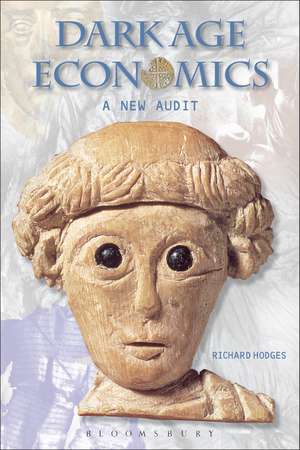
Dark Age Economics: A New Audit
Autor Dr Richard Hodgesen Limba Engleză Paperback – 5 iul 2012
Ranging across western Europe, with an emphasis upon the role of the Church as an agent of change, the author advances a new thesis about the shift from the consumption economies of Antiquity to the emphasis on production in the Middle Ages.
Preț: 197.11 lei
Preț vechi: 239.87 lei
-18%
Puncte Express: 296
Carte tipărită la comandă
Livrare economică 06-20 iunie
Specificații
ISBN-13: 9780715636794
ISBN-10: 0715636790
Pagini: 176
Ilustrații: c. 25 bw illus
Dimensiuni: 156 x 234 x 15 mm
Greutate: 0.3 kg
Ediția:New.
Editura: Bloomsbury Publishing
Colecția Bristol Classical Press
Locul publicării:London, United Kingdom
ISBN-10: 0715636790
Pagini: 176
Ilustrații: c. 25 bw illus
Dimensiuni: 156 x 234 x 15 mm
Greutate: 0.3 kg
Ediția:New.
Editura: Bloomsbury Publishing
Colecția Bristol Classical Press
Locul publicării:London, United Kingdom
Cuprins
Preface
The Debate
Models
The 'Original Affluent Society'?
Of 'Mushroom Cities' and 'Mouseholes'
New Directions
Bibliography
Index
The Debate
Models
The 'Original Affluent Society'?
Of 'Mushroom Cities' and 'Mouseholes'
New Directions
Bibliography
Index
Recenzii
Richard Hodges' Dark Age Economics: The Origins of Towns and Trade (1982) was one of the most influential and provocative works on early medieval archaeology in the latter part of the 20th century . . . Dark Age Economics: A New Audit sees Hodges survey the impact of his work and summarise his current thinking on the issues that it raised. For each, it makes for a stimulating and thought-provoking read . . . [The book] provides an extraordinary wealth of ideas for further cogitation; like its predecessor, it deserves to be read and discussed extensively.
This is a distinguished archaeologist's overview of the current assessment of the early medieval economy since his Dark Age Economics: The Origins of Towns and Trade AD 600-1000 (1982) . Perhaps of greatest interest to readers will be Chapter 4, which reports recent scholarship on monasteries, focusing on San Vincenzo at Volturno in Beneventum as it adjusted its production to its changing environment in the eighth and ninth centuries.
This is a distinguished archaeologist's overview of the current assessment of the early medieval economy since his Dark Age Economics: The Origins of Towns and Trade AD 600-1000 (1982) . Perhaps of greatest interest to readers will be Chapter 4, which reports recent scholarship on monasteries, focusing on San Vincenzo at Volturno in Beneventum as it adjusted its production to its changing environment in the eighth and ninth centuries.