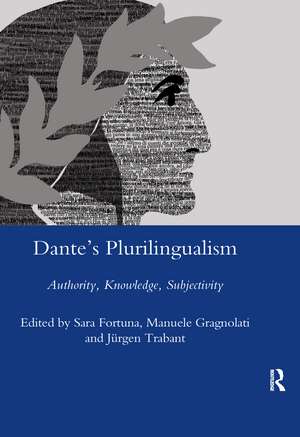
Dante's Plurilingualism: Authority, Knowledge, Subjectivity
Autor Sara Fortunaen Limba Engleză Paperback – 30 iun 2020
Preț: 370.81 lei
Preț vechi: 417.02 lei
-11%
Puncte Express: 556
Carte indisponibilă temporar
Doresc să fiu notificat când acest titlu va fi disponibil:
Se trimite...
Specificații
ISBN-13: 9780367602444
ISBN-10: 036760244X
Pagini: 308
Dimensiuni: 170 x 247 x 20 mm
Greutate: 0.57 kg
Ediția:1
Editura: Taylor & Francis
Colecția Routledge
Locul publicării:Oxford, United Kingdom
ISBN-10: 036760244X
Pagini: 308
Dimensiuni: 170 x 247 x 20 mm
Greutate: 0.57 kg
Ediția:1
Editura: Taylor & Francis
Colecția Routledge
Locul publicării:Oxford, United Kingdom
Cuprins
Introduction: Dante’s Plurilingualism Part I: Theories 1. Mother Tongues in the Middle Ages and Dante 2. Millena variatio: Overcoming the Horror of Variation 3. Man as a Speaking and Political Animal: A Political Reading of Dante's De vulgari eloquentia 4. Volgare e latino nella storia di Dante 5. Le idee linguistiche di Dante e il naturalismo fiorentino-toscano del Cinquecento 6. Aristotele e Dante, filosofi della variabilità linguistica Part II: Authority 7. The Roots of Dante's Plurilingualism: 'Hybridity' and Language in the Vita nova 8. Language as a Mirror of the Soul: Guilt and Punishment in Dante's Concept of Language 9. Plurilingualism sub specie aeternitatis and the Strategies of a Minority Author Part III: Subjectivity 10. Dante's Blind Spot (Inferno XVI-XVII) 11. Trasmutabile per tutte guise': Dante in the Comedy 12. Is Ulysses Queer? The Subject of Greek Love in Inferno XV and XXVI 13. Lost for Words: Recuperating Melancholy Subjectivity in Dante's Eden 14. (In-)Corporeality, Language, Performance in Dante's Vita Nuova and Commedia 15. Dante After Wittgenstein: 'Aspetto', Language, and Subjectivity from Convivio to Paradiso
Descriere
This book focuses on Dante's central problem of the plurality of languages. It discusses the medieval theories of language and explores Dante's original place with respect to them by focusing on the concepts of universality, unity, variability and plurality.