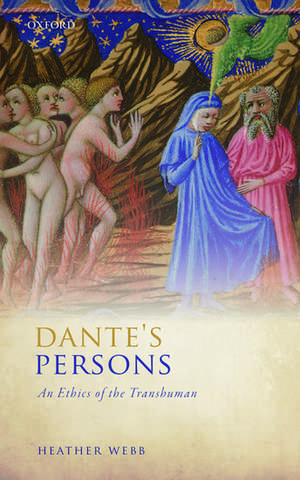
Dante's Persons: An Ethics of the Transhuman
Autor Heather Webben Limba Engleză Hardback – 12 mai 2016
Preț: 724.02 lei
Preț vechi: 1047.04 lei
-31%
Puncte Express: 1086
Carte tipărită la comandă
Livrare economică 10-15 decembrie
Livrare prin curier în România Termenul estimat este afișat lângă disponibilitate.
Transport gratuit pentru acest produs Plată online sau ramburs, în funcție de opțiunile comenzii.
Retur gratuit în 14 zile Comandă securizată și suport în română.
Specificații
ISBN-13: 9780198733485
ISBN-10: 0198733488
Pagini: 238
Ilustrații: 8 black-and-white halftones
Dimensiuni: 142 x 223 x 19 mm
Greutate: 0.4 kg
Editura: OUP OXFORD
Colecția OUP Oxford
Locul publicării:Oxford, United Kingdom
ISBN-10: 0198733488
Pagini: 238
Ilustrații: 8 black-and-white halftones
Dimensiuni: 142 x 223 x 19 mm
Greutate: 0.4 kg
Editura: OUP OXFORD
Colecția OUP Oxford
Locul publicării:Oxford, United Kingdom
V-ar putea interesa
-
 FALL POPPIES PBHeather WebbPreț: 117.59 lei
 -
 Last Christmas in ParisHazel GaynorPreț: 111.40 lei
 -
 Selected PoemsPaul Celan-18%Preț: 76.67 lei93.89 lei
 -
 Dante, Artist of GestureHeather Webb-31%Preț: 557.41 lei802.90 lei
 -
 William Carlos Williams and the Diagnostics of CultureBrian A. Bremen-32%Preț: 1322.01 lei1940.08 lei
 -
 -32%Preț: 963.46 lei1410.28 lei
 -
 Dante's "Vita Nova"Zygmunt G. BaranskiPreț: 535.65 lei
 -
 Preț: 250.79 lei
 -
 The Medieval HeartHeather Webb-5%Preț: 635.74 lei669.20 lei
 -
 Shakespeare's Imagined PersonsP. Murray-15%Preț: 667.01 lei784.71 lei
 -
 A. E. HousmanNorman PagePreț: 386.05 lei
 -
 Shakespeare and CarnivalR. Knowles-18%Preț: 981.18 lei1196.57 lei
 -
 The World of Emily DickinsonPolly LongsworthPreț: 143.72 lei
 -
 Preț: 265.07 lei
 -
 Preț: 262.70 lei
 -
 Lectura Dantis – Inferno – A Canto–by–Canto Commentary (Paper)Allen MandelbaumPreț: 308.28 lei
 -
 Preț: 341.21 lei
 -
 Cavafy's AlexandriaEdmund KeeleyPreț: 420.28 lei
 -
 Preț: 456.91 lei
 -
 Desert Voices: Bedouin Women's Poetry in Saudi ArabiaMoneera Al-Ghadeer-26%Preț: 207.35 lei278.88 lei
 -
 Larkin, Ideology and Critical ViolenceJ. OsbornePreț: 405.89 lei
 -
 The Eighteenth-Century British Verse EpistleB. OvertonPreț: 406.28 lei
 -
 The Next Ship HomeHeather WebbPreț: 102.82 lei
 -
 Queens of LondonHeather WebbPreț: 100.70 lei
 -
 Vertical Readings in Dante's ComedyGeorge CorbettPreț: 231.98 lei
Recenzii
As Girard said of all great literature, The Divine Comedy exceeds any theory about it. Dante's Persons approaches the poem in that spirit, showing yet another side of its inexhaustible riches through insightful readings of many more passages than this review has touched on, and along the way pressing further than any account I know of into its enduring value for those interested in mimetic theory.
Webb unobtrusively works some of the weightiest traditions of thinking about persons, as well as some of the newer knowledge from cognitive psychology and the neurosciences, into her probes of Dante's incomparable phenomenological exploration of the experience of being a person. She sounds its hardly fathomable pitfalls and seemingly impossible demands and marvelous discoveries.
This is a sincere and heartfelt reading of the Commedia, not as a distant historical document, but as a guide for life, a guide to interpersonal relations, a guide to recognizing the personhood of the other.
Heather Webb confronts the issue from a modern theological perspective ... the case she makes has more force than many interpretations that hold religion at a historical distance.
The strength of this work is in its readability and comprehensiveness. Through her enjoyable prose, Webb introduces innovative ideas built on existing scholarship and drawn from multiple sources and disciplines (ranging from critical theory and theology to ethics, history, and art). ... it provides readers with a deep understanding of Dante's concept of persona and encourages further reflections about the relevance of human dignity.
Offering insightful and fresh readings of two pairs of characters -- Franscesca and Paolo in Inferno and Statius and Virgil in Purgatorio -- Dantes Persons is provocative, erudite, and best suited to advanced scholars.
Webb is right, I think, to contend that Dante also presents what he might have called the anagogic vision of blessedness and that he anchors that vision in the face that knows itself in the love of God that it sees and shares with others...after all, there is no consequence, only simultaneity. In the end, Webb's claim that the substance of personhood is ethical seems to me a canny way to recast the function of the intellect, which is the faculty that oversees one's relation to oneself, and the will, which is the faculty that oversees one's relations with others...they are one, joined by an act that corresponds to the ardent regarding that joins the blessed in heaven, itself a reflection of the Holy Spirit, which, breathing love between them, joins the Father and the Son. For this, as for many other reasons, Dante's Persons is a valuable, mind-expanding contribution to our understanding of human and divine relations in the Comedy.
Webb unobtrusively works some of the weightiest traditions of thinking about persons, as well as some of the newer knowledge from cognitive psychology and the neurosciences, into her probes of Dante's incomparable phenomenological exploration of the experience of being a person. She sounds its hardly fathomable pitfalls and seemingly impossible demands and marvelous discoveries.
This is a sincere and heartfelt reading of the Commedia, not as a distant historical document, but as a guide for life, a guide to interpersonal relations, a guide to recognizing the personhood of the other.
Heather Webb confronts the issue from a modern theological perspective ... the case she makes has more force than many interpretations that hold religion at a historical distance.
The strength of this work is in its readability and comprehensiveness. Through her enjoyable prose, Webb introduces innovative ideas built on existing scholarship and drawn from multiple sources and disciplines (ranging from critical theory and theology to ethics, history, and art). ... it provides readers with a deep understanding of Dante's concept of persona and encourages further reflections about the relevance of human dignity.
Offering insightful and fresh readings of two pairs of characters -- Franscesca and Paolo in Inferno and Statius and Virgil in Purgatorio -- Dantes Persons is provocative, erudite, and best suited to advanced scholars.
Webb is right, I think, to contend that Dante also presents what he might have called the anagogic vision of blessedness and that he anchors that vision in the face that knows itself in the love of God that it sees and shares with others...after all, there is no consequence, only simultaneity. In the end, Webb's claim that the substance of personhood is ethical seems to me a canny way to recast the function of the intellect, which is the faculty that oversees one's relation to oneself, and the will, which is the faculty that oversees one's relations with others...they are one, joined by an act that corresponds to the ardent regarding that joins the blessed in heaven, itself a reflection of the Holy Spirit, which, breathing love between them, joins the Father and the Son. For this, as for many other reasons, Dante's Persons is a valuable, mind-expanding contribution to our understanding of human and divine relations in the Comedy.
Notă biografică
Heather Webb received her PhD from Stanford University in 2004. She taught at The Ohio State University from 2004 to 2012 as an Assistant Professor and an Associate Professor. She has been a University Lecturer at the University of Cambridge since 2012 and a Fellow of Selwyn College since 2013. She is the author of The Medieval Heart (Yale University Press, 2010). She is co-editor, with George Corbett, of Vertical Readings in Dante's Comedy (Open Book Publishers, 2015-2017).
Cuprins
- I: Introduction
- II: Gestural Persons
- III: Recognizing Suffering Persons
- IV: Ardent Attention
- V: Transhuman Faces