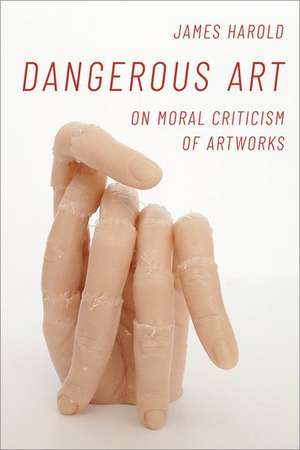
Dangerous Art: On Moral Criticisms of Artwork: Thinking Art
Autor James Harolden Limba Engleză Hardback – 22 oct 2020



Preț: 445.94 lei
Preț vechi: 622.65 lei
-28%
Puncte Express: 669
Carte tipărită la comandă
Livrare economică 04-09 decembrie
Livrare prin curier în România Termenul estimat este afișat lângă disponibilitate.
Transport gratuit pentru acest produs Plată online sau ramburs, în funcție de opțiunile comenzii.
Retur gratuit în 14 zile Comandă securizată și suport în română.
Specificații
ISBN-13: 9780197519769
ISBN-10: 0197519768
Pagini: 208
Dimensiuni: 236 x 157 x 20 mm
Greutate: 0.45 kg
Editura: Oxford University Press
Colecția OUP USA
Seria Thinking Art
Locul publicării:New York, United States
ISBN-10: 0197519768
Pagini: 208
Dimensiuni: 236 x 157 x 20 mm
Greutate: 0.45 kg
Editura: Oxford University Press
Colecția OUP USA
Seria Thinking Art
Locul publicării:New York, United States
Recenzii
Summing Up: Recommended. Lower-division undergraduates through faculty; professionals.
...Harold's book is essential reading for anyone interested in the moral criticism of art. Harold's approach to the issue is notable...
...Harold's book is essential reading for anyone interested in the moral criticism of art. Harold's approach to the issue is notable...
Notă biografică
James Harold is Professor of Philosophy at Mount Holyoke College.
Cuprins
- Preface
- Acknowledgements
- Introduction
- Chapter 1: Morality and art: a little history
- I. Music in classical China
- II. Poetry in ancient Greece
- III. Art and propaganda in the Harlem Renaissance
- IV. Conclusions
- Chapter 2: Does art change us?
- I. The prima facie case that art can change us morally
- II. Evaluating art, but not its effects
- III. Further considerations
- Chapter 3: Wicked artists
- I. Objections
- II. Moral taint
- III. Artworks and moral communities
- IV. Related questions: virtuous artists, immoral production, and identity injustice
- Chapter 4: Art and moral understanding
- I. Propositional moral knowledge
- II. Going to art and seeking knowledge
- III. Non-propositional accounts of moral learning
- IV. Corrupting our moral understanding
- V. Conclusions
- Chapter 5: Artworks and persons
- Chapter 6: From relativism to expressivism
- I. Value scheme relativism
- II. Locke's value theory
- III. Feeling and value
- IV. The expressivist's answer to the relativist
- Chapter 7: An expressivist account of the differences between aesthetic and moral judgments
- I. Candidate differences between aesthetics and morality
- II. Two further differences
- III. Moral particularism
- IV. Conclusion
- Chapter 8: Should moral judgments affect aesthetic judgments (or the other way around)?
- I. Defining autonomism
- II. The no-error argument
- III. Four objections
- IV. Conclusion
- Chapter 9: Conclusions and illustrations
- I. Moral criticisms of groups of works
- II. Moral criticisms of individual works
- III. A little history, revisited