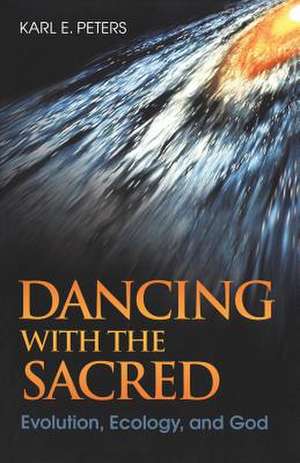
Dancing with the Sacred: Evolution, Ecology, and God
Autor Karl Petersen Limba Engleză Paperback – aug 2002
Preț: 177.60 lei
Preț vechi: 213.48 lei
-17%
Puncte Express: 266
Carte tipărită la comandă
Livrare economică 04-18 decembrie
Livrare prin curier în România Termenul estimat este afișat lângă disponibilitate.
Transport gratuit de la 400.00 lei Plată online sau ramburs, în funcție de opțiunile comenzii.
Retur gratuit în 14 zile Comandă securizată și suport în română.
Specificații
ISBN-13: 9781563383939
ISBN-10: 1563383934
Pagini: 182
Dimensiuni: 138 x 216 x 10 mm
Greutate: 0.26 kg
Ediția:New.
Editura: Bloomsbury Publishing
Colecția Trinity Press International
Locul publicării:New York, United States
ISBN-10: 1563383934
Pagini: 182
Dimensiuni: 138 x 216 x 10 mm
Greutate: 0.26 kg
Ediția:New.
Editura: Bloomsbury Publishing
Colecția Trinity Press International
Locul publicării:New York, United States
V-ar putea interesa
-
 Why Beliefs Matter: Reflections on the Nature of ScienceE. Brian Davies-16%Preț: 187.51 lei224.52 lei
 -
 Religion as a Social Determinant of Public HealthEllen L. Idler-28%Preț: 506.84 lei700.87 lei
 -
 -30%Preț: 995.36 lei1425.91 lei
 -
 -22%Preț: 364.69 lei464.91 lei
 -
 Preț: 108.16 lei
 -
 All in the Mind?Peter ClarkePreț: 86.09 lei
 -
 The Lost World of Adam and EveJohn H. WaltonPreț: 134.91 lei
 -
 True Scientists, True FaithR J BerryPreț: 97.48 lei
 -
 Preț: 130.36 lei
 -
 In Praise of Darwin: George Romanes and the Evolution of a Darwinian BelieverProfessor J. David Pleins-23%Preț: 260.32 lei337.21 lei
Recenzii
"Karl Peters, culminating a lifetime of leadership in the science and religion dialogue, offers a rare combination of both theory and practice, the learned and the existential. Here is an exemplary role model of participating in the creative process--what Peters metaphorically calls 'dancing with the sacred.' He creatively couples evolution with ecology, nature with culture. His insights are especially of value when, with his "naturalistic God," the music is in a minor key."
"Dancing with the Sacred" is a sensitive analysis of the problems facing humankind in the realm of ecology and evolution. It is written from a religious perspective but in a way that should be of interest and appeal to all. Highly recommended!" Michael Ruse Lucyle T Werkmeister Professor of Philosophy, Florida State University
"There is much wisdom in this book. In a careful thought-through and beautifully written presentation of a faith-stance for today, Karl Peters shows the profoundly religious meaning of modern scientific understandings of ordering of life on Earth into which we humans must fit ourselves. As he makes clear in his careful exposition - in straightforward non-technical language dotted with good illustrations and striking quotations - thinking of God as the creativity manifest throughout the cosmos (instead of as the Creator apart from the world) opens up resources for rich religious reflection and profound experience; and it provides significant guidance for life in today's world. Highly recommended for college classes and for others interested in the issues the modern sciences pose for religion." Gordon D. Kaufman Mallinckrodt Professor of Divinity, Emeritus Harvard University
"In a much-awaited volume, Karl Peters has given us an insightful, sensitive, and personal look at evolution and the nature of Fod. The result is a milestone--a highly readable and warmly recommended work that reveals a lifetime of thought and action at the interface of religion and science." Eric Chaisson author of The Rise to Complexity in Nature
"In this inspiring theological meditation, Peters, a former editor of Zygon, proposes a fresh version of theological naturalism. He is trying to find out what credibility religion and theology might have in an age of science, especially now that the ideas of cosmic and biological evolution have become preeminent...Even though some readers will question aspects of Peter's theological naturalism, they will be deeply moved and challenged by this informed, disarming book."--John F. Haught, Theology Today, April 2003
"Here is a readable, engaging presentation of the author's naturalistic theism, a version of the burgeoning theological movement known frequently as Religious Naturalism..The religious traditions supply the wisdom by which to live--emotional and moral orientation and ritual. Moreover, since our cultural life is a continual process of innovation and selection, religious praxis and theory are continually winnowed by our scientific understanding..Karl Peters is a religious naturalist for all seasons."--Noreen Herzfeld, for Theology and Science, Vol. 1, No. 1, 2003
"This is an engaging and readable statement of a naturalsitic theism, a version of the emerging theological movement often known as Religious Naturalism. It is the fruit of a lifelong wrestling with the issue of being religious in a scientific and pluralistic age by the co-editor of Zygon: Journal of Science and Religion. It deals with how to live responsibly and find meaning in today's world. The writing is given extra intensity by the disclosures of the author's grif and triumph as he lived through his wife's terminal illness...This book is one of the clearest, intellectually rigorous and emotionally compelling statements of religious naturalism...Karl Peters is a religious naturalist for all seasons."--Harvard Square Library Review- Volume 1, October 2003
"Page after page revelas the sense of struggle, and ultimately the sense of joy, that Peters has experienced in terms of making sense of his own life and that of friends he observes...Peters shows in sensitive detail why supernatural treatments have not worked for him, why he thinks (accurately, in my opinion) that they have not worked for large segments of modern persons, and most importantly how a more natural approach can and does work...I will predict that many readers will find this book to be the most exciting thing they have ever read."--Michael Cananaugh, President of the Institute on Religion in a Age of Science, for Harvard Square Library Review, Volume 1, October 2003.
"Karl Peters uses an approach that might be called "natural theism" to write about "evolution, ecology and God" in Dancing with the Sacred (2002). Taking ideas from evolutionary biology, process theology and world religions, Peters proposes a new way of thinking about God- as a creative process, or a dance - and describes a new model of God that is based on the Darwinian ideas of random variation and natural selection."--Science & Theology News, February 2004
"Taking ideas from evolutionary biology, process theology and world religions, Peters proposes a new way of thinking about God--as a creative process, or a dance--and describes a new model of God that is based on the Darwinian ideas of random variation and natural selection." -Science & Theology News
"Peters argues convincingly that it is important for us to think not only of our "phenomenal self" (the self that appears to our senses) but also of our "big self"-the selves that reflect our interrelation with the rest of the evolutionary process. Dancing with the Sacred has much to commend it...Peters's theology here provides a[n]...intriguing account and exciting way of thinking about God. I find Peter's emphasis on our "big self" as an expression of our interconnectedness with culture and cosmos to be a helpful antidote to an excessive individualism and anthropocentrism that can endanger not only the environment but people in need as well. Peters's recognition that the creative process includes suffering and death saves his "big-self" view from being unduly romantic...Dancing with the Sacred is helpful, stimulating, and challenging, especially for those concerned for the intersection of faith and science."
"In this book, Karl Peters makes his greatest contribution to the growing body of important work that goes by the name "Empirical Theology". Both his method and his wisdom deserve careful attention. Most of all, he offers an honest theology, and in so doing he speaks to the hearts, as well as the minds, of his readers."--Philip Hefner, Professor of Systematic Theology Emeritus, Lutheran School of Theology at Chicago, July 8, 2002
"If you wish to understand the mind of a scholar who has spent his life teaching and writing on naturalist theism in a scientific age, this is your book....This clearly written book offers the finest personal exposition of the school of naturalist theism that dominates the writings of many contemporary intellectuals and scientists." -James F. Salmon, S. J., Theological Studies, Vol. 65, No. 3, September 2004
"Dancing with the Sacred" is a sensitive analysis of the problems facing humankind in the realm of ecology and evolution. It is written from a religious perspective but in a way that should be of interest and appeal to all. Highly recommended!" Michael Ruse Lucyle T Werkmeister Professor of Philosophy, Florida State University
"There is much wisdom in this book. In a careful thought-through and beautifully written presentation of a faith-stance for today, Karl Peters shows the profoundly religious meaning of modern scientific understandings of ordering of life on Earth into which we humans must fit ourselves. As he makes clear in his careful exposition - in straightforward non-technical language dotted with good illustrations and striking quotations - thinking of God as the creativity manifest throughout the cosmos (instead of as the Creator apart from the world) opens up resources for rich religious reflection and profound experience; and it provides significant guidance for life in today's world. Highly recommended for college classes and for others interested in the issues the modern sciences pose for religion." Gordon D. Kaufman Mallinckrodt Professor of Divinity, Emeritus Harvard University
"In a much-awaited volume, Karl Peters has given us an insightful, sensitive, and personal look at evolution and the nature of Fod. The result is a milestone--a highly readable and warmly recommended work that reveals a lifetime of thought and action at the interface of religion and science." Eric Chaisson author of The Rise to Complexity in Nature
"In this inspiring theological meditation, Peters, a former editor of Zygon, proposes a fresh version of theological naturalism. He is trying to find out what credibility religion and theology might have in an age of science, especially now that the ideas of cosmic and biological evolution have become preeminent...Even though some readers will question aspects of Peter's theological naturalism, they will be deeply moved and challenged by this informed, disarming book."--John F. Haught, Theology Today, April 2003
"Here is a readable, engaging presentation of the author's naturalistic theism, a version of the burgeoning theological movement known frequently as Religious Naturalism..The religious traditions supply the wisdom by which to live--emotional and moral orientation and ritual. Moreover, since our cultural life is a continual process of innovation and selection, religious praxis and theory are continually winnowed by our scientific understanding..Karl Peters is a religious naturalist for all seasons."--Noreen Herzfeld, for Theology and Science, Vol. 1, No. 1, 2003
"This is an engaging and readable statement of a naturalsitic theism, a version of the emerging theological movement often known as Religious Naturalism. It is the fruit of a lifelong wrestling with the issue of being religious in a scientific and pluralistic age by the co-editor of Zygon: Journal of Science and Religion. It deals with how to live responsibly and find meaning in today's world. The writing is given extra intensity by the disclosures of the author's grif and triumph as he lived through his wife's terminal illness...This book is one of the clearest, intellectually rigorous and emotionally compelling statements of religious naturalism...Karl Peters is a religious naturalist for all seasons."--Harvard Square Library Review- Volume 1, October 2003
"Page after page revelas the sense of struggle, and ultimately the sense of joy, that Peters has experienced in terms of making sense of his own life and that of friends he observes...Peters shows in sensitive detail why supernatural treatments have not worked for him, why he thinks (accurately, in my opinion) that they have not worked for large segments of modern persons, and most importantly how a more natural approach can and does work...I will predict that many readers will find this book to be the most exciting thing they have ever read."--Michael Cananaugh, President of the Institute on Religion in a Age of Science, for Harvard Square Library Review, Volume 1, October 2003.
"Karl Peters uses an approach that might be called "natural theism" to write about "evolution, ecology and God" in Dancing with the Sacred (2002). Taking ideas from evolutionary biology, process theology and world religions, Peters proposes a new way of thinking about God- as a creative process, or a dance - and describes a new model of God that is based on the Darwinian ideas of random variation and natural selection."--Science & Theology News, February 2004
"Taking ideas from evolutionary biology, process theology and world religions, Peters proposes a new way of thinking about God--as a creative process, or a dance--and describes a new model of God that is based on the Darwinian ideas of random variation and natural selection." -Science & Theology News
"Peters argues convincingly that it is important for us to think not only of our "phenomenal self" (the self that appears to our senses) but also of our "big self"-the selves that reflect our interrelation with the rest of the evolutionary process. Dancing with the Sacred has much to commend it...Peters's theology here provides a[n]...intriguing account and exciting way of thinking about God. I find Peter's emphasis on our "big self" as an expression of our interconnectedness with culture and cosmos to be a helpful antidote to an excessive individualism and anthropocentrism that can endanger not only the environment but people in need as well. Peters's recognition that the creative process includes suffering and death saves his "big-self" view from being unduly romantic...Dancing with the Sacred is helpful, stimulating, and challenging, especially for those concerned for the intersection of faith and science."
"In this book, Karl Peters makes his greatest contribution to the growing body of important work that goes by the name "Empirical Theology". Both his method and his wisdom deserve careful attention. Most of all, he offers an honest theology, and in so doing he speaks to the hearts, as well as the minds, of his readers."--Philip Hefner, Professor of Systematic Theology Emeritus, Lutheran School of Theology at Chicago, July 8, 2002
"If you wish to understand the mind of a scholar who has spent his life teaching and writing on naturalist theism in a scientific age, this is your book....This clearly written book offers the finest personal exposition of the school of naturalist theism that dominates the writings of many contemporary intellectuals and scientists." -James F. Salmon, S. J., Theological Studies, Vol. 65, No. 3, September 2004