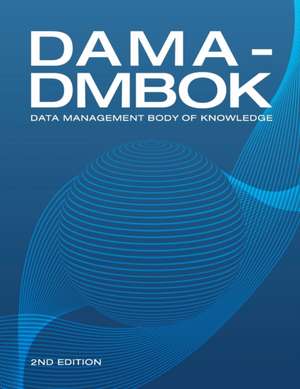
DAMA-DMBOK
Autor Dama Internationalen Limba Engleză Paperback – 4 iul 2017
Resursele terminologice și cadrele de lucru propuse în DAMA-DMBOK constituie fundamentul tehnic pentru orice profesionist care dorește să standardizeze procesele informaționale dintr-o organizație. Remarcăm faptul că acest volum nu este doar un ghid teoretic, ci o referință practică de 590 de pagini care oferă un vocabular comun și un set de principii directoare pentru zonele funcționale ale managementului datelor. Observăm o abordare riguroasă a ciclului de viață al datelor, de la modelare și design la securitate și stocare. Pe linia practică a lucrării DAMA-DMBOK Guide de Susan Earley, dar cu focus pe complexitatea și valoarea economică a datelor în contextul actual, ediția a doua (DMBOK2) rafinează conceptele introduse anterior. Dacă Navigating the Labyrinth de Laura Sebastian-Coleman este un instrument de comunicare pentru executivi, DAMA-DMBOK rămâne manualul de inginerie și execuție, detaliind metrici și tehnici specifice. Această lucrare reprezintă pilonul central al publicațiilor Dama International, fiind superioară edițiilor localizate, precum DAMA-DMBOK, Italian Version, prin universalitatea și actualitatea normelor propuse pentru piața globală. Structura este una modulară, abordând teme critice precum guvernanța datelor, interoperabilitatea și managementul calității. În contextul tehnologiilor emergente, includerea capitolelor despre Big Data și Data Science oferă o perspectivă tehnică necesară pentru integrarea noilor fluxuri de lucru în arhitecturile enterprise deja existente. Este, în esență, echivalentul standardelor PMBOK pentru managementul de proiect, oferind rigoarea necesară pentru a transforma datele brute în active strategice.
Preț: 512.84 lei
Preț vechi: 641.05 lei
-20%
Carte disponibilă
Livrare economică 06-20 noiembrie
Specificații
ISBN-10: 1634622340
Pagini: 590
Dimensiuni: 216 x 280 x 32 mm
Greutate: 1.45 kg
Ediția:Second
Editura: Technics Publications
V-ar putea interesa
-
 Building Forms & ReportsF. Mark Schiavone-20%Preț: 129.30 lei161.63 lei
 -
 Building VBA AppsF. Mark Schiavone-20%Preț: 128.47 lei160.59 lei
 -
 MySQL Replication SimplifiedSribatsa Das-20%Preț: 93.06 lei116.33 lei
 -
 -20%Preț: 407.48 lei509.35 lei
 -
 The dBASE Book, Vol 1Ken Mayer-20%Preț: 328.18 lei410.22 lei
 -
 The dBASE Book, Vol 2Ken Mayer-20%Preț: 265.66 lei332.07 lei
 -
 -20%Preț: 226.54 lei283.17 lei
 -
 SQL Database for BeginnersMR Martin Holzke-20%Preț: 142.41 lei178.02 lei
 -
 Optimizacion SQL En OracleJavier Morales Carreras-20%Preț: 170.78 lei213.49 lei
 -
 Oracle PL/SQL Programming FundamentalsDjoni Darmawikarta-20%Preț: 56.58 lei70.72 lei
 -
 PL/SQL in IBM DB2Djoni Darmawikarta-20%Preț: 39.41 lei49.25 lei
 -
 IBM DB2 SQL for BeginnersDjoni Darmawikarta-20%Preț: 51.70 lei64.62 lei
 -
 Oracle SQL Performance Tuning and OptimizationKevin Meade-20%Preț: 239.64 lei299.54 lei
 -
 Use Libreoffice BaseMR Thomas Ecclestone-20%Preț: 85.18 lei106.48 lei
 -
 Keeping Up with Oracle Database 12c Multitenant - Book OneMR Robert G. Freeman-20%Preț: 64.37 lei80.46 lei
 -
 Microsoft Access 2013 EssentialsEdward C. Jones-20%Preț: 75.81 lei94.77 lei
 -
 SQL for BeginnersPreston Prescott-20%Preț: 77.94 lei97.42 lei
 -
 Learning the Basics in No TimeDjoni Darmawikarta-20%Preț: 81.03 lei101.29 lei
 -
 -20%Preț: 42.38 lei52.97 lei
 -
 Data AnalyticsJames Smith-20%Preț: 51.96 lei64.95 lei
 -
 Data AnalyticsNix, Cedric-20%Preț: 68.89 lei86.11 lei
 -
 Oracle SQL and PL/SQL Performance TuningNiraj Gupta-20%Preț: 51.27 lei64.09 lei
 -
 MySQL 8 CookbookKarthik Appigatla-20%Preț: 301.81 lei377.27 lei
 -
 Mastering PostgreSQL 10Hans-Jurgen Schonig-20%Preț: 247.00 lei308.75 lei
 -
 Relational Databases for Agile DevelopersBallard, Ron-20%Preț: 139.22 lei174.03 lei
 -
 DockerPrice, Miles-20%Preț: 83.83 lei104.78 lei
 -
 Concise Oracle Database for People with No TimeMyint, Billy Aung-20%Preț: 34.39 lei42.98 lei
 -
 -20%Preț: 43.05 lei53.81 lei
 -
 -20%Preț: 44.10 lei55.12 lei
 -
 -20%Preț: 44.42 lei55.53 lei
De ce să citești această carte
Recomandăm acest volum specialiștilor IT și managerilor de date care au nevoie de un cadru de lucru standardizat. Cititorul câștigă o înțelegere profundă a arhitecturii și guvernanței datelor, primind instrumente concrete (metrici, roluri, livrabile) pentru a implementa un management al datelor matur și eficient. Este resursa esențială pentru oricine pregătește o certificare profesională în domeniu sau dorește să alinieze deciziile tehnologice cu nevoile de business.