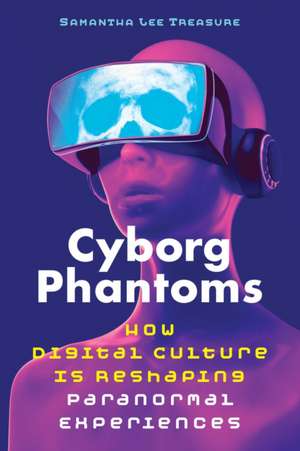
Cyborg Phantoms: How Digital Culture Is Reshaping Paranormal Experiences
Autor Samantha Lee Treasureen Limba Engleză Paperback – 11 feb 2027
• Describes paranormal and hallucinatory experiences specific to our time, such as apparitions of cartoons, celebrities, screens, and phantom cell phone ringing
• Uncovers the cyborg anthropology of the supernatural, by exploring the effects of television, video games and the internet on paranormal encounters
• Examines the neurological effects of screens on our psyches as well as medical and scientific explanations for Screen Age phantom encounters
Just as society and technology evolve, so do our anomalous experiences. In this book, Samantha Lee Treasure examines accounts of paranormal phenomena and hallucinations from around the world that illustrate the effects our screens and media-saturated environments have on both the psyche and the supernatural.
Drawing on interviews and scientific studies, the author describes encounters with cartoon and celebrity apparitions, phantom screens, phantom cell phone ringing, and immersion in technological psychedelic realms. Looking at a variety of states of consciousness, she details accounts of sleep paralysis, animated entities in out-of-body experiences (OBEs), and the intensely vivid hallucinations known as Charles Bonnet syndrome, which can occur among people with vision loss.
Treasure explores the effects of television, video games, and the internet on paranormal encounters, including induced synesthesia and the intentional and unintentional creation of thoughtforms and tulpas. She looks at the development of “shifting”—the use of altered states to enter fictional worlds—as well as possible scientific explanations for Screen Age phantom encounters and phantom perceptions.
By tracing how paranormal experiences have changed over the past 150 years, Treasure helps us imagine how future cultural changes will continue to reshape our perceptions of the paranormal and how to maintain our sense of self along the way.
Preț: 90.53 lei
Preț vechi: 168.61 lei
-46% Precomandă
Puncte Express: 136
Carte nepublicată încă
Livrare prin curier în România Precomanda se expediază când titlul devine disponibil.
Transport gratuit de la 400.00 lei Plată online sau ramburs, în funcție de opțiunile comenzii.
Retur gratuit în 14 zile Comandă securizată și suport în română.
Doresc să fiu notificat când acest titlu va fi disponibil:
Se trimite...
Specificații
ISBN-13: 9781644114650
ISBN-10: 1644114658
Pagini: 288
Dimensiuni: 152 x 229 mm
Greutate: 0.27 kg
Editura: Inner Traditions/Bear & Company
Colecția Park Street Press
ISBN-10: 1644114658
Pagini: 288
Dimensiuni: 152 x 229 mm
Greutate: 0.27 kg
Editura: Inner Traditions/Bear & Company
Colecția Park Street Press
Notă biografică
Samantha Lee Treasure holds a master’s degree in medical anthropology from SOAS University of London. She is a member of the Society for Psychical Research and an affiliate of the University of Virginia Division of Perceptual Studies as a volunteer researcher. She lives on Geoje Island, South Korea.
Extras
1
Ghosts of the User Interface
A cyborg is a cybernetic organism, a hybrid of machine and organism, a creature of social reality as well as a creature of fiction.
Donna Haraway, A Cyborg Manifesto
Since the development of the screen interface that brought us an influx of imagery and ideas at a pace unknown to our ancestors, our lives have been dominated by these windows into other worlds. We use them to wake up in the morning, to buy food, to meet loved ones, to close an important deal, to “switch off” our brains at the end of a busy day, and to fall asleep. And now they’re spilling over into our spiritual and paranormal worlds.
In the autumn of 2016, I was traveling alone on a train from Leeds to London when two men in business suits boarded the carriage. One slumped on the seat two rows ahead and promptly fell asleep, while his colleague took the seat directly across the table from me. As the train thundered along the rails, I continued typing up my notes from the previous day’s Society for Psychical Research (SPR) conference before grabbing a hot drink from the onboard café.
When I settled back into my seat, the passenger across from me struck up a conversation, introducing himself as Mr. Tanaka, the employee of a Japanese printer company on his first business trip abroad. With formalities out of the way, he pointed to my laptop and asked what I was writing. I mentioned the parapsychology conference. Having lived in Japan—and being a ghost geek—I had luckily retained the word for parapsychology in Japanese: choushinrigaku. His eyes lit up, and what he shared next would set me on the path to writing this book.
Mr. Tanaka had been cycling on a busy road one day when a car struck him, knocking him unconscious. When he regained consciousness on the side of the road, he stood up and immediately a light projected a screen from his chest, hovering in mid-air a few meters in front of him, as if his body itself were a film projector. On the screen were hundreds of people, visible from the shoulders up—family, friends, and others—who he had known throughout his life. Although he didn’t know what to make of this surreal vision, it inspired him to start meditating in the hopes of encountering the same spiritual force again. But as of the day we met on the train, he had yet to have another similar experience.
As I made my way home from the station that night, I couldn’t help but replay Mr. Tanaka’s story in my mind. I’d heard of ghostly visitations when ill or injured, but this was the first time I’d heard of such a visit being mediated by a screen. Mr. Tanaka’s phantom video call made me reconsider other media-related accounts, like my brother’s Alf encounter, as well as an experience that I’d heard from our mom growing up (see chapter 11). Although these both occurred in an otherwise classic paranormal context, I dismissed them at the time as they diverged wildly from my idea of hauntings.
A year after meeting Mr. Tanaka, I came across another phantom screen account in Celia Green and Charles McCreery’s book Apparitions (first published in 1975). Two days after returning home on leave from Germany, the witness was staying at his sister’s house, sharing the spare room with his son. After settling into bed at around 11:30 p.m., he switched the lamp off, leaving only a thread of light under the door. In his own words, he wrote,
Suddenly a patch of light appeared on the wall in the form of a square, like a T.V. screen, but the light was natural looking, a golden sunlight, and in this square was a busy street scene, in fact, it was crowded with people, all on the move, in the foreground a young man wearing a dark suit, coat undone and one hand in his trouser-pocket, hatless, and as he walked briskly along, he looked slightly backwards and downwards where my son lay sleeping, and he kept looking until he walked out of sight, and as he did so, the picture gradually faded, and the room was dark again.
By the time the experience ended, the witness was sitting up wide-eyed, alert, and still fixated on the wall. He had never seen anything like it before or since, and he assured the authors that he “had not been watching television earlier.”
Later on, I found another account of a phantom screen in a letter from 1982 in the SPR archives at the Cambridge University Library, although this conjuring was deliberate (and maybe a little dubious):
In search of first hand reports of poltergeist phenomena (the subject of my degree project) I visited the Southsea Temple of Spiritualism and spoke at length with a “spiritual medium” (for a small fee of £1.00!) who informed me that that coming night she would, with some friends, be holding a séance at which “the spirits” would “build a television set entirely out of ectoplasm” through which departed relatives of those present could manifest themselves. I made absolutely sure that she was indeed claiming that this T.V. set was constituted entirely out of “ectoplasm.”
The student asked if he could attend this sitting, but the psychic replied that he was “not prepared,” promising instead to let him sit in on subsequent séances.
In the late nineteenth century, long before the invention of television, Oliver Fox wrote about seeing a kind of phantom projector in his book Astral Projection. He had spent much of his childhood bedridden with illness, during which he often experienced vivid hallucinations, many of which were unsettling or frightening. But one in particular stood out for its whimsical charm.
A funny little fellow dressed in brown—rather like those garden gnomes—clambered up on to my bed and smiled at me reassuringly. He pointed to a screen that stood near, and then a bright circle of light appeared which is now suggestive of a magic-lantern, although I do not think I had ever seen one at the time this happened. In this circle, from misty beginnings, gradually evolved an enchanting, vividly coloured picture of a farmyard scene. And everything was moving. Horses, cows, dogs, etc. All moving; ducks swimming on the pond; and a woman in a blue dress waving her hand from the doorway of the farmhouse. Presently the picture faded away, the gnome vanished with a farewell nod and smile, and I was left apparently awake and greatly wondering. The chief point of interest here is the circle of light; for in the years to come I was to see it again, though without the gnome and the farmyard scene, and other investigators have noted a similar phenomenon.
In this account, the gnome was putting on a show for Fox, much like the leprechaun in Jack Hunter’s foreword; but this time, it was using a medium that was just becoming popular elsewhere: the magic-lantern, our precursor to the television.
Phantom screens also appear in reports of alien encounters. In a collection of humanoid encounter cases curated by Albert S. Rosales is a striking report that took place in Donetsk, Ukraine, in 1990. A woman named Irina described an opalescent cloud that materialized in her bedroom, which “appeared to have a ‘screen’ on it:”
At first the screen was blank but the image of an alien being appeared on it. He seemed to have stepped into the screen. The alien was completely unearthly looking, with a large round head, long neck, and sloping shoulders. He resembled an aged man with brown bumpy skin. His eyes were very big, slanted, darkish and without pupils. He wore a long folded cloth, of a slightly bluish tint. He stood and gazed upon her fixedly. Afraid, she asked him “mentally” who he was but received no answer. After 20 minutes the screen blacked out.
Later, Irina witnessed another screen appear in her room, this time showing images of technological equipment.
In these cases, the phantom screens displayed beings of various sorts: human, nature spirit, and alien. The scenes were often two-way, with the observer also being observed by the beings on screen. In each case, they were all described, by the person reporting the event, in great detail (this becomes important in the next chapter). It’s worth noting that these examples happened at times of upheaval or change: after an accident, while on military leave, during illness, and during the Ukrainian revolution. Times like these can lead to sleep disruption, which can cause vivid experiences of hypnagogia, hypnopompia, sleep paralysis, false awakenings, or OBEs, especially around bedtime, which is when most of these experiences occurred (see chapter 11 for more on this).
Whatever the cause of these experiences, what are we to make of the fact that these entities showed up on phantom screens? This can sometimes only be a matter of description—had the incident with the man on military leave occurred in the era before television, he might have likened the patch of light (described as “natural light” or “sunlight”) to an open door or window instead of a TV screen. In another age, such a phantom interface might have been described as a phantasmagoria show or floating crystal ball, whatever device or tool we would expect to give us a glimpse into the nonordinary world.
In a more recent story set in our current computer-dominated society, this window into another world is described as a computer glitch. A subreddit called r/Glitch_in_the_Matrix acts as a modern-day campfire for modern ghost—or should I say glitch?—stories like these. Inspired by the film The Matrix, this genre considers ghosts and apporting objects evidence that we’re living in a simulation. Modern additions to paranormal phenomena in this category include disappearing gas stations and visions of grids, pixelated overlays, or flickering distortions. These inconsistencies are the glitches of this simulated reality, like the ones we encounter with our not-so-trusty computers.
Ghosts of the User Interface
A cyborg is a cybernetic organism, a hybrid of machine and organism, a creature of social reality as well as a creature of fiction.
Donna Haraway, A Cyborg Manifesto
Since the development of the screen interface that brought us an influx of imagery and ideas at a pace unknown to our ancestors, our lives have been dominated by these windows into other worlds. We use them to wake up in the morning, to buy food, to meet loved ones, to close an important deal, to “switch off” our brains at the end of a busy day, and to fall asleep. And now they’re spilling over into our spiritual and paranormal worlds.
In the autumn of 2016, I was traveling alone on a train from Leeds to London when two men in business suits boarded the carriage. One slumped on the seat two rows ahead and promptly fell asleep, while his colleague took the seat directly across the table from me. As the train thundered along the rails, I continued typing up my notes from the previous day’s Society for Psychical Research (SPR) conference before grabbing a hot drink from the onboard café.
When I settled back into my seat, the passenger across from me struck up a conversation, introducing himself as Mr. Tanaka, the employee of a Japanese printer company on his first business trip abroad. With formalities out of the way, he pointed to my laptop and asked what I was writing. I mentioned the parapsychology conference. Having lived in Japan—and being a ghost geek—I had luckily retained the word for parapsychology in Japanese: choushinrigaku. His eyes lit up, and what he shared next would set me on the path to writing this book.
Mr. Tanaka had been cycling on a busy road one day when a car struck him, knocking him unconscious. When he regained consciousness on the side of the road, he stood up and immediately a light projected a screen from his chest, hovering in mid-air a few meters in front of him, as if his body itself were a film projector. On the screen were hundreds of people, visible from the shoulders up—family, friends, and others—who he had known throughout his life. Although he didn’t know what to make of this surreal vision, it inspired him to start meditating in the hopes of encountering the same spiritual force again. But as of the day we met on the train, he had yet to have another similar experience.
As I made my way home from the station that night, I couldn’t help but replay Mr. Tanaka’s story in my mind. I’d heard of ghostly visitations when ill or injured, but this was the first time I’d heard of such a visit being mediated by a screen. Mr. Tanaka’s phantom video call made me reconsider other media-related accounts, like my brother’s Alf encounter, as well as an experience that I’d heard from our mom growing up (see chapter 11). Although these both occurred in an otherwise classic paranormal context, I dismissed them at the time as they diverged wildly from my idea of hauntings.
A year after meeting Mr. Tanaka, I came across another phantom screen account in Celia Green and Charles McCreery’s book Apparitions (first published in 1975). Two days after returning home on leave from Germany, the witness was staying at his sister’s house, sharing the spare room with his son. After settling into bed at around 11:30 p.m., he switched the lamp off, leaving only a thread of light under the door. In his own words, he wrote,
Suddenly a patch of light appeared on the wall in the form of a square, like a T.V. screen, but the light was natural looking, a golden sunlight, and in this square was a busy street scene, in fact, it was crowded with people, all on the move, in the foreground a young man wearing a dark suit, coat undone and one hand in his trouser-pocket, hatless, and as he walked briskly along, he looked slightly backwards and downwards where my son lay sleeping, and he kept looking until he walked out of sight, and as he did so, the picture gradually faded, and the room was dark again.
By the time the experience ended, the witness was sitting up wide-eyed, alert, and still fixated on the wall. He had never seen anything like it before or since, and he assured the authors that he “had not been watching television earlier.”
Later on, I found another account of a phantom screen in a letter from 1982 in the SPR archives at the Cambridge University Library, although this conjuring was deliberate (and maybe a little dubious):
In search of first hand reports of poltergeist phenomena (the subject of my degree project) I visited the Southsea Temple of Spiritualism and spoke at length with a “spiritual medium” (for a small fee of £1.00!) who informed me that that coming night she would, with some friends, be holding a séance at which “the spirits” would “build a television set entirely out of ectoplasm” through which departed relatives of those present could manifest themselves. I made absolutely sure that she was indeed claiming that this T.V. set was constituted entirely out of “ectoplasm.”
The student asked if he could attend this sitting, but the psychic replied that he was “not prepared,” promising instead to let him sit in on subsequent séances.
In the late nineteenth century, long before the invention of television, Oliver Fox wrote about seeing a kind of phantom projector in his book Astral Projection. He had spent much of his childhood bedridden with illness, during which he often experienced vivid hallucinations, many of which were unsettling or frightening. But one in particular stood out for its whimsical charm.
A funny little fellow dressed in brown—rather like those garden gnomes—clambered up on to my bed and smiled at me reassuringly. He pointed to a screen that stood near, and then a bright circle of light appeared which is now suggestive of a magic-lantern, although I do not think I had ever seen one at the time this happened. In this circle, from misty beginnings, gradually evolved an enchanting, vividly coloured picture of a farmyard scene. And everything was moving. Horses, cows, dogs, etc. All moving; ducks swimming on the pond; and a woman in a blue dress waving her hand from the doorway of the farmhouse. Presently the picture faded away, the gnome vanished with a farewell nod and smile, and I was left apparently awake and greatly wondering. The chief point of interest here is the circle of light; for in the years to come I was to see it again, though without the gnome and the farmyard scene, and other investigators have noted a similar phenomenon.
In this account, the gnome was putting on a show for Fox, much like the leprechaun in Jack Hunter’s foreword; but this time, it was using a medium that was just becoming popular elsewhere: the magic-lantern, our precursor to the television.
Phantom screens also appear in reports of alien encounters. In a collection of humanoid encounter cases curated by Albert S. Rosales is a striking report that took place in Donetsk, Ukraine, in 1990. A woman named Irina described an opalescent cloud that materialized in her bedroom, which “appeared to have a ‘screen’ on it:”
At first the screen was blank but the image of an alien being appeared on it. He seemed to have stepped into the screen. The alien was completely unearthly looking, with a large round head, long neck, and sloping shoulders. He resembled an aged man with brown bumpy skin. His eyes were very big, slanted, darkish and without pupils. He wore a long folded cloth, of a slightly bluish tint. He stood and gazed upon her fixedly. Afraid, she asked him “mentally” who he was but received no answer. After 20 minutes the screen blacked out.
Later, Irina witnessed another screen appear in her room, this time showing images of technological equipment.
In these cases, the phantom screens displayed beings of various sorts: human, nature spirit, and alien. The scenes were often two-way, with the observer also being observed by the beings on screen. In each case, they were all described, by the person reporting the event, in great detail (this becomes important in the next chapter). It’s worth noting that these examples happened at times of upheaval or change: after an accident, while on military leave, during illness, and during the Ukrainian revolution. Times like these can lead to sleep disruption, which can cause vivid experiences of hypnagogia, hypnopompia, sleep paralysis, false awakenings, or OBEs, especially around bedtime, which is when most of these experiences occurred (see chapter 11 for more on this).
Whatever the cause of these experiences, what are we to make of the fact that these entities showed up on phantom screens? This can sometimes only be a matter of description—had the incident with the man on military leave occurred in the era before television, he might have likened the patch of light (described as “natural light” or “sunlight”) to an open door or window instead of a TV screen. In another age, such a phantom interface might have been described as a phantasmagoria show or floating crystal ball, whatever device or tool we would expect to give us a glimpse into the nonordinary world.
In a more recent story set in our current computer-dominated society, this window into another world is described as a computer glitch. A subreddit called r/Glitch_in_the_Matrix acts as a modern-day campfire for modern ghost—or should I say glitch?—stories like these. Inspired by the film The Matrix, this genre considers ghosts and apporting objects evidence that we’re living in a simulation. Modern additions to paranormal phenomena in this category include disappearing gas stations and visions of grids, pixelated overlays, or flickering distortions. These inconsistencies are the glitches of this simulated reality, like the ones we encounter with our not-so-trusty computers.
Cuprins
Foreword by Jack Hunter, PhD
Prologue My Brother’s Outer Space Jaunts with Alf
Introduction The Gray Area Between Hallucinations and Paranormal Phenomena
Part 1
Introducing Media Phantoms
One Ghosts of the User Interface
When Our Technology Crosses Over
Two Spectral Interference
Not Now, We’re Watching Something
Three Familiar Faces from the Media
The Quaker Oat Man, Bugs Bunny, and Elvis
Four Arcade Perceptions
(Video) Game Transfer Phenomena
Five Hearing the Phantom Ring
Hallucinations of Phone Vibrations and Ringing
Part 2
Senses Shaped by Media
Six “Theater of the Mind”
Charles Bonnet Syndrome
Seven Smell-O-Vision
Phantosmia, Parosmia, and Synesthesia
Eight On “a Spectrum of Spooky”
Visits from Scissor Man and Marilyn Monroe
Part 3
Altered States of Consciousness
Nine Zombies in Pajamas
Bitten by the TV Dream Virus
Ten The Television Trance
The Flickering Glow, Hypnosis, and the Brain
Eleven On the Edge of Sleep
When Dreams Spill into the Waking World
Twelve My Sleep Paralysis Demon Is Tech-Savvy Too
Intrusive Broadcasts from the Borderlands
Thirteen Screens as Astral Portals
The Rise of Cartoonified Ethereal Planes
Part 4
Hauntings and Aliens in the Screen Age
Fourteen Invasion of the Puppet People
Screen Memories, Thoughtforms, and Mimics
Fifteen Revisiting Alf
Haunted People Syndrome, Aliens, and OBEs
Sixteen From Shadows to Greys
How Horror Movies Shape Alien Sightings
Part 5
Intentional Practices
Seventeen Lucy in the Sky with Diodes
Visions on LSD, Salvia, and DMT
Eighteen Reality Shifting
Teens Journey to Their Comfort Characters
Nineteen Falling in Love with My Tulpa
Manifesting Characters into Our World
Part 6
Unintentional Effects of Media and Technology Use
Twenty Experiential Crossing
When Phantoms Escape from Books and Paintings
Twenty-One You Are What You Watch
Alters, Advertising, and the Hyperreal Self
Epilogue Stories Shape Our Consciousness
Acknowledgments
Notes
Bibliography
Index
Prologue My Brother’s Outer Space Jaunts with Alf
Introduction The Gray Area Between Hallucinations and Paranormal Phenomena
Part 1
Introducing Media Phantoms
One Ghosts of the User Interface
When Our Technology Crosses Over
Two Spectral Interference
Not Now, We’re Watching Something
Three Familiar Faces from the Media
The Quaker Oat Man, Bugs Bunny, and Elvis
Four Arcade Perceptions
(Video) Game Transfer Phenomena
Five Hearing the Phantom Ring
Hallucinations of Phone Vibrations and Ringing
Part 2
Senses Shaped by Media
Six “Theater of the Mind”
Charles Bonnet Syndrome
Seven Smell-O-Vision
Phantosmia, Parosmia, and Synesthesia
Eight On “a Spectrum of Spooky”
Visits from Scissor Man and Marilyn Monroe
Part 3
Altered States of Consciousness
Nine Zombies in Pajamas
Bitten by the TV Dream Virus
Ten The Television Trance
The Flickering Glow, Hypnosis, and the Brain
Eleven On the Edge of Sleep
When Dreams Spill into the Waking World
Twelve My Sleep Paralysis Demon Is Tech-Savvy Too
Intrusive Broadcasts from the Borderlands
Thirteen Screens as Astral Portals
The Rise of Cartoonified Ethereal Planes
Part 4
Hauntings and Aliens in the Screen Age
Fourteen Invasion of the Puppet People
Screen Memories, Thoughtforms, and Mimics
Fifteen Revisiting Alf
Haunted People Syndrome, Aliens, and OBEs
Sixteen From Shadows to Greys
How Horror Movies Shape Alien Sightings
Part 5
Intentional Practices
Seventeen Lucy in the Sky with Diodes
Visions on LSD, Salvia, and DMT
Eighteen Reality Shifting
Teens Journey to Their Comfort Characters
Nineteen Falling in Love with My Tulpa
Manifesting Characters into Our World
Part 6
Unintentional Effects of Media and Technology Use
Twenty Experiential Crossing
When Phantoms Escape from Books and Paintings
Twenty-One You Are What You Watch
Alters, Advertising, and the Hyperreal Self
Epilogue Stories Shape Our Consciousness
Acknowledgments
Notes
Bibliography
Index
Recenzii
“Ranging through the decades and listening sympathetically to contemporary experiencers, Samantha Lee Treasure explores the many ways that technological media—with its screens, cartoons, and virtual fictions—has come to shape the margins and shadowlands of the psyche. Moving deftly between culture and consciousness, science and the occult, Treasure has produced a cyborg anthropology of media phantoms that is rich, insightful, and disturbingly fun.”
“I sometimes use the phrase ‘comic-book strange.’ This book is comic-book strange, literally. These pages constitute a careful and utterly joyful look at the paranormal shaped by technology, film, television, pop culture, and now AI. Get ready for a ride. This is it. Told ya’ so.”
“Some of our deepest assumptions about reality are so familiar that we rarely notice them. Samantha Lee Treasure invites us to examine experiences that challenge those assumptions, reminding us that questioning them is often less an ideological act than an attentional one. Cyborg Phantoms is a thoughtful exploration of questions that may be more open than we imagine.”
“As the encroaching tide of novelty reshapes our world, paranormal experiences evolve in tandem. Samantha Lee Treasure’s exploration of the uneasy intersection of modernity, technology, and the supernatural reveals what endures within us even as everything else changes.”
“Samantha Treasure opens a mysterious, mostly unnoticed world in which each of us dwell—much as we are encompassed by air, light, consciousness, and dream. This world represents the active engagements among personal unconscious, collective unconscious, and subconscious mind phases that give rise to ghosts, phantoms, and a cornucopia of characters as winsome and periodically dire as anything created by Walt Disney, Charles Addams, or Max Fleischer, father of Betty Boop.”
“A sweeping exploration of technology, human consciousness, and the paranormal. Samantha Lee Treasure understands that technology is much broader than we recognize it to be. Technology itself is human consciousness—in material form—and our new technologies are yet another step forward in understanding the paranormal and our place in this cosmic mystery.”
“In Cyborg Phantoms, Samantha Lee Treasure explores the paranormal in a fresh and fascinating way. Her intriguing premise is that our screens, stories, and digital lives are shaping the very form that modern hauntings and strange encounters take, just as previous generations were shaped by their world. Yet her book doesn’t dismiss such encounters as purely in the mind. Instead, her work on the interplay between the human lens and reality leaves room for a potentially supernatural realm, meaning her findings will intrigue both believers and skeptics.”
“Ghosts and aliens are your grandparents’ paranormal experiences! Cyborg Phantoms is an intriguing study in how today’s brushes with the supernatural can include cell phones, popular cartoon characters, and yes, even Sesame Street puppets. Hallucinations? Shapeshifters? Tulpas? Or something else that today’s technology has opened our eyes to see? Today, we’ve fused ourselves with the internet. Cyborg Phantoms gives us a fascinating anthropological study of how this cyborg modernity has influenced the classic paranormal experience.”
“I sometimes use the phrase ‘comic-book strange.’ This book is comic-book strange, literally. These pages constitute a careful and utterly joyful look at the paranormal shaped by technology, film, television, pop culture, and now AI. Get ready for a ride. This is it. Told ya’ so.”
“Some of our deepest assumptions about reality are so familiar that we rarely notice them. Samantha Lee Treasure invites us to examine experiences that challenge those assumptions, reminding us that questioning them is often less an ideological act than an attentional one. Cyborg Phantoms is a thoughtful exploration of questions that may be more open than we imagine.”
“As the encroaching tide of novelty reshapes our world, paranormal experiences evolve in tandem. Samantha Lee Treasure’s exploration of the uneasy intersection of modernity, technology, and the supernatural reveals what endures within us even as everything else changes.”
“Samantha Treasure opens a mysterious, mostly unnoticed world in which each of us dwell—much as we are encompassed by air, light, consciousness, and dream. This world represents the active engagements among personal unconscious, collective unconscious, and subconscious mind phases that give rise to ghosts, phantoms, and a cornucopia of characters as winsome and periodically dire as anything created by Walt Disney, Charles Addams, or Max Fleischer, father of Betty Boop.”
“A sweeping exploration of technology, human consciousness, and the paranormal. Samantha Lee Treasure understands that technology is much broader than we recognize it to be. Technology itself is human consciousness—in material form—and our new technologies are yet another step forward in understanding the paranormal and our place in this cosmic mystery.”
“In Cyborg Phantoms, Samantha Lee Treasure explores the paranormal in a fresh and fascinating way. Her intriguing premise is that our screens, stories, and digital lives are shaping the very form that modern hauntings and strange encounters take, just as previous generations were shaped by their world. Yet her book doesn’t dismiss such encounters as purely in the mind. Instead, her work on the interplay between the human lens and reality leaves room for a potentially supernatural realm, meaning her findings will intrigue both believers and skeptics.”
“Ghosts and aliens are your grandparents’ paranormal experiences! Cyborg Phantoms is an intriguing study in how today’s brushes with the supernatural can include cell phones, popular cartoon characters, and yes, even Sesame Street puppets. Hallucinations? Shapeshifters? Tulpas? Or something else that today’s technology has opened our eyes to see? Today, we’ve fused ourselves with the internet. Cyborg Phantoms gives us a fascinating anthropological study of how this cyborg modernity has influenced the classic paranormal experience.”
Descriere
Revealing how the Screen Age is changing our paranormal, spiritual, and hallucinatory encounters