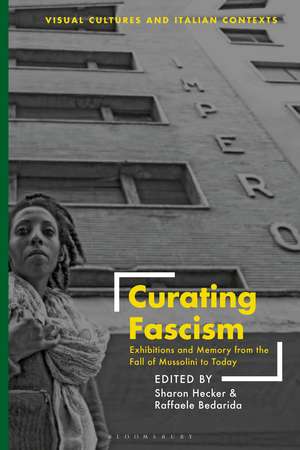
Curating Fascism: Exhibitions and Memory from the Fall of Mussolini to Today: Visual Cultures and Italian Contexts
Editat de Dr. Sharon Hecker, Raffaele Bedaridaen Limba Engleză Paperback – 15 dec 2022
Featuring contributions from an international group of art, architectural, design, and cultural historians, as well as journalists and curators, this book treats fascism as both a historical moment and as a major paradigm through which critics, curators, and the public at large have defined the present moment since World War II. It interweaves historical perspectives, critical theory, and direct accounts of exhibitions from the people who conceived them or responded to them most significantly in order to examine the main curatorial strategies, cultural relevance, and political responsibility of art exhibitions focusing on the Fascist period. Through close analysis, the chapter authors unpack the multifaceted specificity of art shows, including architecture and exhibition design; curatorial choices and institutional history; cultural diplomacy and political history; theories of viewership; and constructed collective memory, to evaluate current curatorial practice.
In offering fresh new perspectives on the historiography, collective memory, and understanding of fascist art and culture from a contemporary standpoint, Curating Fascism sheds light on the complex exhibition history of Italian fascism not just within Italy but in such countries as the USA, the UK, Germany, and Brazil. It also presents an innovative approach to the growing field of exhibition theory by bringing contributions from curators and exhibition historians, who critically reflect upon curatorial strategies with respect to the delicate subject of fascism and fascist art, into dialogue with scholars of Italian studies and art historians. In doing so, the book addresses the physical and cultural legacy of fascism in the context of the current historical moment.

Preț: 214.37 lei
Preț vechi: 275.49 lei
-22%
Puncte Express: 322
Carte disponibilă
Livrare economică 16-30 noiembrie
Livrare express 31 octombrie-06 noiembrie pentru 105.23 lei
Livrare prin curier în România Termenul estimat este afișat lângă disponibilitate.
Transport gratuit de la 400.00 lei Plată online sau ramburs, în funcție de opțiunile comenzii.
Retur gratuit în 14 zile Comandă securizată și suport în română.
Specificații
ISBN-13: 9781350229457
ISBN-10: 1350229458
Pagini: 320
Ilustrații: 100 bw illus
Dimensiuni: 156 x 232 x 18 mm
Greutate: 0.68 kg
Editura: Bloomsbury Publishing
Colecția Bloomsbury Visual Arts
Seria Visual Cultures and Italian Contexts
Locul publicării:London, United Kingdom
ISBN-10: 1350229458
Pagini: 320
Ilustrații: 100 bw illus
Dimensiuni: 156 x 232 x 18 mm
Greutate: 0.68 kg
Editura: Bloomsbury Publishing
Colecția Bloomsbury Visual Arts
Seria Visual Cultures and Italian Contexts
Locul publicării:London, United Kingdom
Cuprins
List of Figures
Notes on Contributors
Acknowledgments
Introduction
Part One: Rethinking Historical Exhibitions in Italy
1. Exhibiting Art of the Fascist Ventennio: Curatorial Choices, Installation Strategies, and Critical Reception from Arte Moderna in Italia 1915-1935 (Florence, 1967) to Annitrenta (Milan, 1982), Luca Quattrocchi, University of Siena, Italy
2. Pluralism as Revisionism: Annitrenta at Palazzo Reale, Milan, 1982, Denis Viva, the University of Trento, Italy
3. Interview with Renato Barilli, Curator of Annitrenta Exhibition at Palazzo Reale (Milan, 1982), Raffaele Bedarida, Cooper Union, New York, USA
4. Art, Life, Politics, and the Seductiveness of Italian Fascism: Post Zang Tumb Tuuum at Fondazione Prada (Milan, 2018), Sharon Hecker and Raffaele Bedarida, Art historian and Curator, Italy; Cooper Union, New York, USA
5. Italy's Holocaust on Display: From Carpi-Fossoli to Auschwitz (to Florence), Robert S. C. Gordon, Cambridge University, UK
6. Umbertino Umbertino: The Many Masks of Rome's Palazzo delle Esposizioni, Romy Golan, the Graduate Center, CUNY, USA
Part Two: Exhibitions of Fascism Around the World
7. Exhibiting and Collecting the F-word in Britain, Rosalind McKever, Curator, the Victoria and Albert Museum, London, UK
8. Novecento Brasiliano: Margherita Sarfatti, Ciccillo Matarazzo, and the Italian Collection of MAC USP, Ana Gonçalves Magalhães, University of São Paulo (MAC USP), Brazil
9. Contextualizing Razionalismo in the exhibition Photographic Recall (2019): Fascist Spaces in Contemporary German Photography, Miriam Paeslack, University at Buffalo (SUNY), New York, USA
10. Feeling at Home: Exhibiting Design, Blurring Fascism, Elena Dellapiana and Jonathan Mekinda, the Politecnico di Torino, Italy; University of Illinois at Chicago (UIC), USA
11. Italian Jewish Artists and Fascist Cultural Politics: on Gardens and Ghettos at the Jewish Museum in New York (1989), Emily Braun, Hunter College and the Graduate Center, CUNY, USA, interviewed by Raffaele Bedarida and Sharon Hecker
Part Three: Absences
12. Exhibiting the Homoerotic Body, the Queer Afterlife of Ventennio Male Nudes, John Champagne Penn State Erie, the Behrend College, USA
13. "Partigiano Portami Via": Exhibiting Antifascism and the Resistance in Post-Fascist Italy, Raffaele Bedarida, Cooper Union, New York, USA
14. Looking at Women and Mental Illness in Fascist Italy: An Exhibition's Dialogical and Feminist Approach, Lucia Re, University of California, Los Angeles, USA
15. Silencing the Colonial Past: The 1993 Exhibition Architettura italiana d'oltremare 1870-1940 in Bologna, Nicola Labanca, University of Siena, Italy
16. Recharting Landscapes in the Exhibition Roma Negata: Postcolonial Routes of the City (2014) and the Digital Project Postcolonial Italy: Mapping Colonial Heritage, Shelleen Greene University of California, Los Angeles, USA
Part Four: Curatorial Practices
17. From MRF to Post Zang Tumb Tuuum: The Responsibilities of the Re-hang, Vanessa Rocco, Southern New Hampshire University, Manchester, USA
18. The Final Ramp: Addressing Fascism in Italian Futurism at the Guggenheim Museum, Vivien Greene and Susan Thompson, the Solomon R. Guggenheim Museum, USA; Curator and Writer, Brooklyn, USA
19. The Making of MART and the Archivio del Novecento: Interview with Gabriella Belli, Director of the Foundation from the Municipal Museums of Venice
20. Now You See It, Now You Don't: Reconstructing Artists' Studios in Exhibitions on Fascist-Era Art, Sharon Hecker, Art Historian and Curator, Italy
21. Interview with Maaza Mengiste on Project 3541: A Photographic Archive of the 1935-41 Italo-Ethiopian War, Raffaele Bedarida and Sharon Hecker, Art historian and Curator, Italy; Cooper Union, New York, USA
Index
Notes on Contributors
Acknowledgments
Introduction
Part One: Rethinking Historical Exhibitions in Italy
1. Exhibiting Art of the Fascist Ventennio: Curatorial Choices, Installation Strategies, and Critical Reception from Arte Moderna in Italia 1915-1935 (Florence, 1967) to Annitrenta (Milan, 1982), Luca Quattrocchi, University of Siena, Italy
2. Pluralism as Revisionism: Annitrenta at Palazzo Reale, Milan, 1982, Denis Viva, the University of Trento, Italy
3. Interview with Renato Barilli, Curator of Annitrenta Exhibition at Palazzo Reale (Milan, 1982), Raffaele Bedarida, Cooper Union, New York, USA
4. Art, Life, Politics, and the Seductiveness of Italian Fascism: Post Zang Tumb Tuuum at Fondazione Prada (Milan, 2018), Sharon Hecker and Raffaele Bedarida, Art historian and Curator, Italy; Cooper Union, New York, USA
5. Italy's Holocaust on Display: From Carpi-Fossoli to Auschwitz (to Florence), Robert S. C. Gordon, Cambridge University, UK
6. Umbertino Umbertino: The Many Masks of Rome's Palazzo delle Esposizioni, Romy Golan, the Graduate Center, CUNY, USA
Part Two: Exhibitions of Fascism Around the World
7. Exhibiting and Collecting the F-word in Britain, Rosalind McKever, Curator, the Victoria and Albert Museum, London, UK
8. Novecento Brasiliano: Margherita Sarfatti, Ciccillo Matarazzo, and the Italian Collection of MAC USP, Ana Gonçalves Magalhães, University of São Paulo (MAC USP), Brazil
9. Contextualizing Razionalismo in the exhibition Photographic Recall (2019): Fascist Spaces in Contemporary German Photography, Miriam Paeslack, University at Buffalo (SUNY), New York, USA
10. Feeling at Home: Exhibiting Design, Blurring Fascism, Elena Dellapiana and Jonathan Mekinda, the Politecnico di Torino, Italy; University of Illinois at Chicago (UIC), USA
11. Italian Jewish Artists and Fascist Cultural Politics: on Gardens and Ghettos at the Jewish Museum in New York (1989), Emily Braun, Hunter College and the Graduate Center, CUNY, USA, interviewed by Raffaele Bedarida and Sharon Hecker
Part Three: Absences
12. Exhibiting the Homoerotic Body, the Queer Afterlife of Ventennio Male Nudes, John Champagne Penn State Erie, the Behrend College, USA
13. "Partigiano Portami Via": Exhibiting Antifascism and the Resistance in Post-Fascist Italy, Raffaele Bedarida, Cooper Union, New York, USA
14. Looking at Women and Mental Illness in Fascist Italy: An Exhibition's Dialogical and Feminist Approach, Lucia Re, University of California, Los Angeles, USA
15. Silencing the Colonial Past: The 1993 Exhibition Architettura italiana d'oltremare 1870-1940 in Bologna, Nicola Labanca, University of Siena, Italy
16. Recharting Landscapes in the Exhibition Roma Negata: Postcolonial Routes of the City (2014) and the Digital Project Postcolonial Italy: Mapping Colonial Heritage, Shelleen Greene University of California, Los Angeles, USA
Part Four: Curatorial Practices
17. From MRF to Post Zang Tumb Tuuum: The Responsibilities of the Re-hang, Vanessa Rocco, Southern New Hampshire University, Manchester, USA
18. The Final Ramp: Addressing Fascism in Italian Futurism at the Guggenheim Museum, Vivien Greene and Susan Thompson, the Solomon R. Guggenheim Museum, USA; Curator and Writer, Brooklyn, USA
19. The Making of MART and the Archivio del Novecento: Interview with Gabriella Belli, Director of the Foundation from the Municipal Museums of Venice
20. Now You See It, Now You Don't: Reconstructing Artists' Studios in Exhibitions on Fascist-Era Art, Sharon Hecker, Art Historian and Curator, Italy
21. Interview with Maaza Mengiste on Project 3541: A Photographic Archive of the 1935-41 Italo-Ethiopian War, Raffaele Bedarida and Sharon Hecker, Art historian and Curator, Italy; Cooper Union, New York, USA
Index
Recenzii
Fifty years going since Susan Sontag's Fascinating Fascism, we have in this marvellous volume a fascinating kaleidoscope of historical and critical perspectives on the art world of Fascism. Grounded in rigorous questions about aesthetics and contexts, the volume brings into lively conversation successive generations of curators, critics and historians from all over the Atlantic World-Italy, Brazil, the USA, Canada. It is in itself like the opening of an exciting exhibition, curated with empathy, loaded with striking and beautiful images, and, above all, guided by a strong, critical collective eye for the many diverse, often controversial ways of looking at the art and artefacts that have yielded the fascist aesthetic, itself so varied, elusive and insidious.
What ethical debts do museums owe to their objects of study-particularly those inextricable from a totalitarian regime? At every turn, this exciting volume unsettles the presumed neutrality of curatorial selection and display, underscoring the often unwitting political contingencies attendant upon seemingly straightforward exhibition strategies.
In confronting a critical lacuna in our understanding of postwar history and memory in Italy - the complex and problematic ways in which the art of the Fascist era was displayed after the fall of the regime - Curating Fascism presents an insightful and disturbing picture of a past that has yet to be faced.
A pivotal and fresh reconsideration of cultural politics in the fascist era, through the lens of a selection of historical and recent exhibitions that have shaped the interpretation of the ventennio over time.
The publication of Curating Fascism, then, is a long-awaited and vital contribution to the fields of art history, museum studies and curatorial practice, one which leads the way for further investigations of the intricate dynamics at play in the politics of display and the reception of art created under totalitarian regimes.
This masterly book provides an extraordinary in-depth look at the untold story of postwar exhibitions on fascism. An international and interdisciplinary group of scholars, raisesd the fundamental question of how these exhibitions have shaped historical narratives and collective memory in Italy and abroad. Subverting the usual categories, historical studies and direct accounts guide us in understanding the peculiar difficulties in exhibiting the works of the fascist era, the related curatorial responsibilities, and the legacy of fascism in the current historical moment.
Methodologically rich and innovative, Bedarida and Hecker's book provides a much-needed intellectual history of postwar exhibitions on fascism. It addressed the multidimensional specificity of the art show by integrating architecture and exhibition design, curatorial practices and institutional history, cultural diplomacy and political history, as well as theories of viewership and the construction of collective memory. This groundbreaking approach opens new avenues for research in areas that are only briefly explored in the book.
What ethical debts do museums owe to their objects of study-particularly those inextricable from a totalitarian regime? At every turn, this exciting volume unsettles the presumed neutrality of curatorial selection and display, underscoring the often unwitting political contingencies attendant upon seemingly straightforward exhibition strategies.
In confronting a critical lacuna in our understanding of postwar history and memory in Italy - the complex and problematic ways in which the art of the Fascist era was displayed after the fall of the regime - Curating Fascism presents an insightful and disturbing picture of a past that has yet to be faced.
A pivotal and fresh reconsideration of cultural politics in the fascist era, through the lens of a selection of historical and recent exhibitions that have shaped the interpretation of the ventennio over time.
The publication of Curating Fascism, then, is a long-awaited and vital contribution to the fields of art history, museum studies and curatorial practice, one which leads the way for further investigations of the intricate dynamics at play in the politics of display and the reception of art created under totalitarian regimes.
This masterly book provides an extraordinary in-depth look at the untold story of postwar exhibitions on fascism. An international and interdisciplinary group of scholars, raisesd the fundamental question of how these exhibitions have shaped historical narratives and collective memory in Italy and abroad. Subverting the usual categories, historical studies and direct accounts guide us in understanding the peculiar difficulties in exhibiting the works of the fascist era, the related curatorial responsibilities, and the legacy of fascism in the current historical moment.
Methodologically rich and innovative, Bedarida and Hecker's book provides a much-needed intellectual history of postwar exhibitions on fascism. It addressed the multidimensional specificity of the art show by integrating architecture and exhibition design, curatorial practices and institutional history, cultural diplomacy and political history, as well as theories of viewership and the construction of collective memory. This groundbreaking approach opens new avenues for research in areas that are only briefly explored in the book.