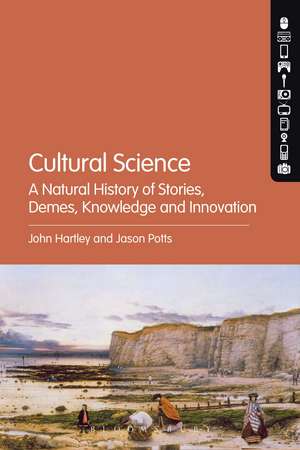
Cultural Science: A Natural History of Stories, Demes, Knowledge and Innovation
Autor Prof. John Hartley, Dr. Jason Pottsen Limba Engleză Paperback – 24 mar 2016
Cultural Science introduces a new way of thinking about culture. Adopting an evolutionary and systems approach, the authors argue that culture is the population-wide source of newness and innovation; it faces the future, not the past. Its chief characteristic is the formation of groups or 'demes' (organised and productive subpopulation; 'demos'). Demes are the means for creating, distributing and growing knowledge. However, such groups are competitive and knowledge-systems are adversarial.
Starting from a rereading of Darwinian evolutionary theory, the book utilises multidisciplinary resources: Raymond Williams's 'culture is ordinary' approach; evolutionary science (e.g. Mark Pagel and Herbert Gintis); semiotics (Yuri Lotman); and economic theory (from Schumpeter to McCloskey).
Successive chapters argue that:
-Culture and knowledge need to be understood from an externalist ('linked brains') perspective, rather than through the lens of individual behaviour;
-Demes are created by culture, especially storytelling, which in turn constitutes both politics and economics;
-The clash of systems - including demes - is productive of newness, meaningfulness and successful reproduction of culture;
-Contemporary urban culture and citizenship can best be explained by investigating how culture is used, and how newness and innovation emerge from unstable and contested boundaries between different meaning systems;
-The evolution of culture is a process of technologically enabled 'demic concentration' of knowledge, across overlapping meaning-systems or semiospheres; a process where the number of demes accessible to any individual has increased at an accelerating rate, resulting in new problems of scale and coordination for cultural science to address.
The book argues for interdisciplinary 'consilience', linking evolutionary and complexity theory in the natural sciences, economics and anthropology in the social sciences, and cultural, communication and media studies in the humanities and creative arts. It describes what is needed for a new 'modern synthesis' for the cultural sciences. It combines analytical and historical methods, to provide a framework for a general reconceptualisation of the theory of culture - one that is focused not on its political or customary aspects but rather its evolutionary significance as a generator of newness and innovation.
Preț: 265.05 lei
Preț vechi: 319.50 lei
-17%
Puncte Express: 398
Preț estimativ în valută:
46.87€ • 55.01$ • 40.66£
46.87€ • 55.01$ • 40.66£
Carte tipărită la comandă
Livrare economică 09-23 martie
Specificații
ISBN-13: 9781474279239
ISBN-10: 1474279236
Pagini: 264
Dimensiuni: 156 x 234 x 14 mm
Greutate: 0.38 kg
Ediția:NIPPOD
Editura: Bloomsbury Publishing
Colecția Bloomsbury Academic
Locul publicării:London, United Kingdom
ISBN-10: 1474279236
Pagini: 264
Dimensiuni: 156 x 234 x 14 mm
Greutate: 0.38 kg
Ediția:NIPPOD
Editura: Bloomsbury Publishing
Colecția Bloomsbury Academic
Locul publicării:London, United Kingdom
V-ar putea interesa
-
 Reporting ConflictJames RodgersPreț: 200.92 lei
 -
 Time, Media and ModernityE. KeightleyPreț: 374.91 lei
 -
 Digital Cultures and the Politics of EmotionAthina Karatzogianni-18%Preț: 752.56 lei917.76 lei
 -
 -15%Preț: 613.80 lei722.11 lei
 -
 The Power of Global Community MediaLinda K FullerPreț: 372.95 lei
 -
 Media Practice in IraqA. Al-RawiPreț: 374.91 lei
 -
 Digital Labor: The Internet as Playground and FactoryTrebor ScholzPreț: 377.98 lei
 -
 -23%Preț: 425.02 lei551.97 lei
 -
 Preț: 352.16 lei
 -
 Media LifeMark DeuzePreț: 188.17 lei
 -
 -15%Preț: 510.67 lei600.79 lei
 -
 Media and Translation: An Interdisciplinary ApproachDr Dror Abend-David-25%Preț: 268.88 lei360.58 lei
 -
 -22%Preț: 240.04 lei308.61 lei
 -
 The Master SwitchTim WuPreț: 194.84 lei
 -
 -24%Preț: 205.58 lei269.87 lei
Cuprins
Intro
1. Curiously Parallel - The Nature of Culture
Part I: Culture Makes Groups
2. Externalism - Identity ('Me' is 'We')
3. Demes - Universal-Adversarial Groupishness ('We' vs 'They')
4. Malvoisine - Bad Neighbours
5. Citizens - Demic Concentration Creates Knowledge
Part II: Groups Make Knowledge
6. Meaningfulness - The Growth of Knowledge
7. Newness - Innovation
8. Waste - Reproductive Success
9. Extinction - Resilience and Ossification
Part III: Outro
10. A Natural History of Demic Concentration
Acknowledgements
References
Index
1. Curiously Parallel - The Nature of Culture
Part I: Culture Makes Groups
2. Externalism - Identity ('Me' is 'We')
3. Demes - Universal-Adversarial Groupishness ('We' vs 'They')
4. Malvoisine - Bad Neighbours
5. Citizens - Demic Concentration Creates Knowledge
Part II: Groups Make Knowledge
6. Meaningfulness - The Growth of Knowledge
7. Newness - Innovation
8. Waste - Reproductive Success
9. Extinction - Resilience and Ossification
Part III: Outro
10. A Natural History of Demic Concentration
Acknowledgements
References
Index
Recenzii
Humans have evolved to make culture in the same way birds have evolved to make nests and spiders to make webs. Even more telling is the fact that culture has evolved over hundreds of thousands of years to make human nature what it is. In this ambitious and persuasive work, Hartley and Potts offer a vision of the unification of behavioral science and cultural studies that shatters traditional disciplinary boundaries.
Hartley and Potts' Cultural Science firmly grounds the study of culture in a Darwinian evolutionary framework, emphasising how knowledge, morality, innovation and even personal identity emerge from the power of groups or demes pursuing shared goals, often in competition with other similar demes. Cultural Science is suitable for lay audiences and also as a reference text for the modern scholarly study of culture.
The charm of Cultural Science is rather like that of watching David Attenborough or Brian Cox in full flight, peering into rock pools, turning over fossils, bringing to light creatures that are both fascinating in themselves and hold clues to the possibilities of life and the universe. Whatever else it may be, this is an intellectual adventure, full of curious details and surprising discoveries. It brims with enthusiasm and pedagogical passion. ... It is a 'dangerous' book in the best sense - ambitious, experimental and heedless of risk.
Cultural Science is a wonderfully mind-challenging, expansive book that is boldly ambitious. ... As I read it, at times I had moments of exclaiming 'but! but! but!', yet those are signs of how thoroughly it challenged me to reconsider and reconceive much of the field of media, communication, and cultural studies, and much of the work within it. Generative, 'big picture' books like this are rare.
Hartley and Potts' Cultural Science firmly grounds the study of culture in a Darwinian evolutionary framework, emphasising how knowledge, morality, innovation and even personal identity emerge from the power of groups or demes pursuing shared goals, often in competition with other similar demes. Cultural Science is suitable for lay audiences and also as a reference text for the modern scholarly study of culture.
The charm of Cultural Science is rather like that of watching David Attenborough or Brian Cox in full flight, peering into rock pools, turning over fossils, bringing to light creatures that are both fascinating in themselves and hold clues to the possibilities of life and the universe. Whatever else it may be, this is an intellectual adventure, full of curious details and surprising discoveries. It brims with enthusiasm and pedagogical passion. ... It is a 'dangerous' book in the best sense - ambitious, experimental and heedless of risk.
Cultural Science is a wonderfully mind-challenging, expansive book that is boldly ambitious. ... As I read it, at times I had moments of exclaiming 'but! but! but!', yet those are signs of how thoroughly it challenged me to reconsider and reconceive much of the field of media, communication, and cultural studies, and much of the work within it. Generative, 'big picture' books like this are rare.