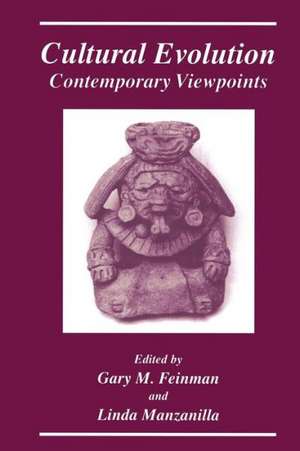
Cultural Evolution
Editat de Gary M Feinman, Linda Manzanillaen Limba Engleză Paperback – 21 ian 2013
Preț: 665.17 lei
Preț vechi: 782.55 lei
-15%
Puncte Express: 998
Carte tipărită la comandă
Livrare economică 25 noiembrie-09 decembrie
Livrare prin curier în România Termenul estimat este afișat lângă disponibilitate.
Transport gratuit pentru acest produs Plată online sau ramburs, în funcție de opțiunile comenzii.
Retur gratuit în 14 zile Comandă securizată și suport în română.
Specificații
ISBN-13: 9781461368717
ISBN-10: 1461368715
Pagini: 269
Ilustrații: XV, 269 p.
Dimensiuni: 155 x 235 x 16 mm
Greutate: 0.44 kg
Ediția:Softcover Reprint of the Original 1st 2000 edition
Editura: Springer Us
Locul publicării:New York, NY, United States
ISBN-10: 1461368715
Pagini: 269
Ilustrații: XV, 269 p.
Dimensiuni: 155 x 235 x 16 mm
Greutate: 0.44 kg
Ediția:Softcover Reprint of the Original 1st 2000 edition
Editura: Springer Us
Locul publicării:New York, NY, United States
Public țintă
ResearchCuprins
I. Introduction.- 1. Cultural Evolutionary Approaches and Archaeology: Past, Present, and Future.- II. Technological Change and Economic Specialization.- 2. Guilá Naquitz Revisited: Agricultural Origins in Oaxaca, Mexico.- 3. The Evolution of theTipití: A Study in the Process of Invention.- 4. Accelerated Technological Change in Archaeology and Ancient History.- 5. High-Intensity Household-Scale Production in Ancient Mesoamerica: A Perspective from Ejutla, Oaxaca.- III. Political Complexity and Its Emergence.- 6. Lightning and Jaguars: Iconography, Ideology, and Politics in Formative Cuicatlán, Oaxaca.- 7. Games, Players, Rules, and Circumstances: Looking for Understandings of Social Change at Different Levels.- 8. Modeling Tributary Economies and Hierarchical Polities: A Prologue.- 9. The Development of Administration from Collective to Centralized Economies in the Mesopotamian World: The Transformation of an Institution from System-Serving to Self-Serving.- IV. Conclusions.- 10. A Concluding Perspective on the Theoretical Contributions of Kent V. Flannery: Tenets for the Next Century of U.S. Archaeology.- Postscript.- Comprehensive Bibliography of Kent V. Flannery.
Recenzii
'All of the chapters are top-knotch, and several make major strides toward understanding the emergence of complexity in more comprehensive theoretical terms. Flannery is definitely to be commended for stimulating such a broad body of research on the cultural evolution of political and economic complexity. Would I buy this book? My answer is another "Yes". Every faculty member interested in the subject certainly should add it to his professional library.'
Journal of Anthropological Research, 58 (2002)
`...this volume's coverage encompasses much of the diversity in conventional cultural evolutionary and processual paradigms and some of the chapters offer quite contemporary solutions to hitherto divisive issues. Overall, the contributions, written by renowned senior scholars, have the quality, depth, and breadth to be of wide interest to current evolutionary archaeologists.'
Journal of the Royal Anthropological Institute, 8:4 (2002)
"In summary, this volume's coverage encompasses much of the diversity in conventional cultural evolutionary and processual paradigms and some of the chapters offer quite contemparary solutions to hitherto diversive issues. Overall, the contributions, written by renowned senior scholars, have the quality, depth, and breadth to be of wide interest to current evolutionary archaeologists." (Marilyn Masson; Journal of the Royal Anthropological Institute, 8:4)
Journal of Anthropological Research, 58 (2002)
`...this volume's coverage encompasses much of the diversity in conventional cultural evolutionary and processual paradigms and some of the chapters offer quite contemporary solutions to hitherto divisive issues. Overall, the contributions, written by renowned senior scholars, have the quality, depth, and breadth to be of wide interest to current evolutionary archaeologists.'
Journal of the Royal Anthropological Institute, 8:4 (2002)
"In summary, this volume's coverage encompasses much of the diversity in conventional cultural evolutionary and processual paradigms and some of the chapters offer quite contemparary solutions to hitherto diversive issues. Overall, the contributions, written by renowned senior scholars, have the quality, depth, and breadth to be of wide interest to current evolutionary archaeologists." (Marilyn Masson; Journal of the Royal Anthropological Institute, 8:4)