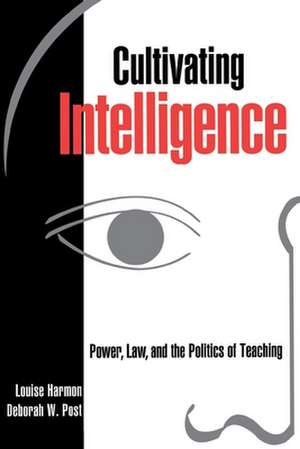
Cultivating Intelligence
Autor Louise Harmon, Deborah W. Posten Limba Engleză Hardback – mar 1996
Preț: 630.54 lei
Preț vechi: 818.88 lei
-23%
Puncte Express: 946
Carte tipărită la comandă
Livrare economică 17 noiembrie-01 decembrie
Livrare prin curier în România Termenul estimat este afișat lângă disponibilitate.
Transport gratuit pentru acest produs Plată online sau ramburs, în funcție de opțiunile comenzii.
Retur gratuit în 14 zile Comandă securizată și suport în română.
Specificații
ISBN-13: 9780814766286
ISBN-10: 0814766285
Pagini: 250
Dimensiuni: 152 x 229 x 18 mm
Greutate: 0.51 kg
Ediția:New.
Editura: NYU Press - IPS
ISBN-10: 0814766285
Pagini: 250
Dimensiuni: 152 x 229 x 18 mm
Greutate: 0.51 kg
Ediția:New.
Editura: NYU Press - IPS
V-ar putea interesa
-
 The Oxford Handbook of Sex Offences and Sex OffendersTeela Sanders-32%Preț: 1102.07 lei1629.92 lei
 -
 Democratic Theory and Mass IncarcerationAlbert Dzur-28%Preț: 474.70 lei660.95 lei
 -
 Unequal: How America's Courts Undermine Discrimination LawSandra F. Sperino-10%Preț: 296.24 lei329.08 lei
 -
 ClarendonB. H. G. WormaldPreț: 342.31 lei
 -
 Feminist Legal Theory: An Anti-Essentialist ReaderNancy E. Dowd-23%Preț: 519.28 lei674.39 lei
 -
 Preț: 212.53 lei
 -
 The Education of the Southern BelleChristie Anne Farnham-23%Preț: 631.79 lei820.50 lei
 -
 IrelandHugh F. Kearney-23%Preț: 467.09 lei606.60 lei
 -
 The Rights of WomenLenora M LapidusPreț: 301.44 lei
 -
 Getting in the GameDeborah L BrakePreț: 291.74 lei
 -
 Feminist Legal Theory (Vol. 1)Frances Olsen-23%Preț: 566.06 lei735.14 lei
 -
 Cultivating IntelligenceLouise HarmonPreț: 289.25 lei
 -
 Laying Down the LawPierre Schlag-23%Preț: 628.47 lei816.19 lei
 -
 Laying Down the LawPierre SchlagPreț: 250.94 lei
 -
 Legal FeminismAnn ScalesPreț: 446.18 lei
 -
 Courting the PeopleAnuj Bhuwania-30%Preț: 594.87 lei846.38 lei
 -
 Property Rights in Post-Soviet RussiaJordan Gans-Morse-11%Preț: 597.60 lei671.46 lei
 -
 The Protection of Economic, Social and Cultural Rights in AfricaDanwood Mzikenge Chirwa-14%Preț: 687.67 lei799.61 lei
 -
 Federal Intervention in American Police DepartmentsStephen RushinPreț: 216.11 lei
 -
 Israel and its Palestinian CitizensNadim N. RouhanaPreț: 291.14 lei
 -
 The British IslesHugh KearneyPreț: 145.90 lei
 -
 -19%Preț: 586.38 lei723.92 lei
 -
 Women’s Rights to Social Security and Social ProtectionBeth Goldblatt-21%Preț: 352.66 lei444.48 lei
 -
 -33%Preț: 525.46 lei788.62 lei
Textul de pe ultima copertă
In this postmodern version of The Paper Chase, Louise Harmon and Deborah W. Post explore what law school looks and feels like today for two women academics. In the tradition of Patricia Williams's The Alchemy of Race and Rights, these two women take the reader on an intimate, intellectual journey, exploring the meanings of difference to them and to the academy. The two women - one intuitive, the other more linear; one black, the other white; one more oriented toward metaphor, the other toward narrative - grapple with what it means to teach law as a woman, as a minority, as an activist, in an environment that remains overwhelmingly white, male, and traditionalist. Harmon and Post devote the core of their conversation to the relationship between intelligence, cognitive theory, and professional education. How do people learn? What does it mean to teach critical thinking in institutions where hierarchy is entrenched, where a professor with a "couch-and-conversation" teaching style confronts 100+ students in an amphitheater, where students with the most interested and animated faces in class often fail miserably on exams? In a book remarkably devoid of posturing and intellectual bravado, Harmon and Post provide a refreshing, revealing portrait of women in academia and the conflicts, anxieties, skepticism, and realities any thinking educator must confront.
Notă biografică
Louise Harmon is Professor of Law at Touro College, Jacob D. Fuchsberg School of Law. Louise Harmon has a J.D. from the University of Texas, an L.L.M from Harvard Law School, and is currently a Ph.D. candidate in Philosophy at Columbia University.