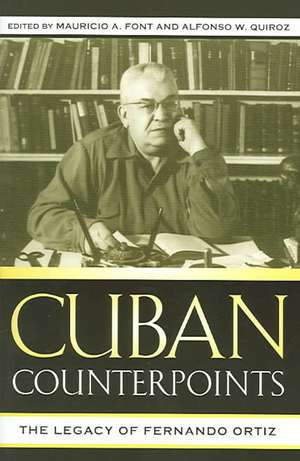
Cuban Counterpoints: The Legacy of Fernando Ortiz: Bildner Western Hemisphere Studies
Editat de Mauricio A. Font, Alfonso W. Quiroz Contribuţii de Carmen Almodóvar Muñoz, Alejandra Bronfman, Patricia Catoira, Fernando Coronil, María Del Rosario Díaz Rodríguez, Antonio Fernández Ferrer, Tomás Fernández Robaina, Roberto González Echevarría, Benjamin L. Lapidus, María Teresa Linares Savio, Octavio di Leo, José Matos Arévalos, Miguel Angel Puig-Samper Mulero, Consuelo Naranjo Orovio, María Fernanda Ortiz Herrera, Marifeli Pérez-Stable, Enrique S. Pumar, Jorge Ramírez Calzadilla, Rafael Rojas Jr., Pamela Maria Smorkaloff, Jean Stubbs, Viñaleten Limba Engleză Paperback – 23 dec 2004




Preț: 325.24 lei
Preț vechi: 418.58 lei
-22%
Puncte Express: 488
Carte tipărită la comandă
Livrare economică 19 noiembrie-03 decembrie
Livrare prin curier în România Termenul estimat este afișat lângă disponibilitate.
Transport gratuit de la 400.00 lei Plată online sau ramburs, în funcție de opțiunile comenzii.
Retur gratuit în 14 zile Comandă securizată și suport în română.
Specificații
ISBN-13: 9780739109687
ISBN-10: 0739109685
Pagini: 316
Dimensiuni: 148 x 226 x 20 mm
Greutate: 0.44 kg
Ediția:New.
Editura: Bloomsbury Publishing
Colecția Lexington Books
Seria Bildner Western Hemisphere Studies
Locul publicării:New York, United States
ISBN-10: 0739109685
Pagini: 316
Dimensiuni: 148 x 226 x 20 mm
Greutate: 0.44 kg
Ediția:New.
Editura: Bloomsbury Publishing
Colecția Lexington Books
Seria Bildner Western Hemisphere Studies
Locul publicării:New York, United States
Cuprins
Part 1 Introduction
Part 2 Life and Education
Chapter 3 Fernando Ortiz, My Father
Chapter 4 Spanish Intellectuals and Fernando Ortiz (1900-1941)
Chapter 5 It All Started in Madrid
Chapter 6 Ethnography at the University of Havana
Part 7 Interpreting Cuban History
Chapter 8 Transculturation and Nationalism
Chapter 9 The Early Republic: Politics, Civic Culture, and Sovereignty
Chapter 10 The Political Ideas of Fernando Ortiz (1906-1933)
Chapter 11 Economic Historian and Editor of Cuban Classics
Chapter 12 Tobacco in the Contrapunteo: Ortiz and the Havana Cigar
Part 13 Social Sciences and the Law
Chapter 14 Economic Sociology and Ortiz's Counterpoint
Chapter 15 Transcultural Anthropology in the Américas (with an Accent): The Uses of Fernando Ortiz
Chapter 16 Poetry in the Presidio: Towards a Study of Proyecto de Código Criminal Cubano
Part 17 Racial Diversity, Religion, and National Identity
Chapter 18 The Term Afro-Cuban: A Forgotten Contribution
Chapter 19 Transculturation a la Ajiaco: A Recipe for Modernity
Chapter 20 Religion in the Work of Fernando Ortiz
Part 21 Literature and Music
Chapter 22 The Counterpoint and Literature
Chapter 23 Of How Fernando Ortiz Foudn and Elusive Maiden for an Enchanted Gentleman
Chapter 24 Comparative Analysis of Theoretical Symbols
Chapter 25 Stirring the Ajiaco: Changüí, Son, and the Haitian Connection
Chapter 26 Fernando Ortiz, Founder
Part 2 Life and Education
Chapter 3 Fernando Ortiz, My Father
Chapter 4 Spanish Intellectuals and Fernando Ortiz (1900-1941)
Chapter 5 It All Started in Madrid
Chapter 6 Ethnography at the University of Havana
Part 7 Interpreting Cuban History
Chapter 8 Transculturation and Nationalism
Chapter 9 The Early Republic: Politics, Civic Culture, and Sovereignty
Chapter 10 The Political Ideas of Fernando Ortiz (1906-1933)
Chapter 11 Economic Historian and Editor of Cuban Classics
Chapter 12 Tobacco in the Contrapunteo: Ortiz and the Havana Cigar
Part 13 Social Sciences and the Law
Chapter 14 Economic Sociology and Ortiz's Counterpoint
Chapter 15 Transcultural Anthropology in the Américas (with an Accent): The Uses of Fernando Ortiz
Chapter 16 Poetry in the Presidio: Towards a Study of Proyecto de Código Criminal Cubano
Part 17 Racial Diversity, Religion, and National Identity
Chapter 18 The Term Afro-Cuban: A Forgotten Contribution
Chapter 19 Transculturation a la Ajiaco: A Recipe for Modernity
Chapter 20 Religion in the Work of Fernando Ortiz
Part 21 Literature and Music
Chapter 22 The Counterpoint and Literature
Chapter 23 Of How Fernando Ortiz Foudn and Elusive Maiden for an Enchanted Gentleman
Chapter 24 Comparative Analysis of Theoretical Symbols
Chapter 25 Stirring the Ajiaco: Changüí, Son, and the Haitian Connection
Chapter 26 Fernando Ortiz, Founder
Recenzii
This volume is a compelling encounter with the many personas of Fernando Ortiz-anthropologist, lawyer, politician, humanist, and, perhaps most important, Cuban visionary. Ortiz's multidisciplinary contributions are approached with respect, affection, critical consciousness, and a welcome playfulness rarely seen in academic anthologies. Whether you are already familiar with the huge corpus left by Ortiz or discovering him for the first time, let this volume be your guide to the exuberance of Ortiz's legacy, which is not only a gift to Cuba but to our globalized world, struggling with ever more pathos to figure out why culture still matters.
This interesting collection of essays . . . highlights how relevant Ortiz's writings are to understanding contemporary as well as historical trends in the Americas.
This interesting collection of essays . . . highlights how relevant Ortiz's writings are to understanding contemporary as well as historical trends in the Americas.