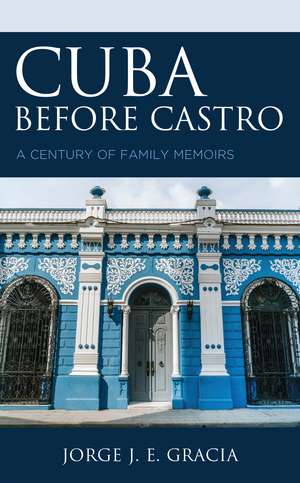
Cuba before Castro: A Century of Family Memoirs
Autor Jorge J. E. Graciaen Limba Engleză Paperback – 27 iul 2020
In this book Jorge J.E. Gracia approaches this situation by telling true stories about some members of his family (Doctor Ignacio Gracia, Maruca Otero, the Marques de Arguelles, and many others) who lived during a culturally rich century before Castro. He hopes to entice historians, academics, tourists and others, to pursue a balanced exploration of the island by telling part of their stories. This enterprise is neither history nor fiction, but memories written by a Cuban who left Cuba when he was eighteen years old and has become a distinguished philosopher in the United States.
Preț: 225.03 lei
Preț vechi: 309.22 lei
-27%
Puncte Express: 338
Carte tipărită la comandă
Livrare economică 25 noiembrie-09 decembrie
Livrare prin curier în România Termenul estimat este afișat lângă disponibilitate.
Transport gratuit de la 400.00 lei Plată online sau ramburs, în funcție de opțiunile comenzii.
Retur gratuit în 14 zile Comandă securizată și suport în română.
Specificații
ISBN-13: 9780761872139
ISBN-10: 0761872132
Pagini: 298
Dimensiuni: 153 x 221 x 26 mm
Greutate: 0.53 kg
Editura: Bloomsbury Publishing
Colecția Hamilton Books
Locul publicării:New York, United States
ISBN-10: 0761872132
Pagini: 298
Dimensiuni: 153 x 221 x 26 mm
Greutate: 0.53 kg
Editura: Bloomsbury Publishing
Colecția Hamilton Books
Locul publicării:New York, United States
Cuprins
Preface
1. Names and Identity. What's in a Name?
2. "Je Suis Française!"
3. Escaping Mexican Wrath
4. The Jesuits Stole My Inheritance
5. Poetry, Spirits, and Flair
6. Treasure Trove for Christmas
7. Promising Future Comes to Naught
8. Una Señora Muy Aseñorada
9. Unexpected Success
10. The Storyteller
11. Bedroom Suite for a Pompadour
12. "¡España Es Nuestra Madre Patria!"
13. Better Marry Than Burn
14. The Marquis' Mistress
15. Ruined by a Hurricane and Resentment Against Spaniards
16. Tears from a "Bileless Dove"
17. Murdered by the Guardia Civil
18. La Dolorosa's Miracle
19. Promising Beginning and Sad End
20. Is Having to Work Punishment for Sin?
21. Broken Promise
22. A Twenty-Five Year Engagement
23. Romance on a Scale
24. "Te Voy a Capar"
25. A Gentleman Farmer at Heart
26. Running Away from Home
27. A Boy's Best Friends
28. A Bad Dream Comes True
29. Rebel with a Cause
30. A Philosophy of Underwear
31. End of Paradise
32. The Bully
33. First Holy Communion
34. Summers at the Beach
35. Yearly Audit and Crocodile Tears
36. Lean Years
37. Written in the Stars
38. A Night to Forget
39. The Refuge of Faith
40. The Consolation of Giving
41. An Interim Abode
42. Long Journey Into Darkness
43. Bicycles Are For Boys
44. Nena's Insistent Gay Suitor
45. Looking for Domestic Help
46. María "Picadillo"
47. "¡Yo soy muy macho!"
48. Teenager in Havana
49. The Club
50. Another Call
51. The Cursed Plantation
52. Sugar and Slavery
53. "El Marañon Aprieta la Boca"
54. "I Believe in God"
55. Building Up the Spirit
56. First Cracks of the Faith
57. Brother Balloon
58. "¿Y Tu Abuela, Dónde Está?"
59. "Mens Sana in Corpore Sano"
60. "De Eso No Se Habla"
61. Two Years of Terror
62. A Beach House at Last
63. Love and Prejudice
64. Quest for Freedom
65. School for Toy Soldiers
66. A Teacher Who Could Not Teach
67. "I've Got Wheels!"
68. Playground of the Caribbean
69. Chaperones
70. Puppy Love
71. Graduation and a Prom of Sorts
72. Starved for Culture
73. Recreating the Garden of Eden
74. From Hope to Despair
75.The University of Havana
76. Alea Iacta Est
77. The Bay of Pigs and a Police State
Acknowledgments
About the Author
1. Names and Identity. What's in a Name?
2. "Je Suis Française!"
3. Escaping Mexican Wrath
4. The Jesuits Stole My Inheritance
5. Poetry, Spirits, and Flair
6. Treasure Trove for Christmas
7. Promising Future Comes to Naught
8. Una Señora Muy Aseñorada
9. Unexpected Success
10. The Storyteller
11. Bedroom Suite for a Pompadour
12. "¡España Es Nuestra Madre Patria!"
13. Better Marry Than Burn
14. The Marquis' Mistress
15. Ruined by a Hurricane and Resentment Against Spaniards
16. Tears from a "Bileless Dove"
17. Murdered by the Guardia Civil
18. La Dolorosa's Miracle
19. Promising Beginning and Sad End
20. Is Having to Work Punishment for Sin?
21. Broken Promise
22. A Twenty-Five Year Engagement
23. Romance on a Scale
24. "Te Voy a Capar"
25. A Gentleman Farmer at Heart
26. Running Away from Home
27. A Boy's Best Friends
28. A Bad Dream Comes True
29. Rebel with a Cause
30. A Philosophy of Underwear
31. End of Paradise
32. The Bully
33. First Holy Communion
34. Summers at the Beach
35. Yearly Audit and Crocodile Tears
36. Lean Years
37. Written in the Stars
38. A Night to Forget
39. The Refuge of Faith
40. The Consolation of Giving
41. An Interim Abode
42. Long Journey Into Darkness
43. Bicycles Are For Boys
44. Nena's Insistent Gay Suitor
45. Looking for Domestic Help
46. María "Picadillo"
47. "¡Yo soy muy macho!"
48. Teenager in Havana
49. The Club
50. Another Call
51. The Cursed Plantation
52. Sugar and Slavery
53. "El Marañon Aprieta la Boca"
54. "I Believe in God"
55. Building Up the Spirit
56. First Cracks of the Faith
57. Brother Balloon
58. "¿Y Tu Abuela, Dónde Está?"
59. "Mens Sana in Corpore Sano"
60. "De Eso No Se Habla"
61. Two Years of Terror
62. A Beach House at Last
63. Love and Prejudice
64. Quest for Freedom
65. School for Toy Soldiers
66. A Teacher Who Could Not Teach
67. "I've Got Wheels!"
68. Playground of the Caribbean
69. Chaperones
70. Puppy Love
71. Graduation and a Prom of Sorts
72. Starved for Culture
73. Recreating the Garden of Eden
74. From Hope to Despair
75.The University of Havana
76. Alea Iacta Est
77. The Bay of Pigs and a Police State
Acknowledgments
About the Author
Recenzii
In this partly biographical and partly philosophical work, Jorge Gracia, who is the current Samuel P. Capen Chair and SUNY Distinguished Professor of Philosophy and Comparative Literature University at Buffalo, provides us with an autobiographical account of his youth in Cuba prior and right after the Cuban Revolution. His is an unmatching riveting and revealing account of his life that can explain his love with philosophy, history and Hispanic/Latino culture in general. Gracia applies his personal experiences to shed light on the emerging field of Latin American philosophy broadly construed in the USA. I do not know of any other living philosopher who has contributed as much and who has helped as many young philosophers in the said field. With his broad background in the history of philosophy, especially Medieval and Latin American philosophy, Gracia has given us an exemplary account of how relevant philosophy could be for exploring challenging issues related to culture, ethnicity, and race. In sum, I think that unquestionably Jorge Gracia can be considered the living dean of Latin American philosophy in North America.
This book is of tremendous testimonial, historical and intellectual significance. Dr. Jorge Gracia, one of the most (if not the most) prominent Hispanic philosophers in the U.S. in the second half of the 20th Century and in the 21st Century, looks back at Cuba before Castro and before his migration to the U.S. Professor Gracia's exquisite prose elegantly uses autobiographical and historical techniques to weave together a narrative that paints a complex and intriguing picture of family life, cultural life, and intellectual and socio-political life in Cuba before Castro. This is a must-read for anyone interested in Cuba, Latin American culture, and the life and thought of influential intellectuals such as Professor Gracia who have shaped Latin American thought in the 20th Century and beyond.
Jorge Gracia's Cuba before Castro: A Century of Family Memoirs is a walk back into the time before Cuba became synonymous with Fidel and a memory chronicle of what happened in the aftermath of the 1959 Cuban Revolution. Gracia's quirky family epitomized the diverse European immigrants who came to pre-Castro Cuba looking for prosperity and new business opportunities. Successful after initial struggles, these mixed European immigrants formed a significant segment of Cuban society and it was their descendants who fled Cuba and arrived in the U.S. and Canada as refugees in the 1960s and ongoing. These new North Americans became a force within their communities of settlements. In Gracia's case, his academic interests as philosopher, art collector, and avid traveler have combined to produce a biographical, yet analytical, retrospective analysis of his life. His assessment of his life as a Cuban, as a refugee, as a philosopher and as the founder, with his wife, Norma, of a Gracia family, living in Canada and the United States, provides personal and academic perspectives on the experience of escape from a fascist regime, establishing a new life and prospering in a new world of possibilities provided by exile. This book will be of interest to anyone who shares these experiences, as well as to a range of individuals who work in academic disciplines where human experience is the subject of interest. Written in a lively and personal style, Gracia's memoir is an invitation to share in his life as he recounts its many passages to the present.
This book is of tremendous testimonial, historical and intellectual significance. Dr. Jorge Gracia, one of the most (if not the most) prominent Hispanic philosophers in the U.S. in the second half of the 20th Century and in the 21st Century, looks back at Cuba before Castro and before his migration to the U.S. Professor Gracia's exquisite prose elegantly uses autobiographical and historical techniques to weave together a narrative that paints a complex and intriguing picture of family life, cultural life, and intellectual and socio-political life in Cuba before Castro. This is a must-read for anyone interested in Cuba, Latin American culture, and the life and thought of influential intellectuals such as Professor Gracia who have shaped Latin American thought in the 20th Century and beyond.
Jorge Gracia's Cuba before Castro: A Century of Family Memoirs is a walk back into the time before Cuba became synonymous with Fidel and a memory chronicle of what happened in the aftermath of the 1959 Cuban Revolution. Gracia's quirky family epitomized the diverse European immigrants who came to pre-Castro Cuba looking for prosperity and new business opportunities. Successful after initial struggles, these mixed European immigrants formed a significant segment of Cuban society and it was their descendants who fled Cuba and arrived in the U.S. and Canada as refugees in the 1960s and ongoing. These new North Americans became a force within their communities of settlements. In Gracia's case, his academic interests as philosopher, art collector, and avid traveler have combined to produce a biographical, yet analytical, retrospective analysis of his life. His assessment of his life as a Cuban, as a refugee, as a philosopher and as the founder, with his wife, Norma, of a Gracia family, living in Canada and the United States, provides personal and academic perspectives on the experience of escape from a fascist regime, establishing a new life and prospering in a new world of possibilities provided by exile. This book will be of interest to anyone who shares these experiences, as well as to a range of individuals who work in academic disciplines where human experience is the subject of interest. Written in a lively and personal style, Gracia's memoir is an invitation to share in his life as he recounts its many passages to the present.