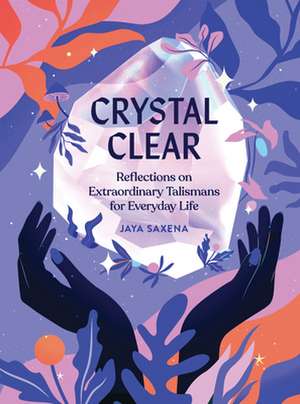
Crystal Clear: Reflections on Extraordinary Talismans for Everyday Life
Autor Jaya Saxenaen Limba Engleză Hardback – 29 dec 2020
Observăm o tendință clară în literatura de lifestyle contemporană: trecerea de la simple manuale tehnice la explorări narative profunde. Crystal Clear se încadrează perfect în această direcție, fiind organizat nu ca un catalog mineralogic, ci ca o serie de reflecții despre unsprezece pietre esențiale care ne pot ancora în cotidian. De la ametist la obsidian, structura cărții urmărește modul în care atribuim semnificații obiectelor pentru a ne înțelege mai bine propriile experiențe, fie că vorbim despre succes, dragoste necondiționată sau echilibru.
Ne-a atras atenția modul în care Jaya Saxena refuză să trateze cristalele doar ca pe niște accesorii estetice. Ea folosește fiecare piatră ca punct de plecare pentru a discuta teme complexe: pirita devine o metaforă pentru sindromul impostorului, în timp ce chihlimbarul deschide o discuție despre mortalitate. Această perspectivă transformă lectura într-un proces de introspecție, oferind un ton intim și clarificator, departe de clișeele ezoterice rigide.
Complementar lui Crystals de Sadie Kadlec: unde acela se concentrează pe proprietățile energetice și vindecarea celor 200 de specimene, Crystal Clear explorează mai degrabă simbolistica culturală și impactul psihologic al acestor talismane asupra identității noastre. În contextul operei autoarei, această carte este o evoluție firească de la Basic Witches și Spells to Raise Hell Cards. Dacă lucrările anterioare se axau pe ritualuri practice și emancipare feminină, noul volum rafinează aceste teme prin eseuri personale, păstrând aceeași voce onestă și spirit critic față de normele sociale, precum conceptul tradițional de căsătorie simbolizat de diamante.
Preț: 114.11 lei
Carte disponibilă
Livrare economică 22 iunie-06 iulie
Livrare express 05-11 iunie pentru 27.58 lei
Specificații
ISBN-10: 1683692039
Pagini: 224
Ilustrații: Throughout
Dimensiuni: 147 x 197 x 23 mm
Greutate: 0.03 kg
Editura: QUIRK BOOKS
Colecția Quirk Books
De ce să citești această carte
Recomandăm această carte cititorilor care caută ceva mai mult decât un ghid vizual. Este o lectură ideală pentru cei care doresc să exploreze spiritualitatea modernă prin filtrul autoanalizei. Veți câștiga o nouă perspectivă asupra modului în care obiectele din jur ne pot ajuta să navigăm prin emoții dificile precum anxietatea sau nesiguranța, totul într-un format elegant de cadou.
Despre autor
Jaya Saxena este o scriitoare și editoare cunoscută pentru modul în care îmbină cultura pop cu spiritualitatea și feminismul. Este co-autoarea volumului de succes Basic Witches, o lucrare care a definit stilul „vrajitoarei moderne” pentru o nouă generație. Stilul său se remarcă prin umor și observație ascuțită, calități vizibile și în proiectele sale satirice precum Dad Magazine. Prin scrierile sale, ea explorează modul în care ritualurile și simbolurile vechi pot fi adaptate pentru a oferi confort și putere în lumea contemporană.
Descriere scurtă
Highly prized for their beauty, crystals can take the shape of jewelry, household objects, and an array of self-care products. But it’s the ideas they stand for that draw people to their raw forms. Like astrology, tarot, and modern witchcraft, crystals help practitioners understand themselves and the wider world around them.
In this collection of sharply observed essays, Jaya Saxena reflects on—and challenges—the ideas associated with eleven popular stones, including unconditional love (rose quartz), happiness and success (citrine), balance (amethyst), self-care (black tourmaline), purity (pearl), imposter syndrome (pyrite), toxic positivity (carnelian), change (opals), traditional concepts of marriage (diamonds), presentation versus identity (obsidian), and death (amber).
The result is a deeply personal book with universal appeal, exploring how we assign meaning and power to crystals in order to give meaning and power to our lives.
Notă biografică
Extras
When you think of marble you probably think of it in its most basic, everyday forms: as a countertop, a kitchen backsplash, or a floor if you frequent slightly more luxe apartments. It’s a material that’s considered opulent but also recedes into the background. Even at the Taj Mahal, it’s not the marble itself that people marvel at; it’s the way it’s carved and inlaid—and the fact that there’s just so much of it. Marble is luxurious but it’s also durable; as much at home in a cathedral or a palace as it is in a hardware catalog. In other words: marble is nothing special.
But the California Crystal Cave in Sequoia National Park, a living structure of marble and calcite, will make you feel like an alien on your own planet. As I stood outside the cave on a midsummer day, looking at the spiderwebbed gate that led to the cavern’s tunnels, I felt a breeze thirty degrees cooler emanate from the entrance, touching my cheek like a ghost beckoning me inside. My partner, Matt, and I were there for a discovery tour, conducted only with flashlights. Over the course of a million years, water had been inching its way across a solid piece of marble inside a mountain, dissolving it bit by bit, sculpting entire rooms in its wake. It’s a magnificent natural structure; the supernatural need not apply.
I was never interested in crystals in a metaphysical or spiritual way. I was always drawn to their reality—their solidity. In a childhood diary, I bragged about my rock collection; pyrite, marble, raw emerald, and smoky quartz that I kept in a seashell-decorated, heart-shaped box. I opened it every night, removing each one by one to admire them, and then puzzling them all back so the lid could shut. In 1992, when I was six years old, I had sixty-two specimens, and big books with big pictures telling me where the rocks were likely mined, and what their practical uses were. Quartz was used in making computers, diamond to cut hard metals, crushed pearls to lend makeup an iridescent quality. In my diary I recorded which were my favorites—one day hematite, another limestone. I liked the way they glittered, the way they felt, how some seemed too light for their size and others too heavy, some sharp and some waxy, and how there could be such variance to what were essentially condensed forms of dirt. These stones didn’t need to have otherworldly properties in order to be valuable. They were fascinating on their own.
Inside the Crystal Cave, there are marble formations that look like a snowdrift, like popcorn or organ pipes. There are white calcite formations that look like the folds of a human brain. There are basins full of clear water called “Fairy Pools” that show a calcite lattice, like the most sturdy and elegant caul fat, beneath its undisturbed surface. Marble reaches out like the mangled claws of spirits trying to escape a dark prison. You could watch your breath becoming vapor in the path of a flashlight. I felt as close to magic as I’ve ever been.
At one point we were asked by our guide, Michelle, to sit in the dark in total silence and listen to the sounds of the cave—water dropping, echoing, some sense of coolness and space the silence only amplified. It seemed natural that people who stumbled into this formation before flashlights and paved trails wanted to take this energy with them, to have a physical remnant to connect them back to this massive formation. Perhaps when they saw the calcite chip stolen from the cavern wall, no matter how out of context, they would remember how it felt to be wholly absorbed by the earth. In the darkness, any theoretical power of the stones around me became immediately obvious.
“Nature” has come to mean something very specific in mainstream understanding, namely, something to save. It’s dying, after all, and we’re the ones killing it. Animals are becoming extinct, coral reefs are drying up, the seas are increasingly inhospitable, and the forests are being cut down. Even without human intervention, these forms of nature change all the time. Animals eat each other, trees dry out and rebloom, rivers push into new courses. But a rock, a mountain, is dark and craggy and rough, ready to kill you. It used to be that mountains inspired terror instead of admiration, back whe nature was something to prepare against, not something to consume. You could die on a mountain (people still die on mountains), but even if you didn’t, you would die anyway, and the mountain would remain. These formations are not changing at a scale a human can understand.
Crystals are nature. Crystals—the shiny, multicolored gems and crystalline structures we speak of here—are born of pressure in the earth and die by eventual erosion. “In a crystal we have clear evidence of the existence of a formative life principle, and though we cannot understand the life of a crystal, it is nonetheless a living being,” wrote Nikola Tesla in his essay “The Problem of Increasing Human Energy,” published in 1900. Crystals are not permanent, but they live outside of human time. Rocks, supposedly, are doing fine without us. Which is exactly why we want them.
Recenzii
“One of the most fascinating and unique books I’ve seen in a long time. Beautifully written, exquisitely researched, and filled with penetrating insight into the pretty rocks that can mean exactly as much as we want them to, and so much more. Saxena surprises you at every turn.”—Nicole Cliffe
“A collection of thunderously well-researched and generously human works."—LitHub