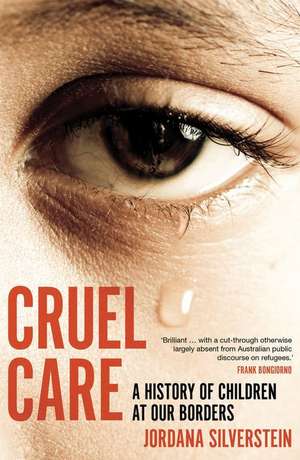
Cruel Care: A History of Children at Our Borders
Autor Jordana Silversteinen Limba Engleză Paperback – mai 2023
Preț: 168.62 lei
Preț vechi: 189.84 lei
-11%
Puncte Express: 253
Preț estimativ în valută:
29.81€ • 34.68$ • 25.93£
29.81€ • 34.68$ • 25.93£
Carte indisponibilă temporar
Doresc să fiu notificat când acest titlu va fi disponibil:
Se trimite...
Specificații
ISBN-13: 9781922633873
ISBN-10: 1922633879
Pagini: 304
Dimensiuni: 153 x 234 x 22 mm
Greutate: 0.52 kg
Editura: Monash University Publishing
Colecția Monash University Publishing
Locul publicării:Melbourne, Australia
ISBN-10: 1922633879
Pagini: 304
Dimensiuni: 153 x 234 x 22 mm
Greutate: 0.52 kg
Editura: Monash University Publishing
Colecția Monash University Publishing
Locul publicării:Melbourne, Australia
Recenzii
The aptly named Cruel Care is a groundbreaking book – confronting, deeply disturbing and revelatory.
Brilliant ... with a cut-through otherwise largely absent from Australian public discourse on refugees.
Cruel Care charts the way so-called “Australia” metes out violence in the name of care to the most vulnerable among us, children seeking asylum. Blackfullas are all too familiar with this violence and its perverse justification from politicians, policymakers and the general public. This book represents a most vital truth-telling of “history”, with an anger that does not compromise the discipline. I strongly recommend this text, which is demonstrative of the type of intellectual work needed in this time, in this place.
Cruel Care is a reminder that political strategies built on the innocence of some assume the guilt and disposability of others, and reinscribe the authority of the colonial state to decide between the two. It is a tender but exacting call to think, dream, write and organise based on justice that far exceeds settler benevolence.
A powerful and damning account of the way Australian government policy, policymakers and the media have conspired to create the current conditions for the treatment of refugees and their children. In this meticulously researched book, Silverstein weaves interviews with policymakers, archival research and media accounts to tell a new critical history. Taking sharp aim at the Australian state and its policymakers, and the discourses they create and perpetuate to govern and control refugee children, Silverstein’s analysis reveals the links between Australia’s treatment of refugees and First Nations peoples, along with related racist discourses. Drawing these connections is crucial for fighting these brutal systems, and so this book will be vital for those who seek to create a new world where people are treated with humanity and dignity. Closely evidenced and told with incredible skill, Cruel Care will push you to challenge ideas you may hold about state benevolence and good intentions. Each eloquent page delivers analysis that strikes blows at the cruelty of the policy and practices of the government towards refugee families. This book is an urgent call to action for us all, to demand better from the government and to overhaul a brutal system.
This is a readable and indispensable analysis of a much-obscured area of Australian immigration policy, viewed through an ingenious lens that shows how Australian colonialism and the immigration system are linked. Although it will provide insightful and engrossing reading, Silverstein’s excellent book does not feel as though it’s intended as an introductory guide to Australia’s treatment of refugee children, but rather a deep dive into the politics and policies, as well as a reframing of the issue, for those already armed with some understanding of Australia’s refugee history.
Brilliant ... with a cut-through otherwise largely absent from Australian public discourse on refugees.
Cruel Care charts the way so-called “Australia” metes out violence in the name of care to the most vulnerable among us, children seeking asylum. Blackfullas are all too familiar with this violence and its perverse justification from politicians, policymakers and the general public. This book represents a most vital truth-telling of “history”, with an anger that does not compromise the discipline. I strongly recommend this text, which is demonstrative of the type of intellectual work needed in this time, in this place.
Cruel Care is a reminder that political strategies built on the innocence of some assume the guilt and disposability of others, and reinscribe the authority of the colonial state to decide between the two. It is a tender but exacting call to think, dream, write and organise based on justice that far exceeds settler benevolence.
A powerful and damning account of the way Australian government policy, policymakers and the media have conspired to create the current conditions for the treatment of refugees and their children. In this meticulously researched book, Silverstein weaves interviews with policymakers, archival research and media accounts to tell a new critical history. Taking sharp aim at the Australian state and its policymakers, and the discourses they create and perpetuate to govern and control refugee children, Silverstein’s analysis reveals the links between Australia’s treatment of refugees and First Nations peoples, along with related racist discourses. Drawing these connections is crucial for fighting these brutal systems, and so this book will be vital for those who seek to create a new world where people are treated with humanity and dignity. Closely evidenced and told with incredible skill, Cruel Care will push you to challenge ideas you may hold about state benevolence and good intentions. Each eloquent page delivers analysis that strikes blows at the cruelty of the policy and practices of the government towards refugee families. This book is an urgent call to action for us all, to demand better from the government and to overhaul a brutal system.
This is a readable and indispensable analysis of a much-obscured area of Australian immigration policy, viewed through an ingenious lens that shows how Australian colonialism and the immigration system are linked. Although it will provide insightful and engrossing reading, Silverstein’s excellent book does not feel as though it’s intended as an introductory guide to Australia’s treatment of refugee children, but rather a deep dive into the politics and policies, as well as a reframing of the issue, for those already armed with some understanding of Australia’s refugee history.