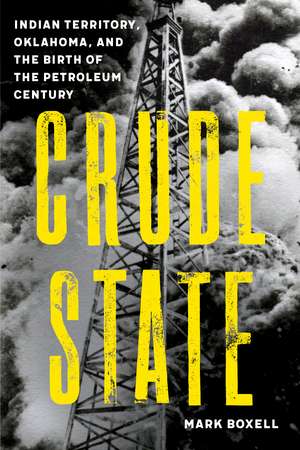
Crude State: Indian Territory, Oklahoma, and the Birth of the Petroleum Century
Autor Mark Boxellen Limba Engleză Hardback – dec 2026
Throughout this period, Indian Territory and Oklahoma oilfields were among the most productive not only in the United States but around the world. But territorial and state officials often sought to ensure that the most socially and politically desirable groups of extractors maintained favored access to crude-bearing land. Lawmakers touted regulatory measures as a bulwark against the monopoly power of consolidated corporations, outspokenly condemning the multinational status of the oil corporations they intended to contain even as they sought to erect exclusionary policies to stymie the arrival of foreign-born migrants, undermine the flourishing of Black residents, and eliminate the sovereign power of tribal nations. These political goals became increasingly conjoined in the era surrounding World War I, when a new settler state was founded just as petroleum’s force in public life began to take on real significance.
Preț: 482.51 lei
Precomandă
Puncte Express: 724
Carte nepublicată încă
Livrare prin curier în România Precomanda se expediază când titlul devine disponibil.
Transport gratuit pentru acest produs Plată online sau ramburs, în funcție de opțiunile comenzii.
Retur gratuit în 14 zile Comandă securizată și suport în română.
Doresc să fiu notificat când acest titlu va fi disponibil:
Se trimite...
Specificații
ISBN-13: 9781496243478
ISBN-10: 1496243471
Pagini: 224
Ilustrații: 13 photos, 1 illustration, 2 maps, index
Dimensiuni: 152 x 229 mm
Editura: Nebraska
Colecția University of Nebraska Press
Locul publicării:United States
ISBN-10: 1496243471
Pagini: 224
Ilustrații: 13 photos, 1 illustration, 2 maps, index
Dimensiuni: 152 x 229 mm
Editura: Nebraska
Colecția University of Nebraska Press
Locul publicării:United States
Notă biografică
Mark Boxell is an assistant professor of history at the University of Nebraska at Omaha.
Cuprins
Acknowledgments
A Note on Terminology
Introduction
Chapter One – Hydrocarbons and Civilization: Oil, Race, and Allotment in Indian Territory
Chapter Two – Petro Citizens: Leasing Allotted Oil Lands during World War I
Chapter Three – The Politics of an Oil Tank: Sub-National Power in the Hydrocarbon Age
Chapter Four – The Pipeline to Violence: White Workers and “Black Gold”
Chapter Five – Oil at the “White Man’s Price”: The Tulsa Race Massacre as Oilfield Violence
Chapter Six – Competing Sovereignties in the Modern Age of Oil: The Great Depression and the Creation of the Interstate Oil Compact
Conclusion
Bibliography
A Note on Terminology
Introduction
Chapter One – Hydrocarbons and Civilization: Oil, Race, and Allotment in Indian Territory
Chapter Two – Petro Citizens: Leasing Allotted Oil Lands during World War I
Chapter Three – The Politics of an Oil Tank: Sub-National Power in the Hydrocarbon Age
Chapter Four – The Pipeline to Violence: White Workers and “Black Gold”
Chapter Five – Oil at the “White Man’s Price”: The Tulsa Race Massacre as Oilfield Violence
Chapter Six – Competing Sovereignties in the Modern Age of Oil: The Great Depression and the Creation of the Interstate Oil Compact
Conclusion
Bibliography
Recenzii
“Mark Boxell has written a deeply researched book with a powerful moral compass. He presents us with a complex story of land rights, state power, and fraught racial politics that shape settler extraction of crude oil in twentieth-century Oklahoma. Crude State is for readers who want to better understand the oily origins of contemporary life—the socioecological consequences of oil extraction, fractious conflicts over land and land ownership, and the racial power exerted over and through all of it. This is a story, in other words, of the ‘Petroleum Century’ in all its complexity, told in a compelling narrative about a place that few people truly understand. We are lucky that Boxell is one of them and can invite us into this troubling, fascinating, and vital world.”—Traci Brynne Voyles, author of The Settler Sea: California's Salton Sea and the Consequences of Colonialism
“Crude State is carefully researched, thoughtfully written, and especially timely. It explores energy transitions, corporate power and state corruption, tariffs, increased political polarity, and ideas about who the state actually serves versus who it should serve. The way Crude State examines the interplay of oil, land, labor, and Indigenous sovereignty sharpens our understanding of the interconnected histories of settler colonialism, white supremacy, and the history of allotment.”—Amy Kohout, author of Taking the Field: Soldiers, Nature, and Empire on American Frontiers
“Crude State is carefully researched, thoughtfully written, and especially timely. It explores energy transitions, corporate power and state corruption, tariffs, increased political polarity, and ideas about who the state actually serves versus who it should serve. The way Crude State examines the interplay of oil, land, labor, and Indigenous sovereignty sharpens our understanding of the interconnected histories of settler colonialism, white supremacy, and the history of allotment.”—Amy Kohout, author of Taking the Field: Soldiers, Nature, and Empire on American Frontiers
Descriere
Crude State demonstrates how the oil industry, the settler culture it helped to foster, and the state entities that governed petroleum extraction altered the lives of countless people in Indian Territory and the state of Oklahoma.