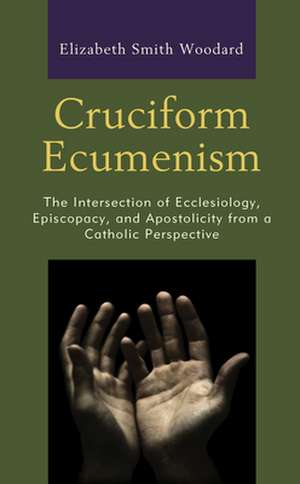
Cruciform Ecumenism: The Intersection of Ecclesiology, Episcopacy, and Apostolicity from a Catholic Perspective
Autor Elizabeth Smith Woodarden Limba Engleză Hardback – 6 sep 2019
Preț: 583.24 lei
Preț vechi: 863.98 lei
-32%
Puncte Express: 875
Carte tipărită la comandă
Livrare economică 23 noiembrie-07 decembrie
Livrare prin curier în România Termenul estimat este afișat lângă disponibilitate.
Transport gratuit pentru acest produs Plată online sau ramburs, în funcție de opțiunile comenzii.
Retur gratuit în 14 zile Comandă securizată și suport în română.
Specificații
ISBN-13: 9781978701472
ISBN-10: 1978701470
Pagini: 286
Dimensiuni: 160 x 228 x 23 mm
Greutate: 0.52 kg
Editura: Bloomsbury Publishing
Colecția Fortress Academic
Locul publicării:New York, United States
ISBN-10: 1978701470
Pagini: 286
Dimensiuni: 160 x 228 x 23 mm
Greutate: 0.52 kg
Editura: Bloomsbury Publishing
Colecția Fortress Academic
Locul publicării:New York, United States
Descriere
The truth claims of Christianity appear compromised by the division of Christ's followers into different denominations. What keeps Christians separated, retreating to their corners labeled Catholic, Orthodox, and various types of Protestant? Elizabeth Smith Woodard accounts for Christian disunity in terms of ecclesiology, episcopacy, and apostolicity: in brief, Who are we? Who is in charge? And are we who we say we are? Woodard argues that the controversial issues dividing Christians today stem from these questions of authority and identity. What would it look like, Woodard asks, if Christians did not insist on making "others" more "like us," but instead worked toward all of "us" becoming more and more like Christ? She answers that growing in such cruciformity should serve as the basis for unity. Using recent unity-achieving Anglican-Lutheran discussions as a case study, she examines the crucial intersection of ecclesiology, episcopacy, and apostolicity to argue that Christians' growth in Christ's mission necessarily entails growing in unity and cruciformity.
Cuprins
Chapter 1: The State of the Problem
Chapter 2: The Anglican-Lutheran Relationship
Chapter 3: The Anglican-Lutheran Solution
Chapter 4: Reception of the Anglican-Lutheran Solution
Chapter 5: What can Catholicism Take from the Anglican-Lutheran Solution?
Chapter 6: How Might Unity among Catholics and Protestants Look?
Chapter 7: Koinonia and Kenosis
Chapter 2: The Anglican-Lutheran Relationship
Chapter 3: The Anglican-Lutheran Solution
Chapter 4: Reception of the Anglican-Lutheran Solution
Chapter 5: What can Catholicism Take from the Anglican-Lutheran Solution?
Chapter 6: How Might Unity among Catholics and Protestants Look?
Chapter 7: Koinonia and Kenosis
Recenzii
A welcome addition to the literature on ecclesial apostolicity, the central point of division between the western Christian traditions. Elizabeth Smith Woodard makes many insightful points in the course of her valuable study. Most useful is the exploration of what the Catholic Church might have to learn from the Anglican and Lutheran traditions in relation to a renewed understanding of apostolicity with ecumenical potential.
The ecumenical agreements between Anglicans and Lutherans in North America and Northern Europe were historic. Rarely have churches which had been divided on episcopacy been able to bridge their differences and come together in closer communion. Other Christian communities need to attend to what these agreements accomplished. Can they be taken up by others in different settings? Woodard asks this question from a Catholic perspective, describing all the texts, carefully laying out their logic, and offering her own creative suggestions for the way forward.
Is there hope for ecumenical theology, indeed for ecumenism itself? Woodard offers a resounding "Yes" to this question through her expertly crafted analysis. Her scholarship is both magnificently comprehensive yet remarkably accessible. All who value unity within a broken Christianity need to read this work.
As a minister in parish and campus life I've watched the tides of ecumenical fervor ebb and flow over the past 45 years. My experience tells me we're presently at a low water mark in the local faith community. Elizabeth Smith Woodard's work offers an opportunity for the conversation to begin anew. Proposing a cruciform ecumenism, Woodard offers a framework for examining and assessing the ecumenical movement and moving forward on the path toward reconciliation. Rooted solidly in the scriptures, this book handily renews our understanding of the ecumenical imperative and articulates the demands of koinonia and kenosis in terms accessible to a broad readership who will find their own faith stirred and challenged by Woodard's thesis. Institutional pastoral leadership and local pastors and groups will benefit from coming to understand cruciform ecumenism as a path to a true, lived and shared "self-emptying for the sake of genuine Christ-like community." Cruciform Ecumenism is highly recommended for those who want to take ecumenism seriously once again.
The ecumenical agreements between Anglicans and Lutherans in North America and Northern Europe were historic. Rarely have churches which had been divided on episcopacy been able to bridge their differences and come together in closer communion. Other Christian communities need to attend to what these agreements accomplished. Can they be taken up by others in different settings? Woodard asks this question from a Catholic perspective, describing all the texts, carefully laying out their logic, and offering her own creative suggestions for the way forward.
Is there hope for ecumenical theology, indeed for ecumenism itself? Woodard offers a resounding "Yes" to this question through her expertly crafted analysis. Her scholarship is both magnificently comprehensive yet remarkably accessible. All who value unity within a broken Christianity need to read this work.
As a minister in parish and campus life I've watched the tides of ecumenical fervor ebb and flow over the past 45 years. My experience tells me we're presently at a low water mark in the local faith community. Elizabeth Smith Woodard's work offers an opportunity for the conversation to begin anew. Proposing a cruciform ecumenism, Woodard offers a framework for examining and assessing the ecumenical movement and moving forward on the path toward reconciliation. Rooted solidly in the scriptures, this book handily renews our understanding of the ecumenical imperative and articulates the demands of koinonia and kenosis in terms accessible to a broad readership who will find their own faith stirred and challenged by Woodard's thesis. Institutional pastoral leadership and local pastors and groups will benefit from coming to understand cruciform ecumenism as a path to a true, lived and shared "self-emptying for the sake of genuine Christ-like community." Cruciform Ecumenism is highly recommended for those who want to take ecumenism seriously once again.