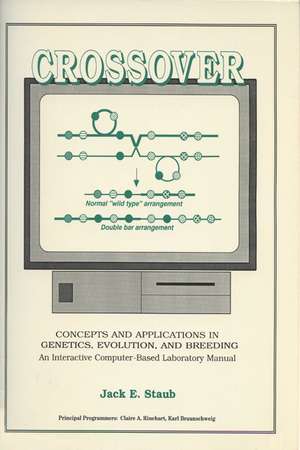
Crossover: Concepts and Applications in Genetics, Evolution, and Breeding: An Interactive Computer-Based Laboratory Manual
Autor Jack E. Stauben Limba Engleză Paperback – 15 feb 1994
Crossover is a laboratory manual and computer program that work together to teach the principles of genetics. Designed to complement regular textbooks and classroom instruction, Crossover consists of thirty-five modules that can be tailored to fit genetics courses at several levels. Examples, interactive computer models, problems, and self-tests all help students understand difficult concepts and learn the basic mathematical skills needed to study contemporary theories of genetics, evolution, and breeding. The easy-to-use tutorial system lets students work at their own pace.
Features include:
• In-depth investigations of meiosis, genetic ratios, linkage mutation, natural selection, Hardy-Weinberg equilibrium, artificial selection, quantitative genetics, breeding methods, mating designs, plant patent law, and the use of molecular markers
• A computer model that allows students to manipulate genetic parameters and compare outcomes. Students can observe evolution and artificial selection in action
• A “Major Concepts” section at the beginning of each chapter to help students focus on the important material to be learned
• A visual, easy-to-understand presentation of material
• Exercises based on genetic data and analyses from actual research projects
• Several stages of complexity within each area of instruction.
• Instant grading of exercises
• “Suggested Readings” at the end of each chapter to direct the student to related books, articles, and computer programs.
Features include:
• In-depth investigations of meiosis, genetic ratios, linkage mutation, natural selection, Hardy-Weinberg equilibrium, artificial selection, quantitative genetics, breeding methods, mating designs, plant patent law, and the use of molecular markers
• A computer model that allows students to manipulate genetic parameters and compare outcomes. Students can observe evolution and artificial selection in action
• A “Major Concepts” section at the beginning of each chapter to help students focus on the important material to be learned
• A visual, easy-to-understand presentation of material
• Exercises based on genetic data and analyses from actual research projects
• Several stages of complexity within each area of instruction.
• Instant grading of exercises
• “Suggested Readings” at the end of each chapter to direct the student to related books, articles, and computer programs.
Preț: 213.92 lei
Preț vechi: 225.17 lei
-5%
Puncte Express: 321
Carte tipărită la comandă
Livrare economică 30 noiembrie-14 decembrie
Livrare prin curier în România Termenul estimat este afișat lângă disponibilitate.
Transport gratuit de la 400.00 lei Plată online sau ramburs, în funcție de opțiunile comenzii.
Retur gratuit în 14 zile Comandă securizată și suport în română.
Specificații
ISBN-13: 9780299135645
ISBN-10: 0299135640
Pagini: 384
Dimensiuni: 216 x 279 x 28 mm
Greutate: 0.94 kg
Editura: University of Wisconsin Press
Colecția University of Wisconsin Press
ISBN-10: 0299135640
Pagini: 384
Dimensiuni: 216 x 279 x 28 mm
Greutate: 0.94 kg
Editura: University of Wisconsin Press
Colecția University of Wisconsin Press
Descriere
Crossover is a laboratory manual and computer program that work together to teach the principles of genetics. Designed to complement regular textbooks and classroom instruction, Crossover consists of thirty-five modules that can be tailored to fit genetics courses at several levels. Examples, interactive computer models, problems, and self-tests all help students understand difficult concepts and learn the basic mathematical skills needed to study contemporary theories of genetics, evolution, and breeding. The easy-to-use tutorial system lets students work at their own pace.
Features include:
• In-depth investigations of meiosis, genetic ratios, linkage mutation, natural selection, Hardy-Weinberg equilibrium, artificial selection, quantitative genetics, breeding methods, mating designs, plant patent law, and the use of molecular markers
• A computer model that allows students to manipulate genetic parameters and compare outcomes. Students can observe evolution and artificial selection in action
• A “Major Concepts” section at the beginning of each chapter to help students focus on the important material to be learned
• A visual, easy-to-understand presentation of material
• Exercises based on genetic data and analyses from actual research projects
• Several stages of complexity within each area of instruction.
• Instant grading of exercises
• “Suggested Readings” at the end of each chapter to direct the student to related books, articles, and computer programs.
Features include:
• In-depth investigations of meiosis, genetic ratios, linkage mutation, natural selection, Hardy-Weinberg equilibrium, artificial selection, quantitative genetics, breeding methods, mating designs, plant patent law, and the use of molecular markers
• A computer model that allows students to manipulate genetic parameters and compare outcomes. Students can observe evolution and artificial selection in action
• A “Major Concepts” section at the beginning of each chapter to help students focus on the important material to be learned
• A visual, easy-to-understand presentation of material
• Exercises based on genetic data and analyses from actual research projects
• Several stages of complexity within each area of instruction.
• Instant grading of exercises
• “Suggested Readings” at the end of each chapter to direct the student to related books, articles, and computer programs.