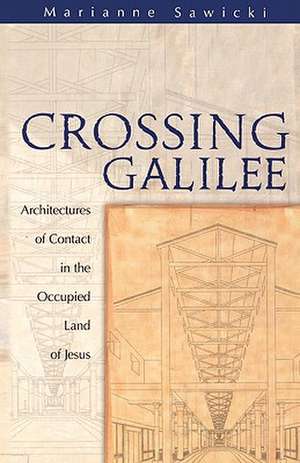
Crossing Galilee: Architectures of Contact in the Occupied Land of Jesus
Autor Marianne Sawickien Limba Engleză Paperback – iun 2000
Sawicki contests recent portraits of Jesus as a Mediterranean peasant, a Cynic sage, or the convener of a fellowship of equals. In addition, she calls into question readings of ancient Galilee that emphasize it as a society marked simply by economic stratification or by an "honor-shame" sociology. Rather, she discovers the Galilean Jesus' indigenous cultural idiom in its material structures for the negotiation of kinship, the management of labor, the distribution of commodities, and the construction of gender.
Sawicki's book is the first to balance classical urban archaeology against the more recent archaeology of villages and of local and regional commerce. It frames current issues in Jesus research in terms that can guide both ongoing village excavations in Israel and responsible exegesis of the Gospels in church and academy.
Marianne Sawicki is the author of Seeing the Lord: Resurrection and Early Christian Practices.
For: Seminarians; graduate students; biblical archaeologists
Preț: 277.87 lei
Preț vechi: 369.45 lei
-25%
Puncte Express: 417
Carte tipărită la comandă
Livrare economică 28 noiembrie-12 decembrie
Livrare prin curier în România Termenul estimat este afișat lângă disponibilitate.
Transport gratuit de la 400.00 lei Plată online sau ramburs, în funcție de opțiunile comenzii.
Retur gratuit în 14 zile Comandă securizată și suport în română.
Specificații
ISBN-13: 9781563383076
ISBN-10: 1563383071
Pagini: 270
Ilustrații: 1
Dimensiuni: 136 x 214 x 16 mm
Greutate: 0.35 kg
Editura: Bloomsbury Publishing
Colecția Trinity Press International
Locul publicării:New York, United States
ISBN-10: 1563383071
Pagini: 270
Ilustrații: 1
Dimensiuni: 136 x 214 x 16 mm
Greutate: 0.35 kg
Editura: Bloomsbury Publishing
Colecția Trinity Press International
Locul publicării:New York, United States
V-ar putea interesa
-
 Sense and Stigma in the Gospels: Depictions of Sensory-Disabled CharactersLouise J. Lawrence-13%Preț: 262.43 lei302.97 lei
 -
 -31%Preț: 1011.55 lei1471.40 lei
 -
 -8%Preț: 426.47 lei463.56 lei
 -
 Preț: 389.82 lei
 -
 -22%Preț: 87.42 lei111.68 lei
 -
 Paul and the Faithfulness of GodN T Wright-8%Preț: 642.40 lei698.27 lei
 -
 Baker Compact Bible DictionaryEd Tremper LongmanPreț: 140.33 lei
 -
 The Lost World of ScriptureJohn H. WaltonPreț: 199.67 lei
 -
 Study Bible-ESVEsv Bibles-9%Preț: 648.53 lei712.66 lei
 -
 Study Bible-ESV-Large PrintT. Desmond Alexander-8%Preț: 404.62 lei439.80 lei
 -
 Preț: 81.76 lei
 -
 -10%Preț: 70.17 lei77.62 lei
Recenzii
"With her disciplined imagination and lucid prose, Marianne Sawicki invites us into the alternative culture of first-century Galilee. Archaeology, anthropology, and exegesis are here coordinated to construct fascinating options in the historical understanding of Jesus and Christian origins." -- Bruce Chilton
"This is a provocative work that leads both the scholar and the believer to reexamine the current consensus...Sawicki forces her readers to take another look at issues that are the most fundamental to both the academy and the church. She does so in an engaging rather than a contentious way. Those interested in the archaeology of first-century Galilee, in the Jesus question, and in the first Christian community will enjoy this book."--Leslie J. Hope, The Catholic Biblical Quarterly, Vol. 63, 2001
"One must appreciate Sawicki's attempt to breathe interpretive life into ancient materials that might be rendered sterile in the hands of a less imaginative researcher."--Donald D. Binder, Southern Methodist University, Interpretation, January 2002
"...a useful, provocative book..." --Casimir Bernas, Holy Trinity Abbey, reviewing for Religious Studies Review, January 2001
"This study points a compelling way forward into the material and social places and matrices that Jesus and his first followers inhabited." --Matthew L. Skinner, Princeton Theological Seminary Theology Today January 2002
"This is a provocative work that leads both the scholar and the believer to reexamine the current consensus...Sawicki forces her readers to take another look at issues that are the most fundamental to both the academy and the church. She does so in an engaging rather than a contentious way. Those interested in the archaeology of first-century Galilee, in the Jesus question, and in the first Christian community will enjoy this book."--Leslie J. Hope, The Catholic Biblical Quarterly, Vol. 63, 2001
"One must appreciate Sawicki's attempt to breathe interpretive life into ancient materials that might be rendered sterile in the hands of a less imaginative researcher."--Donald D. Binder, Southern Methodist University, Interpretation, January 2002
"...a useful, provocative book..." --Casimir Bernas, Holy Trinity Abbey, reviewing for Religious Studies Review, January 2001
"This study points a compelling way forward into the material and social places and matrices that Jesus and his first followers inhabited." --Matthew L. Skinner, Princeton Theological Seminary Theology Today January 2002