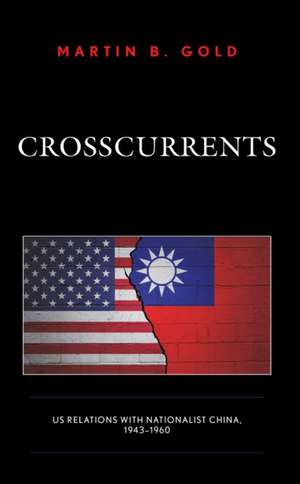
Crosscurrents: US Relations with Nationalist China, 1943-1960
Autor Martin B. Golden Limba Engleză Paperback – 29 ian 2025
| Toate formatele și edițiile | Preț | Express |
|---|---|---|
| Paperback (1) | 255.93 lei 6-8 săpt. | |
| Bloomsbury Publishing – 29 ian 2025 | 255.93 lei 6-8 săpt. | |
| Hardback (1) | 644.57 lei 6-8 săpt. | |
| Bloomsbury Publishing – 15 feb 2023 | 644.57 lei 6-8 săpt. |
Preț: 255.93 lei
Preț vechi: 342.44 lei
-25%
Puncte Express: 384
Preț estimativ în valută:
45.29€ • 52.93$ • 39.32£
45.29€ • 52.93$ • 39.32£
Carte tipărită la comandă
Livrare economică 19 februarie-05 martie
Preluare comenzi: 021 569.72.76
Specificații
ISBN-13: 9781793631169
ISBN-10: 1793631166
Pagini: 430
Ilustrații: 20 b/w photos;
Dimensiuni: 158 x 237 x 25 mm
Greutate: 0.57 kg
Editura: Bloomsbury Publishing
Colecția Lexington Books
Locul publicării:New York, United States
ISBN-10: 1793631166
Pagini: 430
Ilustrații: 20 b/w photos;
Dimensiuni: 158 x 237 x 25 mm
Greutate: 0.57 kg
Editura: Bloomsbury Publishing
Colecția Lexington Books
Locul publicării:New York, United States
Cuprins
Acknowledgments
Introduction
Chapter 1: A Fraught Partnership
Chapter 2: An Impossible Coalition
Chapter 3: Estrangement and a Lifeline
Chapter 4: 1953: A New Administration Arrives in Washington
Chapter 5: Rising Tensions in the Strait
Chapter 6: Eisenhower Goes to Congress
Chapter 7: The Formosa Resolution: Floor Proceedings
Chapter 8: After the Resolution, a Treaty
Chapter 9: Defend or Abandon Quemoy and Matsu
Chapter 10: A Crisis Renewed
Conclusion
Appendix A: Text of the President Eisenhower's Message to Congress on the Formosa Resolution
Appendix B: Text to the Formosa Resolution
Appendix C: Text of the United States Mutual Defense Treaty with the Republic of China and related letters of understanding
Appendix D: The Anti-Secession Law of 2005
Appendix E: Maps of China and Taiwan
Bibliography
About the Author
Introduction
Chapter 1: A Fraught Partnership
Chapter 2: An Impossible Coalition
Chapter 3: Estrangement and a Lifeline
Chapter 4: 1953: A New Administration Arrives in Washington
Chapter 5: Rising Tensions in the Strait
Chapter 6: Eisenhower Goes to Congress
Chapter 7: The Formosa Resolution: Floor Proceedings
Chapter 8: After the Resolution, a Treaty
Chapter 9: Defend or Abandon Quemoy and Matsu
Chapter 10: A Crisis Renewed
Conclusion
Appendix A: Text of the President Eisenhower's Message to Congress on the Formosa Resolution
Appendix B: Text to the Formosa Resolution
Appendix C: Text of the United States Mutual Defense Treaty with the Republic of China and related letters of understanding
Appendix D: The Anti-Secession Law of 2005
Appendix E: Maps of China and Taiwan
Bibliography
About the Author
Recenzii
The queue of nations in modern times seeking America's shield for defense or its sword in settling ancient conflicts is very long, indeed. In this volume, Marty Gold provides us with a clear-eyed look at the innumerable conflicting factors in the Taiwan Strait that, if not navigated with the wisdom of an Eisenhower, could lead to world-wide conflagration. All who wish to understand the complexities of this international flashpoint should read this book.
Martin Gold applies his extensive knowledge of Congressional history, politics, and policy to a pivotal period in U.S.-China relations, 1943-1960. This book should be read by Members of Congress and policymakers in the executive branch to understand the complex role of Taiwan in U.S.-China relations at this time of escalating tensions between these two major powers.
Marty deftly explains how the debate over Taiwan has bedeviled and been the crux of US/China relations, beginning with Mao's rise and continuing to this day. His exhaustive material includes riveting arguments by key principles in relevant countries. It's fascinating to see such an honest, objective, and perceptive work, especially when much of Taiwan's oxygen has been consumed by so many leaders. It's a must read for anyone who is concerned about Taiwan today.
Martin Gold applies his extensive knowledge of Congressional history, politics, and policy to a pivotal period in U.S.-China relations, 1943-1960. This book should be read by Members of Congress and policymakers in the executive branch to understand the complex role of Taiwan in U.S.-China relations at this time of escalating tensions between these two major powers.
Marty deftly explains how the debate over Taiwan has bedeviled and been the crux of US/China relations, beginning with Mao's rise and continuing to this day. His exhaustive material includes riveting arguments by key principles in relevant countries. It's fascinating to see such an honest, objective, and perceptive work, especially when much of Taiwan's oxygen has been consumed by so many leaders. It's a must read for anyone who is concerned about Taiwan today.