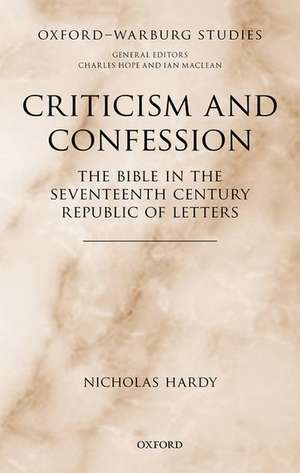
Criticism and Confession: The Bible in the Seventeenth Century Republic of Letters: Oxford-Warburg Studies
Autor Nicholas Hardyen Limba Engleză Hardback – 6 iul 2017
Din seria Oxford-Warburg Studies
- 18%
 Preț: 332.22 lei
 - 32%
 Preț: 883.32 lei
 - 32%
 Preț: 693.92 lei
 - 31%
 Preț: 663.66 lei
 - 33%
 Preț: 1594.02 lei
 - 34%
 Preț: 681.13 lei
 - 33%
 Preț: 1204.13 lei
 - 33%
 Preț: 1783.33 lei
 - 33%
 Preț: 1825.04 lei
 - 33%
 Preț: 1895.79 lei
 - 32%
 Preț: 1625.56 lei
 - 33%
 Preț: 1741.45 lei
 - 22%
 Preț: 390.99 lei
 - 32%
 Preț: 1330.07 lei
 - 33%
 Preț: 2299.70 lei
 - 30%
 Preț: 446.52 lei
 - 33%
 Preț: 1189.83 lei
 - 31%
 Preț: 1393.09 lei
 - 22%
 Preț: 381.38 lei
 - 23%
 Preț: 346.53 lei
 - 31%
 Preț: 742.58 lei
 - 30%
 Preț: 664.89 lei
 - 31%
 Preț: 863.88 lei
 - 32%
 Preț: 696.23 lei
 - 30%
 Preț: 748.07 lei
 - 30%
 Preț: 558.96 lei
 - 32%
 Preț: 828.12 lei
 - nou
 Preț: 672.01 lei
Preț: 823.50 lei
Preț vechi: 1194.46 lei
-31%
Puncte Express: 1235
Carte tipărită la comandă
Livrare economică 27 noiembrie-08 decembrie
Livrare prin curier în România Termenul estimat este afișat lângă disponibilitate.
Transport gratuit pentru acest produs Plată online sau ramburs, în funcție de opțiunile comenzii.
Retur gratuit în 14 zile Comandă securizată și suport în română.
Specificații
ISBN-13: 9780198716099
ISBN-10: 0198716095
Pagini: 478
Dimensiuni: 152 x 222 x 33 mm
Greutate: 0.7 kg
Editura: OUP OXFORD
Colecția OUP Oxford
Seria Oxford-Warburg Studies
Locul publicării:Oxford, United Kingdom
ISBN-10: 0198716095
Pagini: 478
Dimensiuni: 152 x 222 x 33 mm
Greutate: 0.7 kg
Editura: OUP OXFORD
Colecția OUP Oxford
Seria Oxford-Warburg Studies
Locul publicării:Oxford, United Kingdom
V-ar putea interesa
-
 The Renaissance: A Very Short IntroductionJerry Brotton-20%Preț: 57.15 lei71.12 lei
 -
 -19%Preț: 300.24 lei369.40 lei
 -
 The Sixteenth CenturyEuan Cameron-21%Preț: 279.72 lei352.31 lei
 -
 -19%Preț: 540.57 lei667.37 lei
 -
 -31%Preț: 626.13 lei909.10 lei
 -
 A World Lit Only by FireWilliam ManchesterPreț: 112.25 lei
 -
 Mosquito EmpiresJ. R. McneillPreț: 244.24 lei
 -
 The Military RevolutionGeoffrey ParkerPreț: 264.77 lei
 -
 -15%Preț: 428.45 lei504.06 lei
 -
 -23%Preț: 231.10 lei298.95 lei
Recenzii
Criticism and Confession exemplifies the very best kind of scholarly book: one that challenges a long-standing narrative and, by interweaving penetrating insight with multivectored erudition, manages to make an important field exciting again.
Criticism and Confession ranges widely and provides a densely referenced treatment of its subjects
A great strength of the book is Hardy's detailed knowledge of the networks of the scholars he covers, which enables him to relate their letters and manuscripts to their interventions in the printed debate. As befits an Oxford- Warburg study, the book delves deeply into the scholarly controversies of the period and explains clearly but precisely how academics went about resolving those controversies - as least in so far as this could be done through erudition, discovery and the operation of patronage. It is a richly textured (and impressively footnoted) account of a complex, intricate and often rather tense world.
guides the reader through a series of fascinating debates... Hardy's achievement is not only to draw our attention to the confessional biases in early modern biblical criticism, but to tease out how those biases operated.
Nicholas Hardy's brilliant book is destined for a long life thanks to its intensive research and bold revisionist argument . . . Hardy's uncompromising and rigorous account will come as a salutary challenge to anyone who wants to discuss these subjects and as an enormous illumination to those who have not studied the primary material ( . . . ) this book is the most forceful achievement so far of the new movement toward early modern scholarship and religion.
[T]his is an ambitious work that helps us to better understand the 17th-century Republic of Letters and especially those figures whom historians have previously been eager to place in a heterodox camp and interpret as part of the gradual secularization of modern scholarship. Hardy's work directs us to the importance of contextualizing early modern scholars with an eye toward their social circles, lines of patronage, and intended audiences. He broadens the scope of evidence by analyzing published works alongside incomplete drafts, suppressed manuscripts, and correspondence, and engages in close readings that show a sensitivity to the theological dimensions of these scholarly works of criticism.
Criticism and Confession is a learned, stimulating and original study in which Nicholas Hardy prompts a profound reconsideration of traditional views.
powerful and controversial ... an ambitious work that covers an entire century. It has no rival.
resurrects the unity of a whole intellectual culture, which was characterized by a dynamic engagement with ancient texts ... very well-researched ... excellent command of sources in Latin and Greek
Criticism and Confession ranges widely and provides a densely referenced treatment of its subjects
A great strength of the book is Hardy's detailed knowledge of the networks of the scholars he covers, which enables him to relate their letters and manuscripts to their interventions in the printed debate. As befits an Oxford- Warburg study, the book delves deeply into the scholarly controversies of the period and explains clearly but precisely how academics went about resolving those controversies - as least in so far as this could be done through erudition, discovery and the operation of patronage. It is a richly textured (and impressively footnoted) account of a complex, intricate and often rather tense world.
guides the reader through a series of fascinating debates... Hardy's achievement is not only to draw our attention to the confessional biases in early modern biblical criticism, but to tease out how those biases operated.
Nicholas Hardy's brilliant book is destined for a long life thanks to its intensive research and bold revisionist argument . . . Hardy's uncompromising and rigorous account will come as a salutary challenge to anyone who wants to discuss these subjects and as an enormous illumination to those who have not studied the primary material ( . . . ) this book is the most forceful achievement so far of the new movement toward early modern scholarship and religion.
[T]his is an ambitious work that helps us to better understand the 17th-century Republic of Letters and especially those figures whom historians have previously been eager to place in a heterodox camp and interpret as part of the gradual secularization of modern scholarship. Hardy's work directs us to the importance of contextualizing early modern scholars with an eye toward their social circles, lines of patronage, and intended audiences. He broadens the scope of evidence by analyzing published works alongside incomplete drafts, suppressed manuscripts, and correspondence, and engages in close readings that show a sensitivity to the theological dimensions of these scholarly works of criticism.
Criticism and Confession is a learned, stimulating and original study in which Nicholas Hardy prompts a profound reconsideration of traditional views.
powerful and controversial ... an ambitious work that covers an entire century. It has no rival.
resurrects the unity of a whole intellectual culture, which was characterized by a dynamic engagement with ancient texts ... very well-researched ... excellent command of sources in Latin and Greek
Notă biografică
Nicholas Hardy is currently Munby Research Fellow in Bibliography at the University Library and Darwin College, Cambridge. His research interests cover early modern humanism, intellectual history, classical reception studies, and the history of the book. He took a BA (2008) in Classics and English at Corpus Christi College, Oxford, and then an MSt (2009) and DPhil (2012) in English, also at Oxford, before joining Trinity College, Cambridge to take up a four-year Research Fellowship in 2012. He has also held visiting fellowships at the Scaliger Institute, Leiden University Library, and the Folger Institute in Washington, DC.
Cuprins
- Introduction
- Prelude: The discourse of critica in the late Renaissance
- PART I: Debating sacred history in England and the continent
- The 'Theological Vortex'? Isaac Casaubon in England, 1610-1614
- Philology divided: the controversy over John Selden's Historie of Tithes (1618)
- PART II: Commenting on the New Testament
- New Testament scholarship after Scaliger
- Hugo Grotius: 'historical criticism' in its generic and controversial contexts
- Conclusion: the myth of 'critical exegesis'
- PART III: Criticizing the Old Testament
- Anti-Protestant controversy and the 'ecclesiastical' versions of the Old Testament: the case of Jean Morin
- Protestants and the Septuagint: the failed edition of Patrick Young
- Critical judgement and theological exegesis: the case of Louis Cappel
- Cappel's Critica sacra in the confessional republic of letters
- The London Polyglot Bible: synthesis, retrospective, or another controversial intervention?
- Conclusion: from humanistic exegesis to sacred criticism
- Coda. From Critica sacra to Enlightened critique?
- Critica criticorum: the case of Richard Simon
- Making the ars critica 'more philosophical': the case of Jean Le Clerc
- Conclusion: the generalization of criticism?
- Bibliography