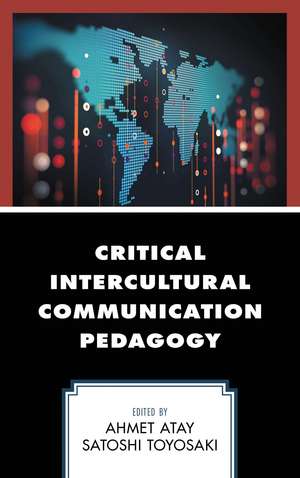
Critical Intercultural Communication Pedagogy
Editat de Ahmet Atay, Satoshi Toyosaki Contribuţii de Bernadette Marie Calafell, Sharon Chuang, Leda Cooks, Linsay Cramer, Tina Harris, Alberto González, Robert Gutierrez-Perez, Rona Tamiko Halualani, Jieyoung Kong, Lore/tta LeMaster, Ryan M. Lescure, Jennifer Martin, S. Lily Mendoza, Keith Nainby, Mark Orbe, Jennifer Sandoval, Amy Aldridge Sanford, Gust Yepen Limba Engleză Paperback – 15 iun 2020
Preț: 272.22 lei
Preț vechi: 370.21 lei
-26%
Puncte Express: 408
Carte tipărită la comandă
Livrare economică 09-23 decembrie
Livrare prin curier în România Termenul estimat este afișat lângă disponibilitate.
Transport gratuit de la 400.00 lei Plată online sau ramburs, în funcție de opțiunile comenzii.
Retur gratuit în 14 zile Comandă securizată și suport în română.
Specificații
ISBN-13: 9781498531221
ISBN-10: 1498531229
Pagini: 280
Ilustrații: 1 b/w photos;
Dimensiuni: 150 x 228 x 18 mm
Greutate: 0.41 kg
Editura: Bloomsbury Publishing
Colecția Lexington Books
Locul publicării:New York, United States
ISBN-10: 1498531229
Pagini: 280
Ilustrații: 1 b/w photos;
Dimensiuni: 150 x 228 x 18 mm
Greutate: 0.41 kg
Editura: Bloomsbury Publishing
Colecția Lexington Books
Locul publicării:New York, United States
Cuprins
Contents
Introduction
Chapter One: Demarcating the "Critical" in Critical Intercultural Communication Studies
Rona Tamiko Halualani
Chapter Two: Making a Place: A Framework for Educators Working with Critical Intercultural Communication and Critical Communication Pedagogy
Jennifer Sandoval and Keith Nainby
Chapter Three: Intercultural Communication, Ethics and Activism Pedagogy
Leda Cooks
Chapter Four: (Critical) Love is a Battlefield: Implications for a Critical Intercultural Pedagogical Approach
Bernadette Marie Calafell and Robert Gutierrez-Perez
Chapter Five: Engaging Historical Trauma in the Classroom: Ethnoautobiography as Decolonizing Practice
S. Lily Mendoza
Chapter Six: Pedagogies of Failure: Queer Communication Pedagogy as Anti-Normative
Benny LeMaster
Chapter Seven: Pedagogy of the Taboo: Theorizing Transformative Teaching-Learning Experiences that Speak Truth(s) to Power
Mark P. Orbe
Chapter Eight: Obstructing the Process of Becoming: Basal Whiteness and the Challenge to Critical
Recenzii
This is a rich and essential collection of essays by leading scholar-educators of critical intercultural communication. Rooted in lived experiences across identities and standpoints, it incorporatespowerful narrative autoethnography, performance, embodied practice, critical love, and other approaches within a variety of contexts. It addresses practical, ethical, and emotional elements of teaching, and offers deep and valuable insights for seasoned and novice critical educators who strive to decolonize our teaching through dialogue and self-reflexivity. Merging insights of intercultural communication scholarship with those of critical pedagogy, the book constitutes an important contribution to the turn toward social justice within communication studies.
Critical Intercultural Communication Pedagogy is a powerful and resonant collection of insights into the nuances of culture, power, and pedagogy. Because the authors open dialogic explorations into teaching, learning, and embodying feminist, mediated, postcolonial, queer, and other critical theories, these writings will be of great interest and value to communication scholars in/of/beyond the classroom. Atay and Toyosaki have assembled established scholars who are committed to modeling reflexivity in illuminating and interrogating structures of power and privilege that affect us all. These readings command us to compassionately and critically investigate our own roles in naming, perpetuating, and challenging these structures in our classrooms and in our scholarship; its value to the discipline is considerable.
Critical Intercultural Communication Pedagogy is a powerful and resonant collection of insights into the nuances of culture, power, and pedagogy. Because the authors open dialogic explorations into teaching, learning, and embodying feminist, mediated, postcolonial, queer, and other critical theories, these writings will be of great interest and value to communication scholars in/of/beyond the classroom. Atay and Toyosaki have assembled established scholars who are committed to modeling reflexivity in illuminating and interrogating structures of power and privilege that affect us all. These readings command us to compassionately and critically investigate our own roles in naming, perpetuating, and challenging these structures in our classrooms and in our scholarship; its value to the discipline is considerable.