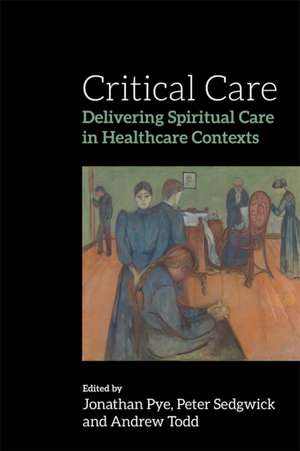
Critical Care: Delivering Spiritual Care in Healthcare Contexts
Editat de Peter Sedgwick, Andrew Todd, Jonathan Pye Contribuţii de Rodney Baxendale, Hamish Ferguson-Stuart, Stephen Flatt, Anne McCormick, Layla Welford, Karen Mackinnon, Mirabai Galashan, Julian Raffay, Richard Wharton, Mark Clayton, Debbie Hodge, Charles Thody, Steve Nolanen Limba Engleză Paperback – 21 iul 2015
The integration of theory and practical application in these essays will be of interest to chaplains, healthcare practitioners, and students of theology and healthcare.
Preț: 220.24 lei
Preț vechi: 293.75 lei
-25%
Puncte Express: 330
Carte disponibilă
Livrare economică 09-23 noiembrie
Livrare prin curier în România Termenul estimat este afișat lângă disponibilitate.
Transport gratuit de la 400.00 lei Plată online sau ramburs, în funcție de opțiunile comenzii.
Retur gratuit în 14 zile Comandă securizată și suport în română.
Specificații
ISBN-13: 9781849054973
ISBN-10: 1849054975
Pagini: 280
Dimensiuni: 169 x 231 x 17 mm
Greutate: 0.41 kg
Editura: JESSICA KINGSLEY PUBLISHERS
Colecția Jessica Kingsley Publishers
Locul publicării:London, United Kingdom
ISBN-10: 1849054975
Pagini: 280
Dimensiuni: 169 x 231 x 17 mm
Greutate: 0.41 kg
Editura: JESSICA KINGSLEY PUBLISHERS
Colecția Jessica Kingsley Publishers
Locul publicării:London, United Kingdom
V-ar putea interesa
-
 The PastorEugene H. PetersonPreț: 103.90 lei
 -
 El Evangelio Segun JuanRodolfo H BlankPreț: 223.78 lei
 -
 Kindling Desire for GodKay L NorthcuttPreț: 147.82 lei
 -
 Preaching as WorshipMary ConnealyPreț: 135.41 lei
 -
 Reading for PreachingCornelius PlantingaPreț: 108.78 lei
 -
 Preaching with VarietyJeffrey ArthursPreț: 112.74 lei
 -
 Gentle ShepherdingJoseph E Bush JrPreț: 160.33 lei
 -
 The Relational PastorAndrew RootPreț: 123.18 lei
 -
 Children's Ministry in the Way of JesusDavid M. CsinosPreț: 141.17 lei
 -
 Slow ChurchC. Christopher SmithPreț: 136.66 lei
 -
 Unfettered SpiritRobert D. CornwallPreț: 84.56 lei
Recenzii
The development of meaning and practice in spiritual and pastoral care in hospital chaplaincy has applications both to the healthcare system and beyond. This book makes a great contribution to that development. Three eminent thinkers in this area provide the context and connections, and several practitioners provide the reflection on practice - bridging the gaps between theory, values and practice; theological reflection and reflective practice; and spirituality and the practice of healthcare. Don't just view this book as relevant to the profession of hospital chaplaincy (significant though its contribution to that is), view it as a major contribution to the profession of care in any context.
This is one of the most comprehensive and practical books on healthcare chaplaincy I've read. Like the act of chaplaincy itself, it takes the reader to a place of deep questioning and embodies the theology it espouses: relational, panentheistic, apophatic and humble. Its value reaches far beyond the healthcare context into what spirituality can offer the public square more generally. Highly recommended.
Though we live in a secular time, we are still confronted with questions about meaning and purpose, particularly when we become ill or are confronted with a terminal condition. Spiritual care tries to support patients, carers and staff to find an answer to such questions in a dialogical and compassionate way. This book presents excellent contributions to spiritual care from a multi-disciplinary perspective and will certainly help to develop spiritual care as a professional practice. This is very much needed in view of the economisation of health care and the marginalization of the care for the spiritual needs of patients and their carers.
For those involved in providing spiritual care within the NHS in the UK, this is an invaluable book - clear, well written and structured, and with impeccable bibliography and further resources to aid study.
This is one of the most comprehensive and practical books on healthcare chaplaincy I've read. Like the act of chaplaincy itself, it takes the reader to a place of deep questioning and embodies the theology it espouses: relational, panentheistic, apophatic and humble. Its value reaches far beyond the healthcare context into what spirituality can offer the public square more generally. Highly recommended.
Though we live in a secular time, we are still confronted with questions about meaning and purpose, particularly when we become ill or are confronted with a terminal condition. Spiritual care tries to support patients, carers and staff to find an answer to such questions in a dialogical and compassionate way. This book presents excellent contributions to spiritual care from a multi-disciplinary perspective and will certainly help to develop spiritual care as a professional practice. This is very much needed in view of the economisation of health care and the marginalization of the care for the spiritual needs of patients and their carers.
For those involved in providing spiritual care within the NHS in the UK, this is an invaluable book - clear, well written and structured, and with impeccable bibliography and further resources to aid study.
Cuprins
Preface. Part 1. Constructing Spiritual Care. 1.1. The narrative of spiritual care: Locating models of spiritual care within contemporary healthcare education and practice. Jonathan H. Pye. 1.2. Discourses of Spiritual Health Care. Hamish Ferguson-Stuart. 1.3. Making Use of Models of Healthcare Chaplaincy. Stephen Flatt. 1.4. Biblical texts, chaplaincy and mental health service users. Anne McCormick. Part 2. Negotiating Spiritual Care in Public. 2.1. The value of spiritual care: Negotiating spaces and practices for spiritual care in the public domain. Andrew Todd. 2.2. Legal and policy frameworks for spiritual care. Layla Welford. 2.3. From atheist to Zoroastrians: What are the implications for professional healthcare chaplaincy of the requirement to provide spiritual care to people of all faiths and none? Mirabai Galashan. 2.4. Developing a Model of Chaplaincy through the Translation of Nursing Theory. Debbie Hodge. Part 3. Researching Spiritual Care. 3.1. Making spiritual care visible: The developing agenda and methodologies for research in spiritual care. Steve Nolan. 3.2. Researching spiritual care in a mental health context. Julian Raffay. 3.3. How secular is the NHS? The significance of volunteers and their beliefs. Karen MacKinnon. 3.4. Observing, recording and analysing spiritual care in an acute setting. Rodney Baxendale. Part 4. Critical Issues in Spiritual Care. 4.1. The practice of spiritual care in the context of suffering: Questions for the self as a 'spiritual being'. Peter Sedgwick. 4.2. Assisted suicide: A dignified end to severe and enduring mental illness? Charles Thody. 4.3. Insights into spiritual need and care arising out of the experience of those living with Mild Cognitive Impairment (MCI). Richard Wharton. 4.4. 'A hidden wholeness': Spiritual care in a children's hospice. Mark Clayton. Bibliography.