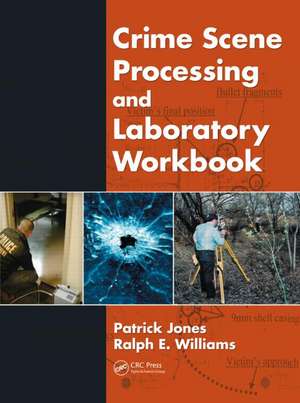
Crime Scene Processing and Laboratory Workbook
Autor Patrick Jones, Ralph E. Williamsen Limba Engleză Paperback – 17 feb 2009
This volume is a useful companion to Gardner’s Practical Crime Scene Processing and Investigation and Fisher’s Techniques of Crime Scene Investigation. The exercises are designed to be completed with or without the help of a partner or as a member of a team. The appendices contain supplemental forms and numbered tent cards that can be used during the exercises along with other additional material such as a glossary and instructions on how to accurately write reports.
Watch Patrick Jones in his laboratory on the CRC Press YouTube channel.
Preț: 435.52 lei
Puncte Express: 653
Carte disponibilă
Livrare economică 02-16 noiembrie
Livrare express 16-22 octombrie pentru 43.12 lei
Livrare prin curier în România Termenul estimat este afișat lângă disponibilitate.
Transport gratuit pentru acest produs Plată online sau ramburs, în funcție de opțiunile comenzii.
Retur gratuit în 14 zile Comandă securizată și suport în română.
Specificații
ISBN-13: 9781420085426
ISBN-10: 1420085425
Pagini: 286
Ilustrații: 122 b/w images
Dimensiuni: 210 x 280 x 20 mm
Greutate: 0.64 kg
Ediția:New.
Editura: Taylor & Francis
Colecția CRC Press
Locul publicării:Oxford, United Kingdom
ISBN-10: 1420085425
Pagini: 286
Ilustrații: 122 b/w images
Dimensiuni: 210 x 280 x 20 mm
Greutate: 0.64 kg
Ediția:New.
Editura: Taylor & Francis
Colecția CRC Press
Locul publicării:Oxford, United Kingdom
V-ar putea interesa
-
 The Science of Crime ScenesMax M. Houck-32%Preț: 439.24 lei648.42 lei
 -
 Forensic Approaches to Buried RemainsJohn HunterPreț: 471.79 lei
 -
 Medical DetectivesRobin OdellPreț: 114.03 lei
 -
 -5%Preț: 647.75 lei681.84 lei
 -
 -18%Preț: 1117.23 lei1362.47 lei
 -
 Bone Histology: An Anthropological PerspectiveSam D. Stout-18%Preț: 1300.05 lei1585.44 lei
 -
 The Neuroscience of Handwriting: Applications for Forensic Document ExaminationMichael P. Caligiuri-18%Preț: 1251.35 lei1526.04 lei
 -
 Forensic Pathology of Fractures and Mechanisms of InjuryMichael P Burke-14%Preț: 1941.77 lei2257.87 lei
 -
 Concepts and Case Studies in Threat ManagementFrederick S. Calhoun-18%Preț: 710.62 lei866.61 lei
 -
 Critical Thinking Skills for Education StudentsLesley-Jane Eales-ReynoldsPreț: 239.44 lei
Public țintă
UndergraduateCuprins
Camera and Equipment. Report Writing and Crime Scene Documentation. The Crime Scene. Photo Imaging Assignment. Evidence Collection and Packaging. The Secondary Crime Scene. Fingerprints. Close Up or Bench Photo Imaging. Wafting. CSI vs. Real CSI. Advanced Fingerprints. Presumptive Testing for Blood. Blood Drops and Blood Spatter Patterns. Car Crash. Toolmarks. Recovering a Firearm. Interactive Virtual Crime Scene. Soil. Forensic Entomology. Additional Practice with Your Camera. Microscopy. Footwear Impressions. Appendices.
Notă biografică
Patrick Jones and Ralph E. Williams are with Purdue University in West Lafayette, Indiana.
Recenzii
The preface of this workbook states that its intent is to assist students in learning the "techniques of collection and processing crime scenes". The authors have achieved this goal.
—Mike Illes, Trent University and Ontario Provincial Police, Canadian Society of Forensic Science Journal, Vol. 43, No. 1, March 2010
—Mike Illes, Trent University and Ontario Provincial Police, Canadian Society of Forensic Science Journal, Vol. 43, No. 1, March 2010
Descriere
Building on prior knowledge and facilitating hands-on experience, this laboratory manual allows students to practice the methods, procedures, and techniques associated with forensic science, crime scene investigation, documentation, and evidence handling. Highlighting the skills and equipment needed for each assignment, the text presents over 20 separate exercises that alternate between investigating physical evidence specific to the crime scene and evidence specific to the laboratory. The book also provides useful forms, including the laboratory submission request, which duplicate real-world experience and demonstrate how to properly collect, record, and submit evidence.