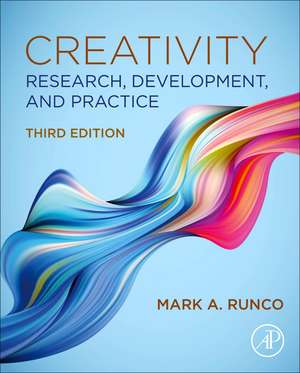
Creativity: Research, Development, and Practice
Autor Mark A. Runcoen Limba Engleză Hardback – 10 mar 2023
The third edition has been thoroughly updated, with a new chapter on psychometrics and substantial updates on the biology and neuroscience of creativity, politics, and creative cognition. It includes quotations, graphics, boxed controversial issues, and biographical examples from unambiguously creative individuals.
- Summarizes research from the full range of perspectives on creativity
- Includes a new chapter on the psychometrics of creativity
- Distinguishes controlled cognition from associative and intuitive cognition
- Features substantial updates on the biology and neuroscience of creativity
- Explores creativity research relating to media, business and leadership
- Addresses the big issues, including cultural differences, traditional intelligence, computer and animal creativity, and more
Preț: 405.29 lei
Preț vechi: 563.56 lei
-28%
Puncte Express: 608
Carte tipărită la comandă
Livrare economică 13-27 noiembrie
Livrare express 15-21 octombrie pentru 115.59 lei
Livrare prin curier în România Termenul estimat este afișat lângă disponibilitate.
Transport gratuit pentru acest produs Plată online sau ramburs, în funcție de opțiunile comenzii.
Retur gratuit în 14 zile Comandă securizată și suport în română.
Specificații
ISBN-13: 9780081026175
ISBN-10: 008102617X
Pagini: 612
Dimensiuni: 191 x 235 x 37 mm
Greutate: 1.26 kg
Ediția:3
Editura: ELSEVIER SCIENCE
ISBN-10: 008102617X
Pagini: 612
Dimensiuni: 191 x 235 x 37 mm
Greutate: 1.26 kg
Ediția:3
Editura: ELSEVIER SCIENCE
Cuprins
1. Cognition and Creativity
2. Personality and Motivation
3. The Psychometrics of Creativity
4. Biological Perspectives on Creativity
5. Health and Clinical Perspectives
6. Social, Attributional, and Organizational Perspectives
7. Culture and Creativity
8. History and Historiometry
9. Creativity and Politics
10. Developmental Trends and Influences on Creativity
11. Educational Perspectives
12. Enhancement and the Fulfillment of Potential
13. Creativity and Philosophy
14. Conclusion: What Creativity is and What it is Not
2. Personality and Motivation
3. The Psychometrics of Creativity
4. Biological Perspectives on Creativity
5. Health and Clinical Perspectives
6. Social, Attributional, and Organizational Perspectives
7. Culture and Creativity
8. History and Historiometry
9. Creativity and Politics
10. Developmental Trends and Influences on Creativity
11. Educational Perspectives
12. Enhancement and the Fulfillment of Potential
13. Creativity and Philosophy
14. Conclusion: What Creativity is and What it is Not