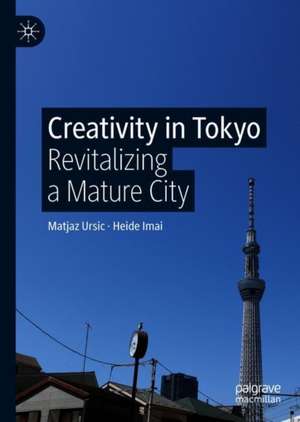
Creativity in Tokyo
Autor Matjaz Ursic, Heide Imaien Limba Engleză Hardback – 9 sep 2020
Preț: 702.99 lei
Preț vechi: 857.30 lei
-18%
Puncte Express: 1054
Carte tipărită la comandă
Livrare economică 30 mai-13 iunie
Specificații
ISBN-13: 9789811566868
ISBN-10: 9811566860
Pagini: 272
Ilustrații: XXIII, 248 p. 50 illus.
Dimensiuni: 153 x 216 x 20 mm
Greutate: 0.47 kg
Ediția:1st ed. 2020
Editura: Springer
Locul publicării:Singapore, Singapore
ISBN-10: 9811566860
Pagini: 272
Ilustrații: XXIII, 248 p. 50 illus.
Dimensiuni: 153 x 216 x 20 mm
Greutate: 0.47 kg
Ediția:1st ed. 2020
Editura: Springer
Locul publicării:Singapore, Singapore
Cuprins
Chapter 1: Introduction.- Chapter 2: Tokyo as a Matured City: Torn Between Global Change and Local Lives.- Chapter 3: Conceptualizing Urban Creativity: Searching for Traces of Tokyo’s Urban Development.- Chapter 4: Going Small Matters: The Role of Small Creative Actors in Tokyo’s Creative Ecosystem.- Chapter 5: Going Local 1: Creative Actors, Spatial Resources, and Social Networks.- Chapter 6: Going Local 2: Subcultural Capital and Social Creativity.- Chapter 7: Going Local 3: The Influence of Cultural Capital on the Creative Capacity of Place.- Chapter 8: Going Local 4: The Significance of Local Soft Environmental Factors for Tokyo’s Creative Capacity.- Chapter 9: Concluding Remarks.
Textul de pe ultima copertă
This book focuses on overlooked contextual factors that constitute the urban creative climate or innovative urban milieu in contemporary cities. Filled with reflections based on interviews with a diverse range of creative actors in various local neighborhoods in Tokyo, it offers a rare glimpse into the complex set of elements that provide long-term, physical, and sociocultural support to urban creativity. Ursic and Imai highlight the interplay between physical and soft (social) factors in the process of place-making and explore how a city’s creativity is influenced by financial support and accessible infrastructure, as well as the sets of informal networks, services, and tacit, locally embedded knowledge that provide the basic layers of stimuli needed for creativity to fully develop. The authors show how the future development of creativity and the overall development of a city depend not only on the (top-down) planning strategies of formal authorities, but also on the appropriate (bottom-up) inclusion of heterogeneous elements that are provided and embedded within the small, hidden context of city spaces.
Dr. Matjaz Ursic is Associate Professor in the Department of Sociology, Faculty of Social Sciences, University of Ljubljana.
Dr. Heide Imai is Associate Professor in the Faculty of Intercultural Communication, Senshu University, Tokyo.
Caracteristici
Analyzes the ‘creative capacity’ of Tokyo, which includes not only the capacity to absorb temporary shocks and react to occasional economic crisis, but involves the capacity for long-term renewal, re-organization and development from the set of available comparative advantages that stem from locally embedded cultural, social, tacit knowledge Examines the spatial factors that either pull or push small creative groups and individuals to/from Tokyo Interprets the social, cultural, economic and spatial characteristics of transformation of public spaces in Tokyo Offers a valuable and fresh contribution to the existing literature on transnational urban cultures, as well as urban network studies Will appeal to architects, urban designers, consultants and community planners as well as local town planning groups, neighbourhood associations and NGO’s globally