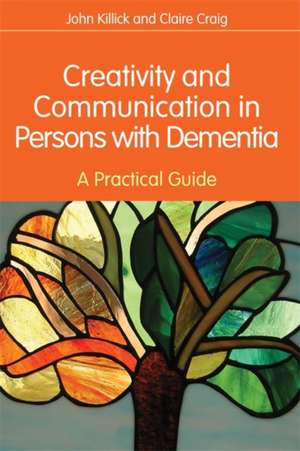
Creativity and Communication in Persons with Dementia: A Practical Guide
Autor Claire Craig, Mr John Killicken Limba Engleză Paperback – 15 sep 2011
Subliniem autoritatea incontestabilă a celor doi autori, Mr John Killick și Claire Craig, a căror cercetare fundamentează acest volum esențial. John Killick aduce o experiență de 16 ani de lucru direct în centre de zi și spitale, fiind pionier în utilizarea poeziei ca instrument de comunicare, în timp ce Claire Craig, terapeut ocupațional și cercetător, contribuie cu o viziune academică asupra legăturii dintre creativitate și calitatea vieții. Împreună, aceștia propun o abordare care depășește simpla ocupare a timpului, vizând consolidarea identității persoanei în fața declinului cognitiv.
Notăm cu interes structura riguroasă a cărții, care ghidează cititorul prin 26 de capitole grupate în patru secțiuni logice. Prima parte explorează fundamentul teoretic al stării de „flow”, a doua oferă un inventar impresionant de medii artistice — de la muzică și dans la prelucrarea metalului sau a sticlei —, în timp ce ultimele secțiuni se concentrează pe logistica organizării sesiunilor și pe măsurarea succesului intervențiilor. Cititorii familiarizați cu The Creative Arts in Dementia Care de Shaun McNiff vor aprecia aici accentul pus pe latura practică și pe diversitatea materialelor propuse, inclusiv capitole dedicate tehnologiei informației și spațiului fizic de lucru.
Această lucrare se înscrie natural în bibliografia autorilor, completând temele abordate în Occupational Therapy and Dementia de Claire Craig. Dacă în lucrările anterioare accentul cădea pe activitățile cotidiene, Creativity and Communication in Persons with Dementia rafinează procesul comunicării non-verbale și metaforice. Este un manual care nu doar descrie tehnici, ci oferă o voce pacienților prin inserțiile color și exemplele de poezie incluse, transformând actul de îngrijire într-un dialog creativ continuu.
Preț: 197.01 lei
Preț vechi: 269.14 lei
-27%
Carte disponibilă
Livrare economică 29 iunie-13 iulie
Specificații
ISBN-10: 1849051135
Pagini: 216
Ilustrații: 4 page colour insert and 2 black and white illustrations
Dimensiuni: 158 x 228 x 12 mm
Greutate: 0.33 kg
Ediția:New.
Editura: JESSICA KINGSLEY PUBLISHERS
Colecția Jessica Kingsley Publishers
Locul publicării:London, United Kingdom
V-ar putea interesa
-
 Breaking FreeSharon RobinsonPreț: 105.95 lei
 -
 Handbook of Research on Trends in the Diagnosis and Treatment of Chronic ConditionsDimitrios I Fotiadis-23%Preț: 2059.44 lei2674.60 lei
 -
 Aspergers and AdulthoodBlythe GrossbergPreț: 87.98 lei
 -
 Not Tonight I Have a HeadacheRavinder Singh-5%Preț: 96.93 lei102.03 lei
 -
 The Peanut Allergy EpidemicHeather FraserPreț: 138.25 lei
 -
 Poetry and Dementia: A Practical GuideMr John Killick-27%Preț: 173.88 lei238.97 lei
 -
 -20%Preț: 155.49 lei195.07 lei
 -
 -27%Preț: 208.91 lei286.95 lei
 -
 -27%Preț: 175.38 lei239.95 lei
 -
 Pathological Demand Avoidance Syndrome - My Daughter is Not NaughtyJane Alison Sherwin-21%Preț: 116.17 lei146.33 lei
 -
 -26%Preț: 178.61 lei242.07 lei
 -
 Preț: 116.12 lei
 -
 Preț: 215.36 lei
 -
 Stroke (186c): Early Stages of RecoveryPritchett &. HullPreț: 93.51 lei
 -
 Preț: 79.94 lei
 -
 Chronic Lung Disease (75g)Pritchett &. HullPreț: 120.85 lei
 -
 How Does Government Listen to Scientists?Claire CraigPreț: 110.10 lei
 -
 FototherapieClaire CraigPreț: 218.93 lei
De ce să citești această carte
Recomandăm această carte profesioniștilor din asistența socială și terapeuților ocupaționali care caută metode concrete de a menține conexiunea cu persoanele diagnosticate cu demență. Cititorul câștigă un set vast de instrumente practice, de la storytelling la ceramică, fundamentate pe experiența clinică. Este o resursă valoroasă pentru oricine dorește să transforme îngrijirea paliativă într-o experiență bazată pe demnitate, creativitate și exprimare personală autentică.
Descriere
The authors explore the concept of creativity - what exactly it is, its particular relevance for people with dementia and how to get into the creative 'flow'. They introduce a range of creative art forms, including poetry and story-telling, collage, drama, music-making, photography, textiles and working with wood and metal, and suggest possibilities for employing them in a range of settings, and with people of all abilities. Consideration is given to the practicalities of facilitating such creative work, including how to organise and run sessions, how to involve people with dementia and their carers, and how to reflect upon the experience. Practice examples are included throughout the book, as well as the comments and observations of people with dementia, and many examples of the artwork and poetry the authors have created with people with dementia over the years.
Brimming with ideas, suggestions and helpful guidance, this is an essential resource for all those who work with people with dementia, and an inspiring read for people with dementia and their families.
Recenzii
Killick and Craig must be applauded for their truly inspirational practical guide on Creativity and Communication in Persons with Dementia. This book is a true celebration of the power of the arts for people living with dementia and is drawn on the authors' own experiences and wisdom. Killick and Craig assert that whilst there has been significant financial investment in biomedical research, the care of people living with dementia has been notably overlooked, to the detriment of wellbeing and affirmation of identity and self-esteem. This book attempts to redress this imbalance and is aimed at anyone (with any level of artistic talent!) with an interest in working alongside people living with dementia in a creative capacity, be they practitioners, volunteers, family members or researchers.
It is refreshing to have a book written where the outlook is of dementia having few barriers of boundaries on creativity... I find this book an inspirational read; it presents a wealth of ideas, suggestions, guidance and experience in the field of creativity and dementia. Most importantly it demonstrates how persons with dementia and those around them can gain from engaging in creativity activity.
Whatever John Killick writes concerning dementia is eminently worth reading, perhaps even more so when he co-authors a book with another expert in the field... The present publication (...) will be invaluable for activities organisers in care homes and community-based projects, and of considerable interest to anyone caring for a person with dementia... The book is both insightful and practical
We can be sure that any book with John Killlick as author or co-author is going to be good. Not just good but inspirational. Killick sparks the creativity in all of us and care homes can be such lively places with people exploring a wide variety of creative activities: music, dance, poetry, drama, storytelling, painting, ceramics, sculpture, textiles, photography. All of these and others are offered by the authors. Just wonderful stuff: exciting, imaginative, and practical.
This charming, erudite book presents a wealth of experience about the arts and dementia in a readable and helpful form. The two authors are acknowledged experts with long experience of using a wide range of arts in this field. The book is therefore well grounded in practice and full of inspirational stories. It is also a treasure trove of ideas, suggestions and helpful guidance.
This book left me speechless. For years, after being diagnosed with dementia, I moaned that not enough attention is paid to creativity in dementia. Little did I know, a work was in progress. As said inside, it is not meant to be comprehensive, but it covers a lot of ground. I couldn't put it down. You won't either.
John and Claire's timely book shows why being engaged and entertained by singing, looking at paintings, taking photographs, dancing and other activities offers a bridge to joy, satisfaction and self identity for people with dementia. Brimming with ideas, research, reflection, and practice examples and woven throughout with comments and observations of people with dementia, it's an inspiring, effortless read not only for a wide range of health and social care practitioners, but, importantly, for artists and performers, whose work can help those experiencing a crisis of self, reconnect with life and living.
This book is like the most colourful toolbox, crammed with a rich variety of materials begging to be used. John and Claire describe a magnificent mix of creative ideas, helpful insights and beautiful personal accounts from their experiences of working creatively with people living with dementia. Their enthusiasm is infectious; anyone who reads this will be inspired and excited to employ the creative strategies within. The book is about relationships; it is about developing sensitivities to be empathic, creative, opportunistic and communicative with people who have dementia and above all it is intensely human. John and Claire bring extraordinary clarity to the ways that they both work with people showing us how to gently gain empathy, use creative media and act as instruments to make tangible other people's words, meanings and feelings. The book will bring insight and inspiration to readers from any background. It will be a valuable tool to me in my continuing practice and I urge you to join me in taking John and Claire's advice, to let go of our assumptions of what we think we can achieve and to throw ourselves into these wonderful ideas.
For practitioners convinced of the value of creative activity, this book will be a valuable resource. The authors offer many thought-provoking accounts and personal insights.
There are currently many books available on communication with people experiencing dementia. This one is distinctly different, both in its approach and how it links creative thought and activities into the whole process of communication. More importantly it delivers what it say on the tin - it is 'A practical guide'. The essence of this book is not the various techniques and equipment (though these are described with admirable clarity) but how creativity and communication are fundamental to the human spirit. This book would benefit anyone working with or caring for individuals experiencing dementia, including informal carers. For health or social care professionals to whom the practical use of creativity to enhance communication is relatively new, this is a motivating and inspirational book.