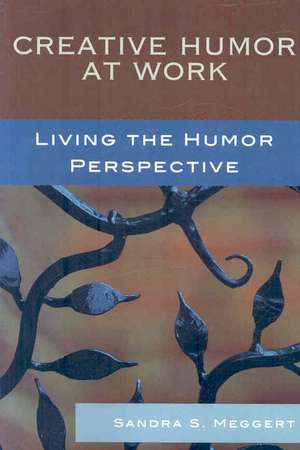
Creative Humor at Work: Living the Humor Perspective
Autor Sandra S. Meggerten Limba Engleză Paperback – 21 oct 2008
Research has demonstrated that humor attracts and motivates people and that having a well-developed sense of humor combats depression and is an effective measure to reduce stress. Each of us can create a mental or physical "Humor Kit", one that contains jokes, stories, songs, sayings, anything that makes us laugh and dip into this kit whenever we find ourselves in stressful situations.
Preț: 271.83 lei
Preț vechi: 377.63 lei
-28%
Puncte Express: 408
Carte tipărită la comandă
Livrare economică 20 noiembrie-04 decembrie
Livrare prin curier în România Termenul estimat este afișat lângă disponibilitate.
Transport gratuit de la 400.00 lei Plată online sau ramburs, în funcție de opțiunile comenzii.
Retur gratuit în 14 zile Comandă securizată și suport în română.
Specificații
ISBN-13: 9780761843610
ISBN-10: 0761843612
Pagini: 124
Dimensiuni: 155 x 230 x 10 mm
Greutate: 0.18 kg
Ediția:New.
Editura: Bloomsbury Publishing
Colecția University Press of America
Locul publicării:New York, United States
ISBN-10: 0761843612
Pagini: 124
Dimensiuni: 155 x 230 x 10 mm
Greutate: 0.18 kg
Ediția:New.
Editura: Bloomsbury Publishing
Colecția University Press of America
Locul publicării:New York, United States
V-ar putea interesa
-
 Neuropsychological AssessmentMuriel Deutsch Lezak-25%Preț: 1527.67 lei2027.37 lei
 -
 Cognitive PsychologyNick Braisby-19%Preț: 464.72 lei573.18 lei
 -
 Pediatric Forensic NeuropsychologyElisabeth M.S. Sherman-32%Preț: 760.77 lei1126.85 lei
 -
 10 Questions Science Can't Answer (Yet)M. HanlonPreț: 374.65 lei
 -
 How God Changes Your BrainAndrew Newberg-20%Preț: 97.48 lei121.40 lei
 -
 -5%Preț: 1271.14 lei1338.04 lei
 -
 The Inner PulseMarc SiegelPreț: 145.35 lei
 -
 ANNIE'S GHOSTSLuxenbergPreț: 143.27 lei
 -
 Preț: 140.05 lei
 -
 New Brain, New WorldErik HoffmanPreț: 101.33 lei
Cuprins
Chapter 1. Introduction to the Humor Perspective-What is it?
Chapter 2. Benefits of Humor
Chapter 3. Obstacles to using Humor
Chapter 4. Gender Differences
Chapter 5. Humor in Relationships-How can I Infuse the Humor Perspective in My Relationships?
Chapter 6. Humor and Techniques
Chapter 7. Creative Humor at Work: Using the Humor Perspective
Chapter 8. More Creative Humor at Work: Professional Settings, Virtual Teams, and Counseling
Chapter 9. Conclusions-Learning to Live the Humor Perspective
Chapter 2. Benefits of Humor
Chapter 3. Obstacles to using Humor
Chapter 4. Gender Differences
Chapter 5. Humor in Relationships-How can I Infuse the Humor Perspective in My Relationships?
Chapter 6. Humor and Techniques
Chapter 7. Creative Humor at Work: Using the Humor Perspective
Chapter 8. More Creative Humor at Work: Professional Settings, Virtual Teams, and Counseling
Chapter 9. Conclusions-Learning to Live the Humor Perspective
Recenzii
Many of the stories she relates along the way are laugh-out-loud funny. Also valuable are Meggert's tips for using humor appropraitely when interacting with persons who are seriously ill or with one's co-workers at the office.
I also saw it as what I might call a 'how to' book in terms of how one would go about utilizing humor in various aspects of educational endeavors, i.e. workshops, classes, the workplace, etc. You make a strong case for the value of humor in all of these situations and also provide the reader ways of utilizing humor for the various publics.
I also saw it as what I might call a 'how to' book in terms of how one would go about utilizing humor in various aspects of educational endeavors, i.e. workshops, classes, the workplace, etc. You make a strong case for the value of humor in all of these situations and also provide the reader ways of utilizing humor for the various publics.