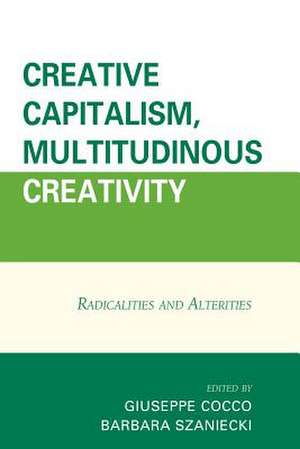
Creative Capitalism, Multitudinous Creativity: Radicalities and Alterities
Editat de Giuseppe Cocco, Barbara Szaniecki Contribuţii de Óscar García Agustín, Sarita Albagli, Emiliana Armano, Eeva Berglund, Yann Moulier-Boutang, Kristin Carls, Bruno Cava, Verónica Gago, Giorgio Griziotti, Clarissa Moreira, Cristina Morini, José Neves, Peter Pál Pelbart, Vladimir Sibylla Pires, Raluca Soreanu, Bruno Tarin, Andrea Fumagallien Limba Engleză Hardback – 20 aug 2015
In the second part, titled "Multitudinous Creativities: Radicalities and Alterities", the book reflects on more autonomous creative experiments in the world.
The third part, titled "Creativity, New Technologies, and Networks", analyses the issues related to the work of creative capitalism and the possible resistance within the digital and collaborative platforms.
Preț: 629.93 lei
Preț vechi: 960.89 lei
-34%
Puncte Express: 945
Carte tipărită la comandă
Livrare economică 19 noiembrie-03 decembrie
Livrare prin curier în România Termenul estimat este afișat lângă disponibilitate.
Transport gratuit pentru acest produs Plată online sau ramburs, în funcție de opțiunile comenzii.
Retur gratuit în 14 zile Comandă securizată și suport în română.
Specificații
ISBN-13: 9781498503983
ISBN-10: 1498503985
Pagini: 288
Ilustrații: 5 b/w photos; 4 tables; 2 graphs
Dimensiuni: 161 x 236 x 28 mm
Greutate: 0.56 kg
Editura: Bloomsbury Publishing
Colecția Lexington Books
Locul publicării:New York, United States
ISBN-10: 1498503985
Pagini: 288
Ilustrații: 5 b/w photos; 4 tables; 2 graphs
Dimensiuni: 161 x 236 x 28 mm
Greutate: 0.56 kg
Editura: Bloomsbury Publishing
Colecția Lexington Books
Locul publicării:New York, United States
V-ar putea interesa
-
 -13%Preț: 267.19 lei305.46 lei
 -
 Global Competition: Law, Markets, and GlobalizationDavid Gerber-31%Preț: 682.53 lei986.75 lei
 -
 China, Asia, and the New World EconomyBarry Eichengreen-6%Preț: 241.52 lei255.81 lei
 -
 -29%Preț: 509.45 lei713.89 lei
 -
 Regions, Globalization, and the Knowledge-Based EconomyJohn H. Dunning-32%Preț: 729.33 lei1079.56 lei
 -
 Global City-Regions: Trends, Theory, PolicyAllen J. Scott-31%Preț: 542.96 lei782.64 lei
 -
 -26%Preț: 364.39 lei490.90 lei
 -
 Why Capitalism?Allan H. Meltzer-20%Preț: 112.60 lei140.37 lei
 -
 Corporate Power in Global Agrifood GovernanceJennifer ClappPreț: 242.39 lei
 -
 Globalisation, Democracy And TerrorismEric Hobsbawm-28%Preț: 66.53 lei92.21 lei
 -
 A Year Without Made in ChinaSara BongiorniPreț: 88.02 lei
 -
 -15%Preț: 98.24 lei115.12 lei
 -
 -18%Preț: 1250.55 lei1525.06 lei
 -
 Preț: 269.18 lei
 -
 Real EnglandPaul KingsnorthPreț: 78.73 lei
Cuprins
Contents
Chapter 1: Creative Capitalism
1. Cognitive, Relational (Creative) Labor and the Precarious Movement for "Commonfare": "San Precario" and EuroMayDay.
Andrea Fumagalli
2. The case of the Braga stadium: work, spectacle and democracy in the 21st century
José Neves
3.The Common and its potential creativity: Post-crisis perspectives
Óscar García Agustín
4. Flexibility and mobility in the Creative Economy: Between "Feminization" of Creative Work and Slave Labor.
Verónica Gago (Argentina)
5. Network subjectivity and its culture of resistance: the challenges in post-fordist capitalism
Bruno Cava
Chapter 2: Multitudinous Creativities: Radicalities and Alterities
6. The creativity of the streets and the urbanism of disaster.
Clarissa Moreira
7. What Can a Face Do? What Can an Arm Do? The Brazilian Uprising and a New Aesthetic of Protest
Raluca Soreanu
8. Cognitive capitalism, the uprising of the multitude and museums:
for the "right to the city" and to "common places"
Vladimir Sibylla Pires
9. Biopolitical Shipwreck
Peter Pál Pelbart
10.Activist design in Helsinki: creating sustainable futures at the margins, the center, and everywhere in between
Eeva Berglund
Chapter 3: Creativity, New Technologies, and Networks
11. The "creative turn": digital space and local dynamics *[1]
Sarita Albagli
12. From culture of labor to cultural labor: youth and networks in today's Brazil
Bruno Tarin
13. Autonomy, free labor and passions as devices of creative capitalism.
Narratives from a co-research in journalism and the editing industry
Cristina Morini, Kristin Carls, Emiliana Armano
14. Unblock the chain - Cooperative processes and P2P technologies: between commons and capitalist integration
Giorgio Griziotti
15. The pollination of creativity: for a basic income in the creative capitalism ofnetwork societies
Yann Moulier Boutang
Chapter 1: Creative Capitalism
1. Cognitive, Relational (Creative) Labor and the Precarious Movement for "Commonfare": "San Precario" and EuroMayDay.
Andrea Fumagalli
2. The case of the Braga stadium: work, spectacle and democracy in the 21st century
José Neves
3.The Common and its potential creativity: Post-crisis perspectives
Óscar García Agustín
4. Flexibility and mobility in the Creative Economy: Between "Feminization" of Creative Work and Slave Labor.
Verónica Gago (Argentina)
5. Network subjectivity and its culture of resistance: the challenges in post-fordist capitalism
Bruno Cava
Chapter 2: Multitudinous Creativities: Radicalities and Alterities
6. The creativity of the streets and the urbanism of disaster.
Clarissa Moreira
7. What Can a Face Do? What Can an Arm Do? The Brazilian Uprising and a New Aesthetic of Protest
Raluca Soreanu
8. Cognitive capitalism, the uprising of the multitude and museums:
for the "right to the city" and to "common places"
Vladimir Sibylla Pires
9. Biopolitical Shipwreck
Peter Pál Pelbart
10.Activist design in Helsinki: creating sustainable futures at the margins, the center, and everywhere in between
Eeva Berglund
Chapter 3: Creativity, New Technologies, and Networks
11. The "creative turn": digital space and local dynamics *[1]
Sarita Albagli
12. From culture of labor to cultural labor: youth and networks in today's Brazil
Bruno Tarin
13. Autonomy, free labor and passions as devices of creative capitalism.
Narratives from a co-research in journalism and the editing industry
Cristina Morini, Kristin Carls, Emiliana Armano
14. Unblock the chain - Cooperative processes and P2P technologies: between commons and capitalist integration
Giorgio Griziotti
15. The pollination of creativity: for a basic income in the creative capitalism ofnetwork societies
Yann Moulier Boutang
Recenzii
Focusing a broad range of examples from the realms of social imagination and precarious cultural work, Creative Capitalism, Multitudinous Creativity is a translocal companion to creative and other commons. The book displays that with every piece of creativity sucked by machinic capitalism, countless new lines of invention are emerging as contemporary multitudinous radicality.
The excellent essays in this collection analyze how creativity functions both with and against contemporary capitalism: how "creative work" configures new forms of domination and how creativity animates anticapitalist protest repertoires. In the course of the essays also emerges a fascinating dialogue between European and Latin American perspectives to demonstrate the extent to which creative capitalism looks and functions differently across the North / South divide.
The excellent essays in this collection analyze how creativity functions both with and against contemporary capitalism: how "creative work" configures new forms of domination and how creativity animates anticapitalist protest repertoires. In the course of the essays also emerges a fascinating dialogue between European and Latin American perspectives to demonstrate the extent to which creative capitalism looks and functions differently across the North / South divide.