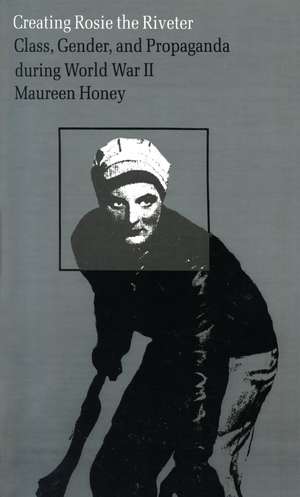
Creating Rosie the Riveter: Class, Gender, and Propaganda during World War II
Autor Maureen Honeyen Limba Engleză Paperback – 5 iul 1985
Creating Rosie the Riveter examines advertisements and fiction published in the Saturday Evening Post and True Story in order to show how propaganda was used to encourage women to enter the work force.
Preț: 215.90 lei
Puncte Express: 324
Carte indisponibilă temporar
Doresc să fiu notificat când acest titlu va fi disponibil:
Se trimite...
Specificații
ISBN-13: 9780870234446
ISBN-10: 0870234447
Pagini: 262
Dimensiuni: 140 x 229 x 20 mm
Greutate: 0.4 kg
Ediția:2nd edition
Editura: University of Massachusetts Press
Colecția University of Massachusetts Press
ISBN-10: 0870234447
Pagini: 262
Dimensiuni: 140 x 229 x 20 mm
Greutate: 0.4 kg
Ediția:2nd edition
Editura: University of Massachusetts Press
Colecția University of Massachusetts Press
Notă biografică
MAUREEN HONEY is professor of English at the University of Nebraska–Lincoln.
Recenzii
“An illuminating study of WWII propaganda directed at women and labor force participation. . . . Excellent reading for courses in women's studies, communications, and culture.”—CHOICE
“Honey's analysis of fiction and advertising in two popular magazines of the period follows the shifting image of women produced in response to advice and actual story ideas from government propaganda agencies, e.g., the Office of War Information. By untangling conflicting themes in these and earlier images, she moves beyond the conspiracy theory often implied in discussions of the ‘feminine mystique.’ This scholarly study is decidedly readable and concise.”—Library Journal
“Honey's fine study of wartime images of women underscores the importance of systematic research. In addition, her book demonstrates the value of scholarly sensitivity to issues of class as well as gender. The differences Honey finds are striking, her conclusions sobering.”—American Historical Review
“Honey has produced a provocative history. Creating Rosie the Riveter makes one think differently about how advertising and the division of labor can affect the image of women.”—Business History Review
“Honey's well-researched and well-written volume helps to demonstrate that continuity with the past and future, not change, was the dominant theme for women in the 1940s.”—D'Ann Campbell, Minerva
“Honey's analysis of fiction and advertising in two popular magazines of the period follows the shifting image of women produced in response to advice and actual story ideas from government propaganda agencies, e.g., the Office of War Information. By untangling conflicting themes in these and earlier images, she moves beyond the conspiracy theory often implied in discussions of the ‘feminine mystique.’ This scholarly study is decidedly readable and concise.”—Library Journal
“Honey's fine study of wartime images of women underscores the importance of systematic research. In addition, her book demonstrates the value of scholarly sensitivity to issues of class as well as gender. The differences Honey finds are striking, her conclusions sobering.”—American Historical Review
“Honey has produced a provocative history. Creating Rosie the Riveter makes one think differently about how advertising and the division of labor can affect the image of women.”—Business History Review
“Honey's well-researched and well-written volume helps to demonstrate that continuity with the past and future, not change, was the dominant theme for women in the 1940s.”—D'Ann Campbell, Minerva