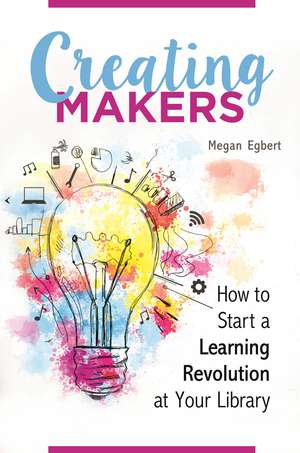
Creating Makers: How to Start a Learning Revolution at Your Library
Autor Megan Egberten Limba Engleză Paperback – 18 iul 2016
În peisajul actual al biblioteconomiei, tranziția de la un spațiu de consum de informație la unul de creație reprezintă o prioritate în programele de studiu și formare profesională. Creating Makers de Megan Egbert se poziționează ca un ghid strategic pentru bibliotecarii care doresc să implementeze mișcarea 'maker' fără a dispune de bugete exorbitante sau de spații generoase. Subliniem faptul că autoarea mută accentul de la infrastructura tehnologică — adesea intimidantă — către dezvoltarea unei mentalități bazate pe inovație, reziliență și curiozitate.
Cartea este organizată riguros în două secțiuni: prima explorează fundamentul teoretic și pedagogic, explicând de ce eșecul controlat și empatia prin design sunt esențiale pentru învățarea în secolul XXI. A doua parte oferă soluții logistice concrete pentru spații mici, colecții circulante de unelte și programe de tip 'pop-up'. Acoperă aceeași arie tematică precum The Maker Cookbook, dar cu o abordare mult mai axată pe psihologia învățării și pe rolul instrucțional al bibliotecarului, depășind nivelul unei simple liste de activități.
Recomandăm această lucrare pentru rigoarea cu care integrează mișcarea maker în inițiativele educaționale STEM și STEAM. Față de Make It Here, care oferă un ghid pas cu pas pentru operațiuni, volumul de față analizează mai profund modul în care bibliotecile pot cultiva antreprenoriatul și cultura participativă. Este un text esențial pentru înțelegerea modului în care design thinking-ul și învățarea bazată pe interogație pot fi aplicate în orice bibliotecă școlară sau publică, indiferent de limitările fizice ale instituției.
Preț: 282.40 lei
Preț vechi: 357.04 lei
-21%
Carte tipărită la comandă
Livrare economică 10-24 noiembrie
Specificații
ISBN-10: 1440843864
Pagini: 124
Dimensiuni: 156 x 235 x 8 mm
Greutate: 0.23 kg
Editura: Bloomsbury Publishing
Colecția Libraries Unlimited
Locul publicării:New York, United States
V-ar putea interesa
-
 How to Build Your Very Own Little Free LibraryLittle Free Little Free Library-16%Preț: 117.46 lei139.60 lei
 -
 Preț: 460.24 lei
 -
 Effectual EntrepreneurshipSaras Sarasvathy-8%Preț: 563.55 lei612.55 leiRecomandat
 -
 Preț: 321.78 lei
 -
 Make SpaceHasso Plattner Institute of Design at Stanford UniversityPreț: 392.27 lei
 -
 Learning in the MakingJackie GersteinPreț: 163.75 lei
 -
 Youth Social Action in the LibraryGina Seymour-21%Preț: 274.68 lei346.30 lei
 -
 Books - A Manifesto: Or, How to Build a LibraryIan PattersonPreț: 141.72 lei
 -
 Worlds of MakingLaura FlemingPreț: 91.36 lei
 -
 Preț: 259.54 lei
 -
 -17%Preț: 164.50 lei198.14 lei
 -
 StorymakingMichelle Kay ComptonPreț: 266.32 lei
 -
 The Art of TinkeringKaren Wilkinson-16%Preț: 168.08 lei199.91 lei
 -
 Preț: 513.83 lei
 -
 -46%Preț: 87.75 lei161.80 lei
 -
 An Opinionated Guide to Make LondonRiya Patel-19%Preț: 62.59 lei77.46 lei
 -
 Book of Making 2025The Makers of Hackspace Magazine-20%Preț: 111.36 lei139.19 lei
 -
 -21%Preț: 269.70 lei343.22 lei
 -
 The AI Toolkit for LibrariansMike McQueen-21%Preț: 183.08 lei232.43 lei
 -
 The Creative Ambush: How to Unleash Your Fire into the WorldMatteo di Pascale-17%Preț: 101.49 lei122.78 leiRecomandat
De ce să citești această carte
Recomandăm această carte bibliotecarilor și educatorilor care doresc să transforme biblioteca într-un centru de inovație, chiar și cu resurse minime. Cititorul câștigă strategii practice pentru a implementa programe maker în spații mici sau mobile și învață cum să conecteze aceste activități cu obiectivele curriculare STEM. Este o lectură care demonstrează că atitudinea creativă este mai valoroasă decât o imprimantă 3D costisitoare.
Descriere
Just because your library is small or limited on funds doesn't mean you can't be part of the maker movement. This book explains that what is really important about the movement is not the space, but the creativity, innovation, and resilience that go along with a successful maker program. All it takes is making some important changes to a library's programs, services, and collections to facilitate the maker mentality in their patrons, and this book shows you how.
The author explains what a maker is, why this movement is important, and how making fits in with educational initiatives such as STEM and STEAM as well as with library service. Her book supplies practical advice for incorporating the principles of the maker movement into library services-how to use small spaces or mobile spaces to accommodate maker programs, creating passive maker programs, providing access to making through circulating maker tools, partnering with other organizations, hosting maker faires, and more. Readers will better understand their instructional role in cultivating makers by human-centered design thinking, open source and shared learning, and implementation of an inquiry approach.
Cuprins
Introduction
SECTION I: MAKER MENTALITY
Chapter 1: What Is a Maker?
Characteristics of Making
Making versus Tinkering
From Consumer to Creator
What Is Not Making
Chapter 2: Making for Everyone
Making for All Abilities
Making for All Ages
Making Is for Girls
Making across Curriculum
Chapter 3: Why Making Matters for Individuals
Learning through Failure
Learning Empathy through Design
Maker Empowerment
Curiosity
Engagement
Chapter 4: Why Making Matters for Libraries
Entrepreneurs
Out-of-School Learning
Participatory Culture
21st Century Learning Skills
Creativity and the Importance of Play
Because It Works-Kind Of
SECTION II: CREATING MAKERS
Chapter 5: Making in Any Space
Small Spaces
Mobile Spaces
Stealth Programs
Pop-up or Dispersed Spaces
Making through Circulation
Making through Partnerships
Chapter 6: Access to Making
Access and Visibility
Cost
Location
Policies and Legalities
Safety
Chapter 7: Teaching Makers
Inquiry-based Learning
Constructionism
Learning Paths
Rapid Prototyping
Design Process
Evaluate Your Programs
Chapter 8: Creating a Culture of Makers
Allow Staff Time to Make
Allow Opportunities for Staff to Share Their Talent
Hire or Train the Staff You Need
Create a Culture That Celebrates Failure
Create a Culture That Celebrates Creativity
Share Your Story
Conclusion
References
Index
Recenzii
Egbert has written one of the best informational texts about makerspaces and the maker movement that this reviewer has read, largely due to her focus on creating makers, not just spaces. This should be the first resource librarians read when determining how to get started with makerspaces. Also, those librarians seeking justification for a makerspace, either with regard to budget or facility, will find ample research examples of how a maker mentality and fostering a learner's curiosity support learning and literacy. Regardless of age or level of experience or education, librarians will find a fresh and insightful perspective of maker culture in this book.