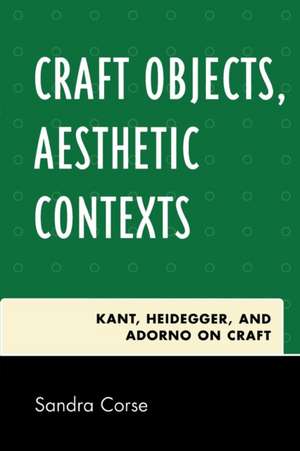
Craft Objects, Aesthetic Contexts: Kant, Heidegger, and Adorno on Craft
Autor Sandra Corseen Limba Engleză Paperback – 14 oct 2008
Similarly, Heidegger and Adorno have been valued largely for their interest in complex and influential art objects, but their comments on art also frequently address issues central to craft, especially the significance of history, functionality, techniques, and materials. This book examines these comments in order to begin a process of appreciating how philosophical aesthetics, as practiced by these important writers, can contribute to our analysis of contemporary craft.
Preț: 274.27 lei
Preț vechi: 376.93 lei
-27%
Puncte Express: 411
Carte tipărită la comandă
Livrare economică 16-30 noiembrie
Livrare prin curier în România Termenul estimat este afișat lângă disponibilitate.
Transport gratuit de la 400.00 lei Plată online sau ramburs, în funcție de opțiunile comenzii.
Retur gratuit în 14 zile Comandă securizată și suport în română.
Specificații
ISBN-13: 9780761842873
ISBN-10: 076184287X
Pagini: 110
Dimensiuni: 148 x 226 x 10 mm
Greutate: 0.18 kg
Ediția:New.
Editura: Bloomsbury Publishing
Colecția University Press of America
Locul publicării:New York, United States
ISBN-10: 076184287X
Pagini: 110
Dimensiuni: 148 x 226 x 10 mm
Greutate: 0.18 kg
Ediția:New.
Editura: Bloomsbury Publishing
Colecția University Press of America
Locul publicării:New York, United States
V-ar putea interesa
-
 The Craft CompanionRamona Barry-16%Preț: 175.79 lei209.32 lei
 -
 Card Games All-In-One for DummiesThe Experts at DummiesPreț: 178.20 lei
 -
 Chess for DummiesJames EadePreț: 114.46 lei
 -
 Preț: 159.42 lei
 -
 -26%Preț: 73.12 lei99.46 lei
 -
 Listography: The GameLisa NolaPreț: 180.85 lei
 -
 America Word SearchDarren KirbyPreț: 45.10 lei
 -
 Sugar SkullsNemeth, Darlene B.Preț: 57.93 lei
 -
 My First Sudoku BookJ. S. LubandiPreț: 47.62 lei
 -
 The True Crime Quiz BookJay Robert NashPreț: 111.43 lei
 -
 -39%Preț: 150.27 lei244.43 lei
 -
 The Elder Scrolls V - The Skyrim LibraryBethesda Softworks-38%Preț: 151.52 lei245.43 lei
 -
 Old Masters Memory GameMieke Gerritzen-9%Preț: 87.82 lei96.16 lei
Cuprins
Chapter 1 Introduction
Chapter 2 Chapter 1: Defining Ground: Issues for Craft
Chapter 3 Chapter 2: Kant: interest and Purpose
Chapter 4 Chapter 3: Heidegger: Art, Tools, and Earth
Chapter 5 Chapter 4: Adorno: Toward a Theory of the Craftwork
Chapter 6 Conclusion
Chapter 2 Chapter 1: Defining Ground: Issues for Craft
Chapter 3 Chapter 2: Kant: interest and Purpose
Chapter 4 Chapter 3: Heidegger: Art, Tools, and Earth
Chapter 5 Chapter 4: Adorno: Toward a Theory of the Craftwork
Chapter 6 Conclusion
Recenzii
It is commonly accepted that Kant's distinction between useful objects and objects with no purpose is responsible for the exclusion of craft from the definition of arts in modern aesthetic theory. Corse's careful anaylsis of Kant's original text in its historical context leads to another conclusion; that Kant's ideas of taste and genius have been slightly distorted in their current interpretation.This deviation has persistently defined craft as something other than art and kept it from being seriously analyzed in modern aesthetics. Corse places Kant, Heidegger and Adorno's aesthetic theories in a historical context that allows room for addressing craft within their philosophies on fine art.